
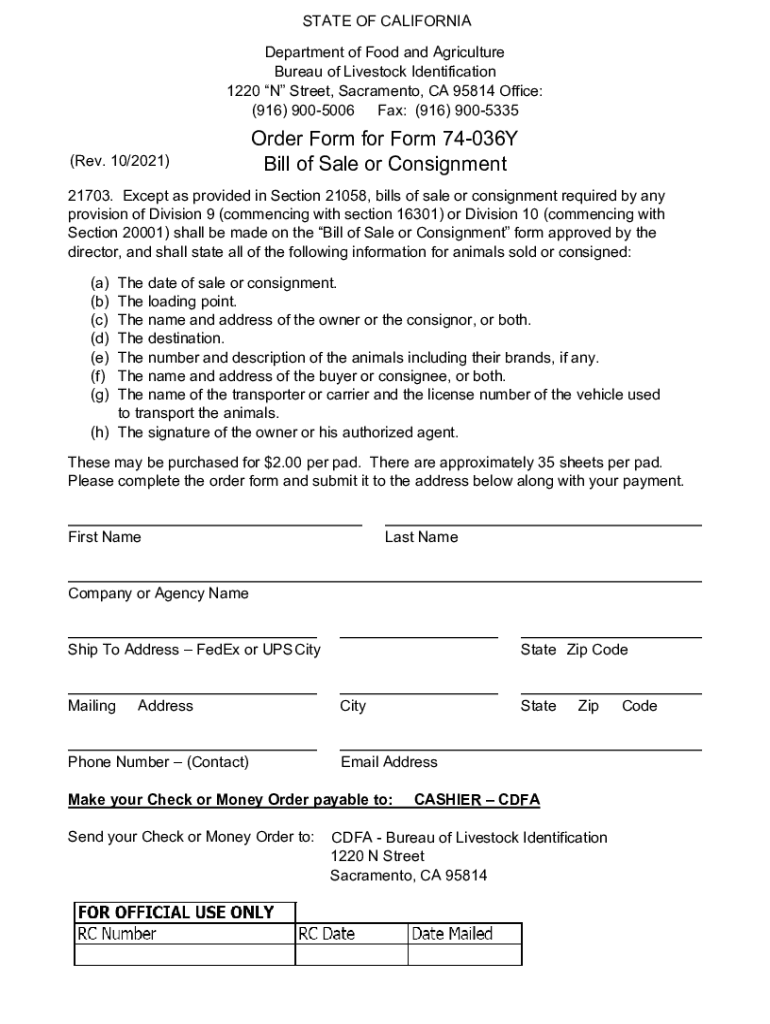







Definition and Purpose of LivestockWashington State Department of Agriculture - WA
The LivestockWashington State Department of Agriculture - WA form serves as a critical document for the regulation and management of livestock within Washington State. It is designed to capture essential data related to the handling, consignment, or sale of livestock, ensuring compliance with state agricultural rules and laws. This document helps in tracking livestock movements, ownership changes, and the health status of animals, thus playing a vital role in maintaining public health and market integrity.
- Livestock Tracking: Maintains accurate records of animal movements to prevent the spread of diseases.
- Ownership Documentation: Provides legal proof of livestock ownership changes through documented transactions.
- Health Status Information: Ensures that livestock meet specific health requirements as mandated by state laws.
How to Obtain and Use the LivestockWashington State Department of Agriculture - WA
To procure the form, individuals must contact the Washington State Department of Agriculture. It can typically be downloaded from the official website or requested through mail for those with limited internet access. Once obtained, the form needs to be filled out accurately, capturing all required details about the livestock, including the type, health status, origin, and destination of the animals.
- Download from Website: Access the department's official site for direct downloads.
- Mail Request: Option for those requiring physical copies.
- Form Completion: Ensure accuracy and completeness to avoid delays in processing.
Steps to Complete the LivestockWashington State Department of Agriculture - WA
- Gather Information: Collect all necessary livestock details, including health records and ownership data.
- Fill Personal Information Section: Enter your name, address, and any business-related details.
- Complete Livestock Details: Fill out sections on the type, number, and condition of livestock.
- Review Compliance Checklists: Ensure all state compliance boxes are checked regarding livestock health and transportation.
- Submit the Form: Utilize online portals for submission or send it via mail, depending on preference.
Legal Use and Compliance Requirements
The form must be used in accordance with laws that govern livestock within Washington state, which is crucial for legal and biosecurity purposes. Adhering to these requirements ensures that livestock transport and transactions do not pose health risks or violate state laws.
- Legal Compliance: Must meet state rules and guidelines regarding livestock handling.
- Biosecurity Measures: Vital to prevent outbreaks and ensure animal welfare.
Key Elements and Requirements
The form includes specific sections that must be completed to ensure compliance and validity:
- Owner Information: Details of the current and future owners.
- Health Certification: Veterinary confirmation of livestock health status.
- Transport Details: Information about how the livestock will be transported, including transporter details.
State-Specific Regulations
Washington State has unique regulations impacting how the form is used. Local policies focus on both animal welfare and disease prevention, necessitating strict adherence to documentation and health standards.
- Disease Control Protocols: Ensures all livestock comply with regional disease control measures.
- Animal Welfare Standards: All livestock must be handled according to state welfare standards.
Examples and Scenarios for Using the Form
Practical examples can illustrate the form's utility. For a farmer selling cattle, the form provides necessary documentation for both parties to complete the sale legally. Similarly, for transport companies moving livestock across state lines, completing this form ensures compliance with interstate transportation laws.
- Farm Transactions: Offers a legal record for buyers and sellers.
- Transport Logistics: Ensures adherence to transportation regulations.
Submission Methods and Considerations
There are various ways to submit the form, accommodating different preferences and capabilities:
- Online Submission: Fast and efficient for those with reliable internet access.
- Mail Options: Traditional approach for individuals without internet access.
- In-Person Submissions: May be offered in certain districts for direct handling and queries.
Important Deadlines and Dates
Staying informed of filing deadlines is crucial to avoid penalties. Deadlines are generally tied to specific livestock activities, such as sales or movements, where timely submission ensures continuous compliance.
- Transaction-Based Deadlines: Dues linked to specific actions like sales or transportation.
- Compliance Review Periods: Regular intervals to review and ensure ongoing compliance with state laws.
Common Penalties for Non-Compliance
Not adhering to rules surrounding the use of the form can result in sanctions, including fines and restrictions from future livestock dealings within the state. Understanding these penalties encourages diligence in following lawful procedures.
- Financial Fines: Monetary penalties for improper or delayed form submission.
- Operational Constraints: Possible suspension from engaging in livestock activities.
Variants and Digital vs. Paper Version
While the primary version remains consistent, digital and paper variants provide flexibility for users. Both formats are recognized legally, but digital versions may offer faster processing times.
- Digital Benefits: Faster processing with real-time updates.
- Paper Version: Suitable for those with a preference for physical documentation.
State-by-State Differences
Although this form is specific to Washington, similar documents may exist in other states, with variations aligning to local laws and regulations. Users managing livestock across states need to adapt accordingly.
- State Legislation Differences: Variances in form content based on local laws.
- Cross-State Transactions: Additional documentation might be required for multi-state activities.




