
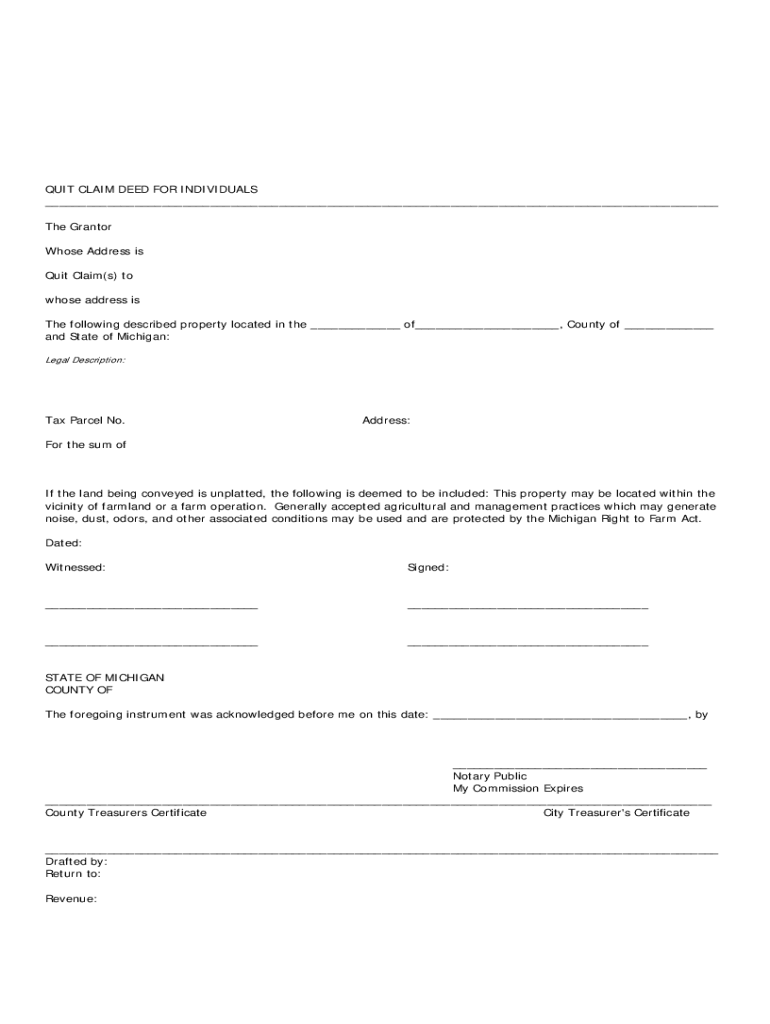







Definition and Meaning of Quit Claim Deed for Individuals
A quit claim deed for individuals is a legal document used to transfer ownership interest in real estate from the grantor (the current owner) to the grantee (the new owner) without providing any warranties or guarantees about the property’s title. It is often used in non-complex transactions where no money changes hands, such as transferring property within a family, removing a spouse from a property title after a divorce, or clarifying ownership when converting property to a living trust.
Key Characteristics
- No Warranties Provided: The grantor does not assure the grantee of a clear title; the grantee accepts the risks involved.
- Simplified Transactions: Ideal for transfers within a trusted relationship, like family members.
- Frequent in Divorce Settlements: Often used to transfer property between ex-spouses, ensuring one person relinquishes claim.
How to Use the Quit Claim Deed for Individuals
To effectively use a quit claim deed, it's important to follow certain procedures to ensure the transfer is legally binding and properly recorded.
Step-by-Step Usage
- Preparation: Obtain a blank quit claim deed form, which includes sections for the property’s legal description, grantor, grantee, and any notarization requirements.
- Fill Out the Form: Complete the form with accurate details such as the names of the grantor and grantee, property address, and legal description.
- Notarization: The grantor must sign the deed in the presence of a notary public to authenticate the transfer.
- Filing: Submit the notarized deed to the county recorder's office where the property is located for official recording.
Considerations
- Legal Assistance: Consulting with a real estate attorney can reduce the risk of complications.
- Record Maintenance: Both parties should retain copies of the recorded deed for their records.
Steps to Complete the Quit Claim Deed for Individuals
Completing a quit claim deed involves a sequence of precise steps to ensure legal compliance and proper transfer.
Detailed Instructions
- Gather Information: Identify all relevant details, including the property’s legal description, and verify the grantor’s and grantee’s identification.
- Drafting the Deed: Input all necessary information into the quit claim deed form, ensuring all fields are completed accurately to avoid future disputes.
- Execute the Deed: Both parties should review the terms before the grantor signs the document in front of a notary.
- Verification: Have the deed notarized to validate the signatures.
Common Errors
- Incomplete Forms: Ensure that all sections, including the legal description and all parties' names, are fully completed.
- Incorrect Details: Verify property details to avoid challenges in validity or ownership later.
Important Terms Related to Quit Claim Deed for Individuals
Understanding essential terms associated with quit claim deeds is crucial for ensuring that the deed is executed and understood correctly.
Essential Concepts
- Grantor/Grantee: The grantor is the person releasing their claim to the property, while the grantee receives the interest in the property.
- Legal Description: A precise definition of the property’s boundaries and location, essential for legal purposes.
- Notarization: A formal process to confirm that the signature is genuine, usually involving a notary public.
Legal Implications
- Title Assurance: Unlike warranty deeds, quit claim deeds do not assure the grantee of a clear title, increasing the potential for future property disputes.
Who Typically Uses the Quit Claim Deed for Individuals
Several entities and situations are commonly associated with the use of quit claim deeds due to their nature.


Common Users
- Family Members: Used frequently for family-based property transfers without monetary transactions.
- Divorced Spouses: Ideal for managing property distribution post-divorce.
- Living Trusts: Often employed to transfer property into or out of living trusts.

Examples
- Inter-family Gifts: Parents transferring property to children.
- Estate Planning: Facilitates the easy administration of estates as part of a larger estate planning strategy.
Legal Use of the Quit Claim Deed for Individuals
Legal application of quit claim deeds involves precise adherence to state laws and recording practices.
Compliance Requirements
- State Law Adherence: Each state has specific requirements regarding the form and execution of a quit claim deed.
- Recording Procedures: Must be recorded in the jurisdiction where the property is located to be effective against third-party claims.
Constraints
- No Title Insurance: Often, title insurers may not be willing to provide title insurance on properties transferred using quit claim deeds due to lack of clear guarantees.
State-Specific Rules for Quit Claim Deed for Individuals
Rules for executing and recording a quit claim deed can vary significantly by state, influenced by local property laws.
Michigan Example
- Right to Farm Acknowledgment: In Michigan, the deed may include clauses acknowledging nearby agricultural activities as per the Michigan Right to Farm Act.
- Signature Requirements: Michigan requires both grantor and grantee signatures to be notarized.
Variations Across States
- Recording Fees: These can differ based on each state’s registry office.
- Legal Description Formats: States may have differing formats for the legal description sections required in deeds.
Required Documents for Quit Claim Deed for Individuals
Certain documents are necessary to facilitate the completion of a quit claim deed and to ensure legitimacy.
Essential Documentation
- Completed Deed Form: The central document detailing the transfer.
- Identity Proof: Valid identification for both grantor and grantee.
- Legal Description: Verified documentation of the property’s boundaries and related features.
- Notary Public Confirmation: A completed acknowledgment from a notary public to validate the deed’s execution.
Additional Considerations
- Supplementary Agreements: Any prior agreements or settlements between parties that may impact the quit claim should be documented.


