




01. Edit your form online
Type text, add images, blackout confidential details, add comments, highlights and more.

Type text, add images, blackout confidential details, add comments, highlights and more.

Draw your signature, type it, upload its image, or use your mobile device as a signature pad.

Send it via email, link, or fax. You can also download it, export it or print it out.
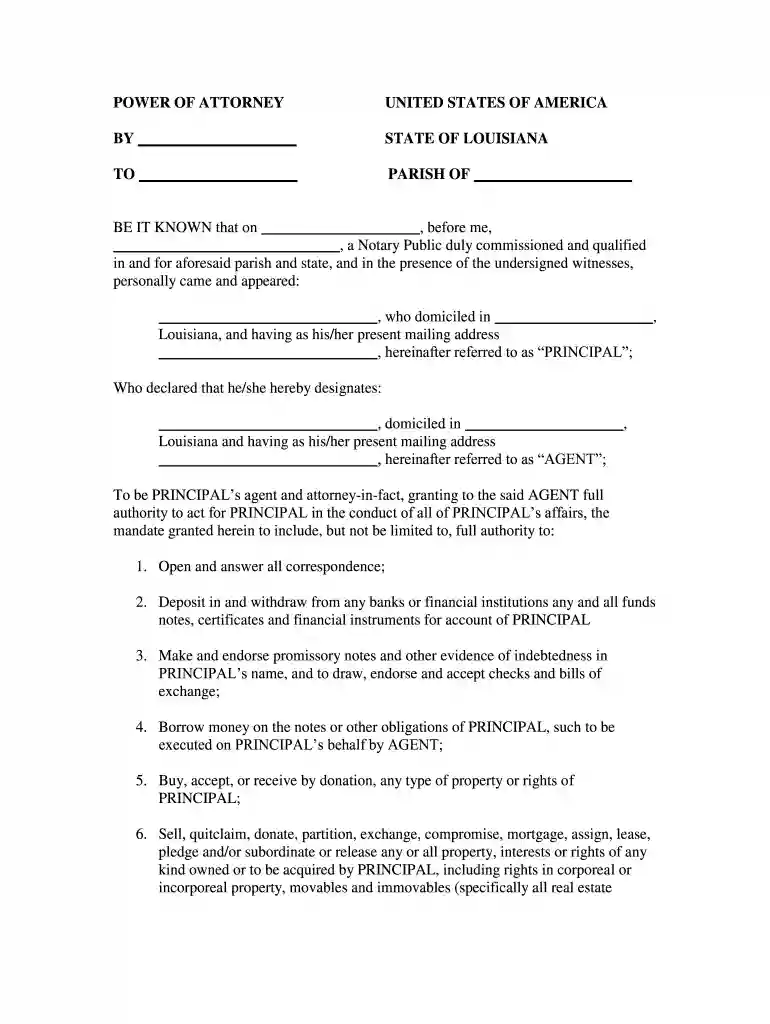
The Power of Attorney (POA) form is a legal document that grants one individual, referred to as the "Agent," the authority to act on behalf of another individual, known as the "Principal," in certain legal, financial, or health-related matters. This arrangement ensures that an Agent can make decisions and perform tasks as if they were the Principal, often used when the Principal is unable to manage their affairs due to absence or incapacity. The scope of power can vary, ranging from broad authority to specific, limited actions defined within the document.
The form must clearly identify who is being appointed as the Agent. This includes their full name and contact information to ensure there is no ambiguity about who is authorized to make decisions on behalf of the Principal.
It is crucial to outline the specific powers being granted to the Agent. This can include transaction management, property dealings, or healthcare decisions. Each power should be detailed to specify the extent and limitations of the Agent's authority.
The document should specify how long the Agent will hold these powers. Some POAs are durable and continue until revoked or the Principal passes away, while others might be springing, only becoming effective upon a specific event or date.
Select the Correct Form: Ensure that the form chosen is suitable for the kind of authority required, considering factors like state-specific requirements.
Fill in Principal and Agent Information: Enter accurate details of the Principal and the Agent, including contact information and identification numbers if needed.
Define the Powers Granted: Clearly enumerate the tasks and decisions that the Agent is allowed to undertake. Be specific to avoid any future misunderstandings.
Set Validity Terms: Determine and state when the POA comes into effect and its duration. Specify any conditions that must be met for the POA to become active, if applicable.
Obtain Necessary Signatures: The form needs to be signed by both the Principal and Agent. Some states require a notarization or witness signatures to validate the document.
POAs are governed by state laws, which can dictate variations in the form. For instance, Louisiana may have different notarization requirements or stipulations about the POA's scope. It's important to consult local laws or legal professionals to ensure compliance with state-specific regulations and ensure the document's legality.
The POA is a critical tool in estate planning and asset management. Legally, it can be used to enable Agents to make healthcare decisions, handle financial affairs, transact property sales, and more. Courts honor the authority granted through a POA, provided it complies with state regulations and is used within the limits set by the Principal.
To complete a Power of Attorney form, gather all necessary identification documents for both the Principal and the Agent. Additional paperwork may include recent financial statements if financial management authority is granted, or medical records if healthcare decisions are involved. Proper documentation streamlines the process and supports the validity of the POA.
Power of Attorney forms are used by a wide range of individuals. Seniors may appoint family members to handle their affairs. Business executives traveling frequently might designate a proxy for business continuity. Parents might grant temporary guardianship to relatives when they travel without their children. The versatility of the POA makes it a valuable and common instrument across various personal and professional circumstances.


Sign in to your DocHub account and import your power attorney form to our editor using one of its upload methods - from your device, cloud storage, protected URL, or your DocHub folders if you have already managed your form before. Open our editor, click the Sign button in the upper toolbar, and decide on your signing method. You can use an image of your handwritten signature, draw it, type in your name, or utilize a QR code instead.
With DocHub, you have several convenient ways to edit your power attorney form online. You can drag and drop the form and modify it directly at the DocHub website or use our browser extension to fill out your form immediately. Additionally, you can modify your PDF on your phone, as DocHub works with all the available mobile platforms.
At DocHub, your data security is our priority. We follow HIPAA, SOC2, GDPR, and other standards, so you can work on your documents with confidence.
We provide all the information you need about getting a power of attorney for you, free power of attorney template and samples , step by step instructions.Read more
Generally, you can use this form wherever you live in the U.S. to name a health care agent or proxy. However, in some states you cannot use this form. Can youRead more
Power of attorney allows someone else to act on your behalf. NYSLRS offers a durable power of attorney form that meets New York State legal requirements.


