




01. Edit your form cg1 2022 online
Type text, add images, blackout confidential details, add comments, highlights and more.

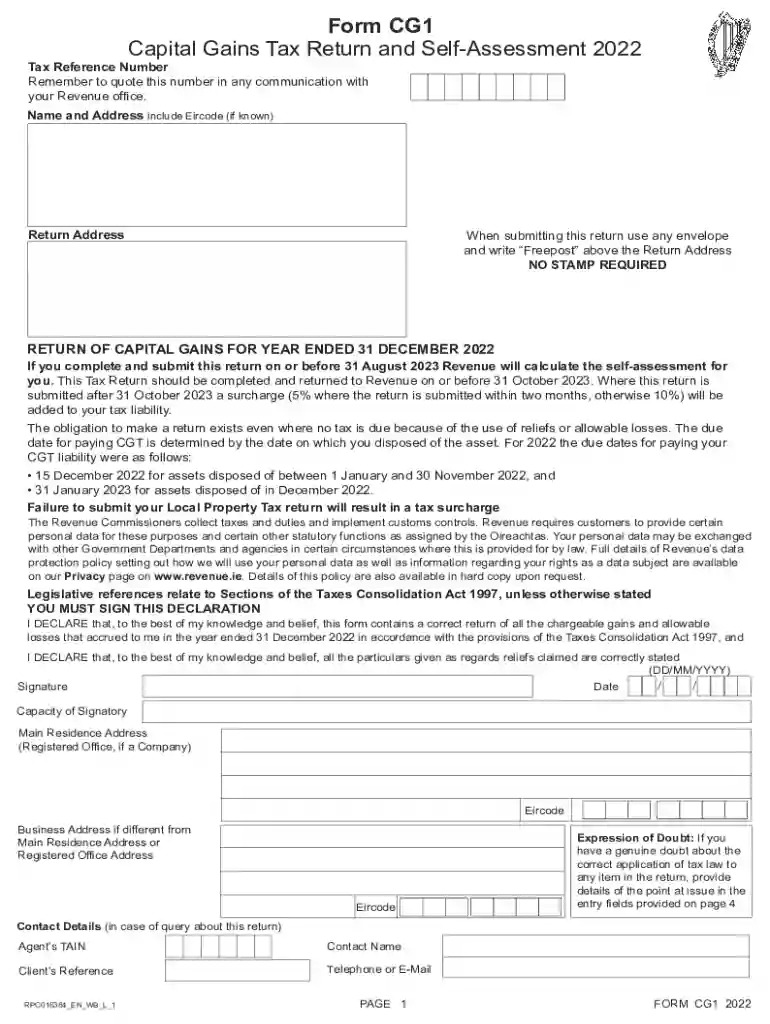
Type text, add images, blackout confidential details, add comments, highlights and more.

Draw your signature, type it, upload its image, or use your mobile device as a signature pad.

Send cg1 form download via email, link, or fax. You can also download it, export it or print it out.
Capital Gains Tax forms, such as Form CG1 and others, are used to report the profits made from the sale of certain assets, a concept known as capital gains. These forms detail the calculation of gains from assets such as property, stocks, and bonds, contrasting acquisition and sale prices. In the United States, these forms help the Internal Revenue Service (IRS) determine the amount of tax owed on these profits. Capital Gains Tax forms are crucial in filing a taxpayer’s complete financial activity, ensuring compliance with federal tax regulations.
Taxpayers must understand which types of assets are taxable under capital gains.
To effectively use Capital Gains Tax forms, it's important to gather all relevant financial documents detailing the purchase and sale of assets. Begin by downloading the necessary form, typically available through the IRS website or tax preparation software compatible with DocHub. Complete each section by entering details about your asset transactions, ensuring you adhere to the guidelines and fields the form prescribes, such as purchase dates, prices, and any additional fees related to the transaction.
Be meticulous in filling out each part, as errors can lead to audits or penalties.
Correct calculations ensure accurate tax reporting and prevent future disputes with the IRS.
Understanding terminology is vital. Terms such as “short-term” and “long-term” gains, “basis,” and “adjusted basis” are frequently used in Capital Gains Tax forms. Short-term gains refer to assets held for one year or less and are taxed as ordinary income. Long-term gains apply to assets held over a year, typically taxed at reduced rates.
These terms are fundamental to understanding tax liabilities and completing Capital Gains Tax forms accurately.
Timeliness is crucial when dealing with Capital Gains Tax forms. The standard deadline for filing is April 15th annually, coinciding with personal income tax filings. Extensions may give additional time, but any taxes owed must be paid by the deadline to avoid interest and penalties.
Awareness of these dates is essential for maintaining compliance and avoiding late submission penalties.
Capital Gains Tax forms can be obtained through several sources, ensuring accessibility for taxpayers. They are available online via the IRS website, integrated into tax software such as TurboTax or QuickBooks, and accessible through online document editing platforms like DocHub. For those without internet access, forms can be requested via mail from local IRS offices.
Failing to file or erroneously reporting on Capital Gains Tax forms can lead to serious penalties. These can include fines, interest on owed amounts, and potential legal action. To avoid these, always ensure accurate and timely filings, and consider seeking professional assistance for complex cases.
Understanding these risks emphasizes the importance of careful and compliant filing.
The IRS provides comprehensive guidelines for completing Capital Gains Tax forms. These include details on filing procedures, required documentation, and rules for calculating gains and losses. Staying informed about these guidelines helps taxpayers navigate the reporting process efficiently, ensuring clarity and compliance.
We've got more versions of the form cg1 2022 form. Select the right form cg1 2022 version from the list and start editing it straight away!
| Versions | Form popularity | Fillable & printable |
|---|---|---|
| 2022 | 4.9 Satisfied (59 Votes) | |
| 2021 | 4.8 Satisfied (61 Votes) | |
| 2020 | 4.9 Satisfied (48 Votes) | |
| 2017 | 4.4 Satisfied (137 Votes) | |
| 2015 | 4.3 Satisfied (40 Votes) | |
| 2014 | 4.4 Satisfied (249 Votes) | |
| 2011 | 4.1 Satisfied (32 Votes) | |
| 2010 | 4 Satisfied (23 Votes) | |
| 2003 | 4 Satisfied (24 Votes) | |
| 2002 | 4 Satisfied (43 Votes) | |
| 2001 | 4 Satisfied (28 Votes) |
At DocHub, your data security is our priority. We follow HIPAA, SOC2, GDPR, and other standards, so you can work on your documents with confidence.
For calendar year 2017, or tax year beginning. , 2017, ending. , 20. A Check appropriate boxes: Initial return. Initial return (extension filed). Final return.Read more
Realized capital gains face a top statutory marginal income tax rate of 20 percent plus a supplemental net investment income tax rate of 3.8 percent, for aRead more
Mar 30, 2026 Use Schedule D (Form 1040) to report the following: The sale or exchange of a capital asset not reported on another form or schedule. GainsRead more


