




01. Edit your rcmp email address online
Type text, add images, blackout confidential details, add comments, highlights and more.

Type text, add images, blackout confidential details, add comments, highlights and more.

Draw your signature, type it, upload its image, or use your mobile device as a signature pad.

Send rcmp application via email, link, or fax. You can also download it, export it or print it out.
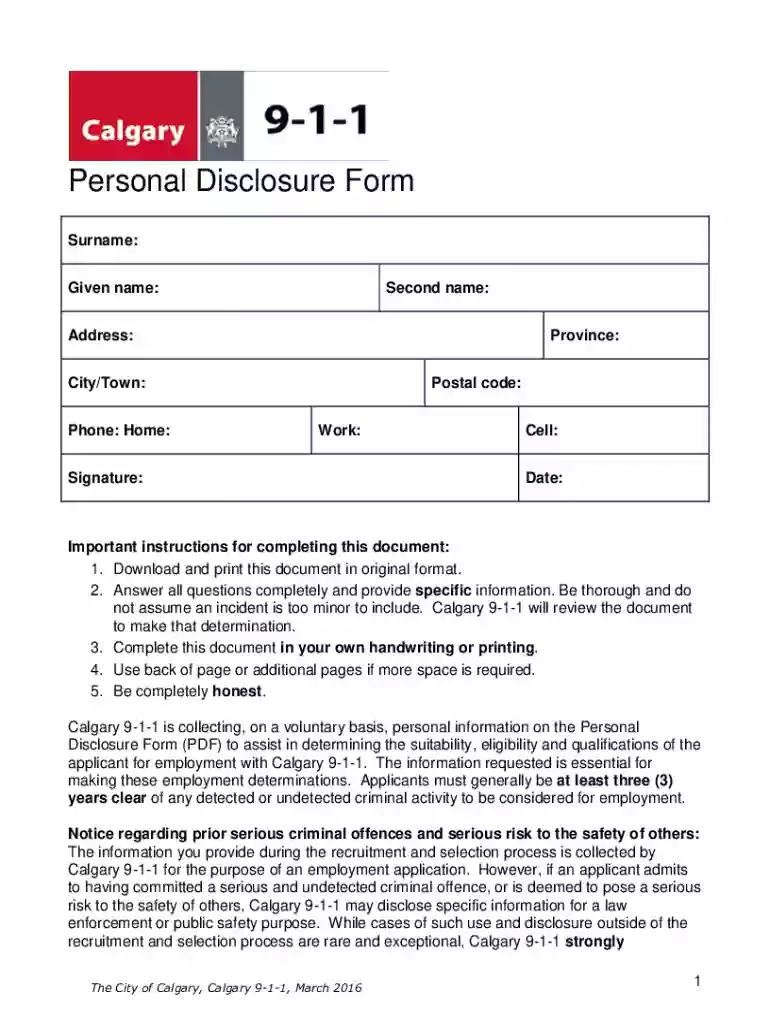
A Personal Disclosure Form is a critical document used in assessing an individual's suitability for roles requiring a high level of responsibility and trust. Often employed in employment processes, particularly for positions involving public safety or security, this form gathers detailed personal information to evaluate an applicant's background. Fields typically cover areas such as criminal history, driving records, financial stability, and possible substance abuse. This form underscores the importance of transparency and thoroughness, as dishonest or incomplete answers can affect an applicant’s chances of employment or lead to potential legal consequences.
When using a Personal Disclosure Form, it is vital to ensure all required fields are completed meticulously. Begin by reading the entire form to understand what information is required. Given the sensitive nature of the data, accuracy and honesty are paramount.
Utilizing guidance from a HR representative or legal advisor can help in correctly filling out complex sections.
Acquiring a Personal Disclosure Form typically involves contacting the requesting organization directly. This could be through:
Always ensure you are obtaining the form from a legitimate source to avoid using outdated or incorrect versions.
Completing this form requires careful attention to detail:
The Personal Disclosure Form is crucial for several reasons:
This form is predominantly used by:
Employers across various sectors may incorporate the form to ensure a high degree of integrity among their personnel.


Some critical elements include:
Each element is essential for a comprehensive assessment, ensuring the security and suitability of the applicant.
Failing to complete the Personal Disclosure Form accurately can lead to:
Understanding these penalties highlights the importance of honesty in completing the form.
We've got more versions of the rcmp email address form. Select the right rcmp email address version from the list and start editing it straight away!
At DocHub, your data security is our priority. We follow HIPAA, SOC2, GDPR, and other standards, so you can work on your documents with confidence.
This agency is requesting disclosure of your Social Security Number in accordance with IC 4-1-8-1; disclosure of this information is REQUIRED.Read more
Self-Disclosure Form. In compliance with the Criminal Background Checks policy, this form must be completed by faculty, academic staff or executiveRead more


