
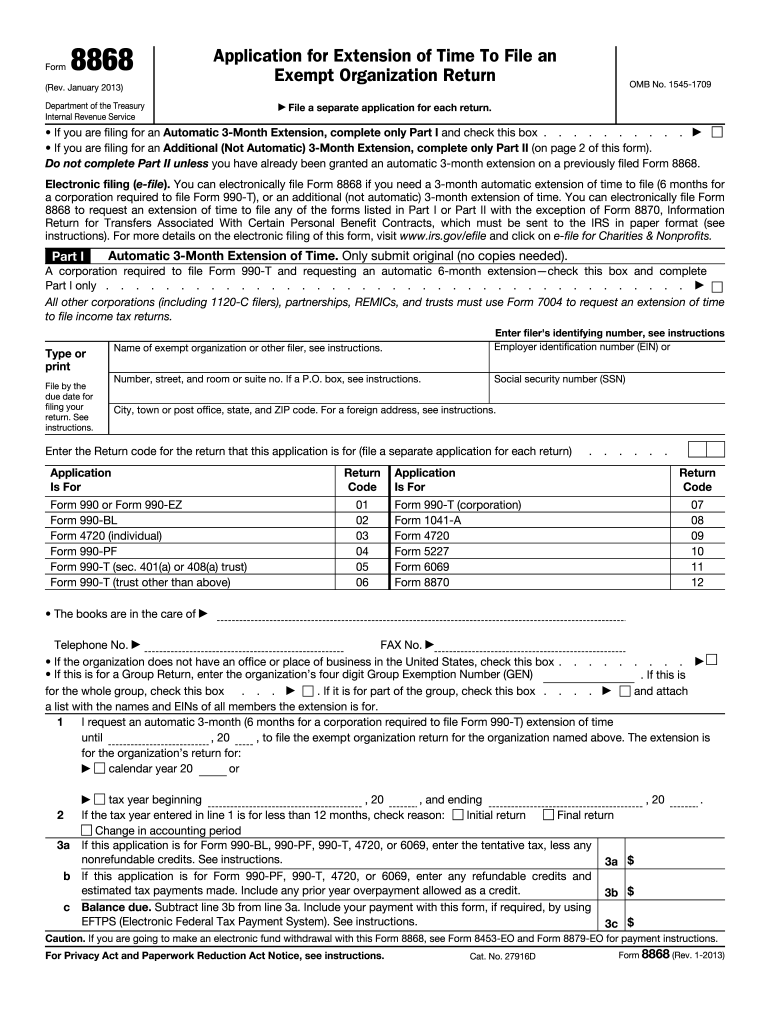







Definition & Meaning
Form 8868, officially known as the "Application for Extension of Time To File an Exempt Organization Return," is utilized by certain tax-exempt organizations in the United States to request additional time to file their tax returns. This form helps organizations avoid late filing penalties by providing an automatic three-month extension, with a possibility of a six-month extension for specific entities, such as corporations filing Form 990-T. Recognizing the importance of adhering to deadlines, Form 8868 offers a structured way to secure extra time, ensuring that organizations can collate necessary documentation to file accurate returns.
Important Terms Related to Form 8868
Understanding the key terminology associated with Form 8868 can aid in comprehending the filing process and requirements:
- Exempt Organization: Non-profit entities that qualify for tax-exempt status under IRS guidelines.
- Automatic Extension: A pre-approved time extension granted automatically upon application filing.
- Return Codes: Numeric or alphanumeric codes that classify the type of tax return being extended.
- Identifying Number: A unique identification number assigned to the organization, often the Employer Identification Number (EIN).
- Additional Extension: A further extension that may be requested beyond the initial period.
These terms are central to accurately completing and submitting Form 8868.
Steps to Complete Form 8868
Completing Form 8868 involves several detailed steps, each crucial for successful filing:
- Provide Organizational Information: Include the organization's name, address, and Employer Identification Number.
- Specify Return Code: Identify the type of return for which the extension is required using the IRS return codes.
- Choose Extension Type: Indicate whether applying for the three-month automatic extension or an additional extension.
- Attach Required Documentation: If seeking an additional extension, additional documentation supporting the request may be necessary.
- Submit by the Due Date: Ensure the form is filed by the original tax return due date to avoid penalties.
- Confirmation Receipt: After submission, retain any confirmation received to verify the extension approval.
Following these steps helps ensure the form is correctly completed and submitted.
Who Typically Uses Form 8868
Form 8868 is primarily used by the following entities:
- Non-Profit Organizations: Entities like charities, religious groups, and educational institutions.
- Foundations: Private and public foundations that operate under specific IRS guidelines.
- Corporations Filing Form 990-T: Businesses filing specific tax forms indicating unrelated business taxable income.
These organizations often require additional time to assemble financial records and complete the necessary documentation for accurate tax return submission.
Eligibility Criteria
Eligibility for filing Form 8868 aligns with the type of organization and the nature of the tax return:
- The organization must qualify as tax-exempt under IRS guidelines.
- The tax return in question must be among those listed in the form instructions, such as Form 990 or Form 990-PF.
- For additional extensions, proof of reasonable cause may be required to justify the time extension beyond the automatic three months.
Meeting these criteria is essential for an extension request to be considered valid by the IRS.


Filing Deadlines / Important Dates
Adhering to filing deadlines is critical when utilizing Form 8868:
- Initial Deadline: The form must be submitted by the original due date of the tax return being extended.
- Additional Extension Request Due Date: Further extension requests must be made before the end of the initial three-month extension period.
- Penalty Avoidance: Timely filing of Form 8868 is crucial to avoid penalties associated with late filing of tax returns.
Keeping track of these important dates ensures compliance with IRS regulations.
Form Submission Methods (Online / Mail / In-Person)
Form 8868 can be submitted through various methods, providing flexibility in the filing process:
- Online Submission: Filing electronically via the IRS e-file system is the most efficient method, offering instant confirmation of receipt.
- Mail Submission: Traditional mail is also an option, though it may slow down the confirmation process.
- In-Person Submission: Direct submission at an IRS office is possible, though less common.
Organizations can choose the method that best aligns with their operational preferences, ensuring the form is submitted timely and accurately.
Penalties for Non-Compliance
Failure to submit Form 8868 or the associated tax return on time can result in significant penalties:
- Late Filing Penalties: Penalties increase the longer the filing is delayed, calculated based on the unpaid tax amount for each month or part of a month the return is late.
- Interest Charges: Interest on any unpaid tax accrues from the original due date of the return until payment is made in full.
- Denial of Extension: Late or incorrect filings could lead to denied extensions, leading to immediate penalties on the late return.
Adhering to deadlines and ensuring accurate form completion can help avoid these costly penalties, ensuring compliance with IRS requirements.




