Ct 706 2014 form-2026

Get Form
ct 706 nt 2021 Preview on Page 1

Here's how it works

01. Edit your ct 706 nt 2021 online
Type text, add images, blackout confidential details, add comments, highlights and more.

02. Sign it in a few clicks
Draw your signature, type it, upload its image, or use your mobile device as a signature pad.

03. Share your form with others
Send it via email, link, or fax. You can also download it, export it or print it out.

How to use or fill out ct 706 2014 form with DocHub

Form edit decoration
9.5
Ease of Setup
DocHub User Ratings on G2
9.0
Ease of Use
DocHub User Ratings on G2
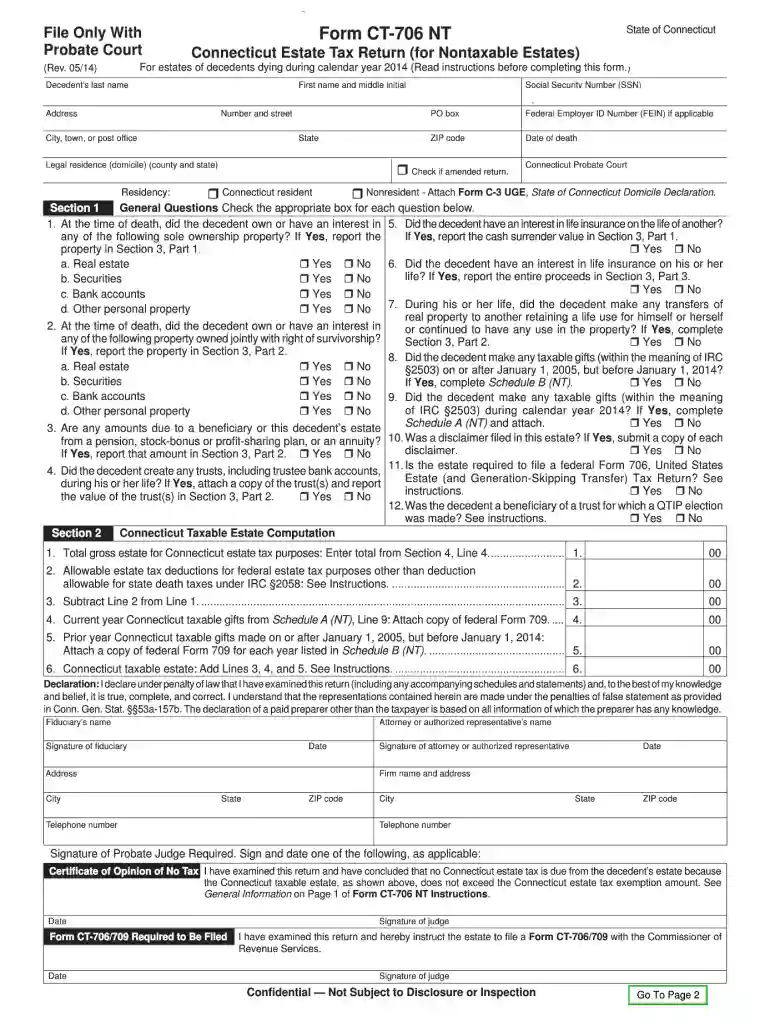
  1. Click ‘Get Form’ to open the CT-706 NT in our editor.
  2. Begin by entering the decedent's last name, first name, and middle initial in the designated fields at the top of the form.
  3. Fill in the address details, including street number, city, state, and ZIP code. Ensure accuracy as this information is crucial for processing.
  4. Provide the Federal Employer ID Number (FEIN) if applicable and enter the date of death along with legal residence details.
  5. Proceed to Section 1 and check the appropriate boxes for general questions regarding property ownership and interests. This section helps determine tax obligations.
  6. In Section 2, compute the Connecticut taxable estate by entering values from previous sections. Follow instructions carefully to ensure correct calculations.
  7. Complete Sections 3 through 6 by reporting all relevant property and proceeds. Use our platform’s features to add additional sheets if necessary.
  8. Finally, review your entries for accuracy before saving or printing your completed form.

Start using our platform today to fill out your CT-706 NT form easily and for free!

See more ct 706 2014 form versions

We've got more versions of the ct 706 2014 form form. Select the right ct 706 2014 form version from the list and start editing it straight away!
Versions Form popularity Fillable & printable
2023 4.7 Satisfied (51 Votes)
2022 4.8 Satisfied (58 Votes)
2021 4.8 Satisfied (75 Votes)
2020 4.3 Satisfied (43 Votes)
2019 4.4 Satisfied (237 Votes)
2018 4.2 Satisfied (85 Votes)
2017 4.4 Satisfied (243 Votes)
2016 4.4 Satisfied (699 Votes)
2015 4.3 Satisfied (152 Votes)
2014 4.2 Satisfied (25 Votes)
2013 4 Satisfied (27 Votes)
2011 4 Satisfied (25 Votes)
2010 4.3 Satisfied (58 Votes)
2009 4.3 Satisfied (35 Votes)
2008 4.2 Satisfied (26 Votes)
be ready to get more

Complete this form in 5 minutes or less

Get form

Got questions?

We have answers to the most popular questions from our customers. If you can't find an answer to your question, please contact us.
Contact us
An estate tax return (Form 706) must be filed if the gross estate of the decedent (who is a U.S. citizen or resident), increased by the decedents adjusted taxable gifts and specific gift tax exemption, is valued at more than the filing threshold for the year of the decedents death, as shown in the table below.
You must file a Connecticut income tax return if your gross income for the 2024 taxable year exceeds: $12,000 and you are married filing separately; $15,000 and you are filing single; $19,000 and you are filing head of household; or.
The executor or administrator of the estate must sign and file Form CT‑706/709. If there is more than one fiduciary, all must sign the return and all are liable for tax, interest, and penalty. See Executor above.
The personal representative is responsible for filing any final individual income tax return(s) and the estate tax return of the decedent when due. You may need to file Form 56, Notice Concerning Fiduciary Relationship to notify the IRS of the existence of a fiduciary relationship.
Form CT-706 NT EXT is used to request a six-month extension to file Form CT-706 NT (Connecticut Estate Tax Return for Nontaxable Estates) with the Probate Court.

People also ask

A Connecticut estate tax return must be filed for each decedent who was a Connecticut resident as well as non-residents who died owning real or tangible personal property located in Connecticut. A Connecticut estate tax return is required for every decedents estate, whether or not tax is due.
At our firm, we frequently encounter these errors that can put families at risk: Not filing Form 706 because the estate falls below the exemption threshold. Incomplete or inaccurate asset valuations that trigger IRS audits. Missing critical deadlines for filing or requesting extensions.

Related links