




01. Edit your irs publication 915 calculator online
Type text, add images, blackout confidential details, add comments, highlights and more.

Type text, add images, blackout confidential details, add comments, highlights and more.

Draw your signature, type it, upload its image, or use your mobile device as a signature pad.

Send pub 915 for 2017 via email, link, or fax. You can also download it, export it or print it out.
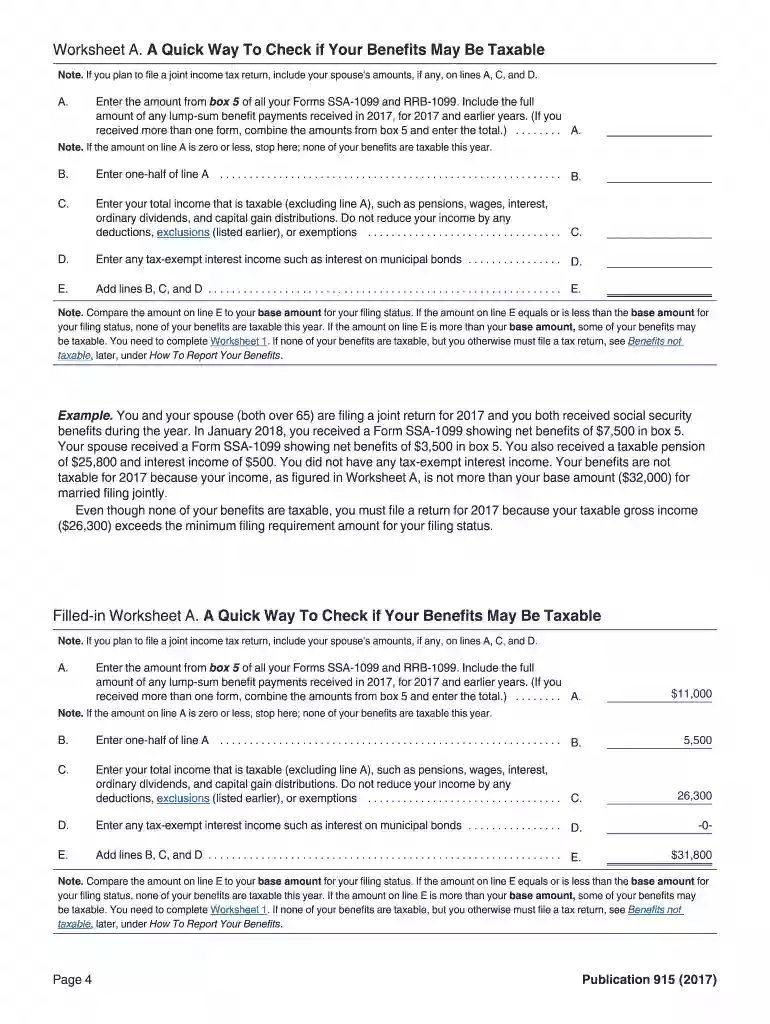
Publication 915, particularly the 2017 version, is an IRS document that offers guidance on the taxation of social security benefits and railway retirement benefits, specifically equivalent tier 1 benefits. It helps taxpayers determine the taxability of such benefits and provides instructions on reporting them on federal income tax returns. Additionally, it offers worksheets for calculating taxable amounts and discusses deductions and repayments related to these benefits.
Using Publication 915 involves understanding its purpose in calculating the taxable portion of social security benefits. Users must follow the worksheets provided within the publication to determine if any portion of their benefits is taxable. This process requires reference to IRS worksheets, ensuring accurate calculations. Familiarity with terms such as adjusted gross income (AGI) and thresholds outlined by the IRS is crucial for effective utilization.
The use of Publication 915 is mandated by U.S. tax laws concerning the reporting of certain benefits. It ensures compliance with federal regulations by guiding taxpayers through the complex tax implications associated with social security benefits. Failing to use the publication appropriately could result in underreporting income and facing IRS penalties.
Guidelines specify that social security benefits may be taxable depending on your filing status and income levels. It is crucial to follow the IRS instructions detailed in Publication 915 to correctly determine and report taxable benefits, especially when dealing with multiple sources of income.
Failure to accurately report taxable social security benefits as required by Publication 915 can lead to penalties. The IRS may impose fines or demand back taxes for underreported income. Accurate adherence to the guidance outlined in Publication 915 minimizes the risk of audits and associated financial consequences.
We've got more versions of the irs publication 915 calculator form. Select the right irs publication 915 calculator version from the list and start editing it straight away!
| Versions | Form popularity | Fillable & printable |
|---|---|---|
| 2025 | 4.6 Satisfied (20 Votes) | |
| 2024 | 4.7 Satisfied (58 Votes) | |
| 2023 | 4.6 Satisfied (30 Votes) | |
| 2022 | 4.4 Satisfied (56 Votes) | |
| 2021 | 4.8 Satisfied (86 Votes) | |
| 2020 | 4.3 Satisfied (129 Votes) | |
| 2019 | 4.4 Satisfied (129 Votes) | |
| 2018 | 4.3 Satisfied (115 Votes) | |
| 2017 | 4.3 Satisfied (141 Votes) | |
| 2016 | 4.4 Satisfied (1167 Votes) | |
| 2015 | 4.4 Satisfied (65 Votes) | |
| 2014 | 4 Satisfied (32 Votes) | |
| 2011 | 4.3 Satisfied (50 Votes) | |
| 2008 | 4.3 Satisfied (62 Votes) | |
| 2005 | 4 Satisfied (37 Votes) |
Yes, a typed name is accepted as a valid electronic signature when you create it on your document utilizing a compliant solution like DocHub. Simply upload your publication 915 2017 form to our editor, click Sign in the top tool pane → Create your signature → Type your name in the appropriate tab, and choose how it will appear on your document.
When you edit your publication 915 2017 form with DocHub, you only require a steady internet connection and virtually any browser installed on your device. No need to install any third-party applications or study tutorials. Just open a tab with DocHub, drag and drop your file, and edit it on the spot.
At DocHub, your data security is our priority. We follow HIPAA, SOC2, GDPR, and other standards, so you can work on your documents with confidence.
Jan 13, 2022 — Your spouse received a Form SSA-1099 showing net benefits of $2,500 in box 5. You also received a taxable pension of $27,200 and interest income ...
915 to figure the taxable part of social security benefits you must include in gross income. Gross income includes gains, but not losses, reported on Form 8949 ...


