




01. Edit your form online
Type text, add images, blackout confidential details, add comments, highlights and more.

Type text, add images, blackout confidential details, add comments, highlights and more.

Draw your signature, type it, upload its image, or use your mobile device as a signature pad.

Send it via email, link, or fax. You can also download it, export it or print it out.
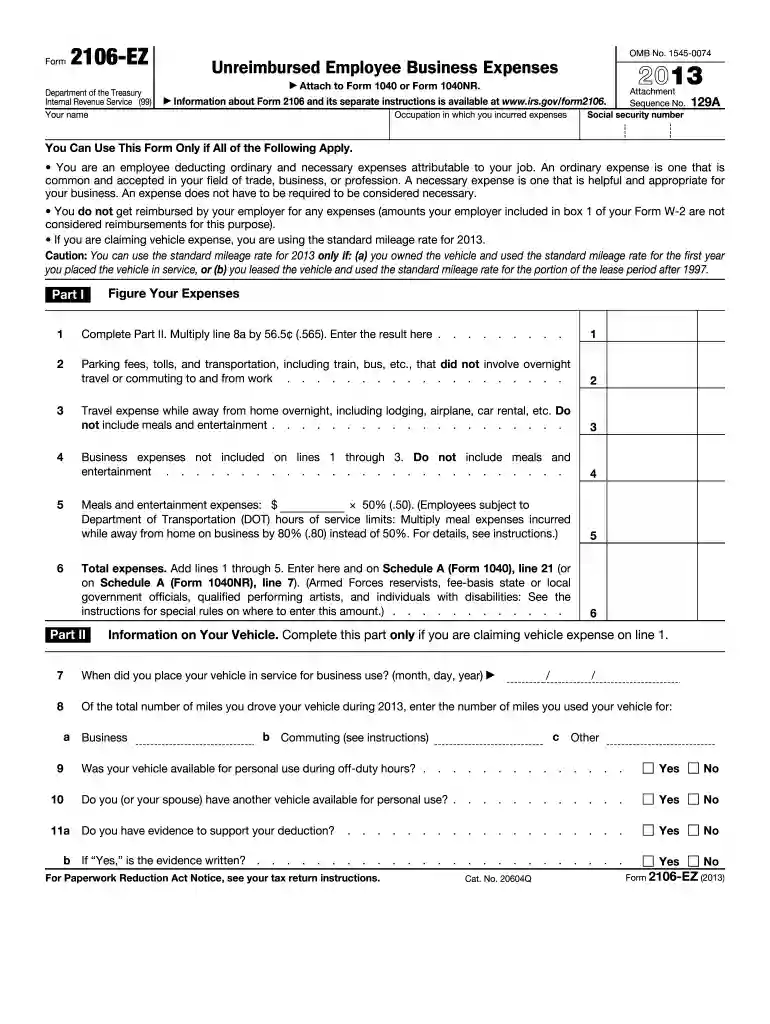
The 2013 IRS Form 2106-EZ was designed to help employees who wish to claim unreimbursed business expenses. This streamlined version of Form 2106 was geared towards simplicity for employees with less complex expense deductions. It included sections for vehicle expenses, travel and meal costs, and other work-related expenditures, supporting individuals in accurately reporting deductions on their tax returns. Essential for employees who did not receive reimbursements from their employers, this form facilitated the proper calculation and reporting of allowable expenses, contributing to potential reductions in taxable income.
To utilize the 2013 Form 2106-EZ, employees had to meet specific criteria. Primarily, the form was available to employees who were not reimbursed by their employers for the business expenses they wished to deduct. Additionally, the form was not suitable for those claiming deductions related to transportation provided to a self-employed business or for those who used the actual expenses method rather than the standard mileage rate for vehicle deductions. Employees were required to maintain accurate records of their expenditures to ensure compliance with IRS standards.


Utilizing the 2013 Form 2106-EZ involved several strategic steps to ensure accuracy and compliance. Employees began by gathering detailed records of their relevant business expenses, including receipts and logbooks for vehicle use when applicable. The form required the completion of specific sections for each type of claimed expense, with clear instructions on how to calculate allowable deductions. Employees needed to fill in their expenses for the year, subtract any reimbursements they might have received, and calculate the total deduction. This total was then transferred to the appropriate line on their individual tax return.
Gather Supporting Documents: Collect all receipts, travel logs, and records of expenses incurred during the tax year.
Enter Personal and Employment Information: Start by filling in your name, Social Security number, and other identifying information at the top of the form.
Calculate Vehicle Expenses: If using a personal vehicle for business, use the standard mileage rate provided by the IRS for 2013, multiplied by the business miles driven. Ensure to record date and purpose of each trip.
Detail Other Expenses: Document any other unreimbursed costs, such as travel and meal expenses, which must be directly related to the performance of job duties.
Adjust for Reimbursements: Subtract any reimbursements received from the employer to calculate the net deductible amount.
Final Review and Transfer: Double-check all figures for accuracy, then transfer the total allowable deductions to Schedule A of Form 1040 if itemizing deductions.
The IRS provided specific guidance on acceptable expenses that could be claimed using Form 2106-EZ. Qualifying expenses included vehicle mileage, travel fares, lodging, and meals incurred while away from the tax home, among others. Moreover, the expenditures had to be ordinary and necessary for the performance of an employee's duties. The IRS mandated meticulous record-keeping to substantiate the claims, requiring a log of date, amount, and business purpose for each expense. Failure to adhere to these guidelines could result in the disallowance of deductions or potential penalties.
Consider an armed forces reservist who travels more than 100 miles from home to perform reserve duties. This individual could use the form to claim travel expenses, including vehicle mileage, necessary meals, and lodging costs. Another scenario might involve a qualified performing artist with substantial costs for costumes and travel to performances, also eligible for deductions. By following the form's instructions and ensuring documentation, these employees could effectively reduce their taxable income.
Typically, the 2013 Form 2106-EZ was filed alongside an individual's federal tax return, normally due by April 15 of the following year. However, careful attention was required to monitor any extensions or changes announced by the IRS that might affect these deadlines. Failing to file by the due date could lead to penalties and interest on unpaid taxes, making it paramount for taxpayers to be aware of all relevant timelines.
Employees needed to compile several specific documents to support their claims on the form. Essential items included receipts for all expenses, mileage logs detailing business use of a vehicle, itineraries for any business-related travel, and records of any partial reimbursements from the employer. Proper organization of these documents not only facilitated accurate form completion but also provided critical evidence in the event of an IRS audit.
Form 2106-EZ could be submitted through multiple channels, including traditional mail and electronic filing methods. For those submitting paper returns, the form had to be attached to the taxpayer's 1040, ensuring that pages remained in the correct order when mailed to the IRS. Alternatively, electronic filing platforms integrated with the IRS e-file system allowed users to streamline submission, reducing errors and expediting processing. With the rise of digital platforms, many taxpayers opted for electronic methods due to their convenience and speed.
We've got more versions of the 2013 irs form 2106 ez form. Select the right 2013 irs form 2106 ez version from the list and start editing it straight away!
At DocHub, your data security is our priority. We follow HIPAA, SOC2, GDPR, and other standards, so you can work on your documents with confidence.
Nov 8, 2013 The expense must be reasonable. As an employee the IRWE is entered on either form 2106 or form 2106-EZ. That information is entered on ScheduleRead more
You Can Use This Form Only if All of the Following Apply. You are an employee deducting ordinary and necessary expenses attributable to your job.Read more


