




01. Edit your 2015 form 2106 ez online
Type text, add images, blackout confidential details, add comments, highlights and more.

Type text, add images, blackout confidential details, add comments, highlights and more.

Draw your signature, type it, upload its image, or use your mobile device as a signature pad.

Send it via email, link, or fax. You can also download it, export it or print it out.
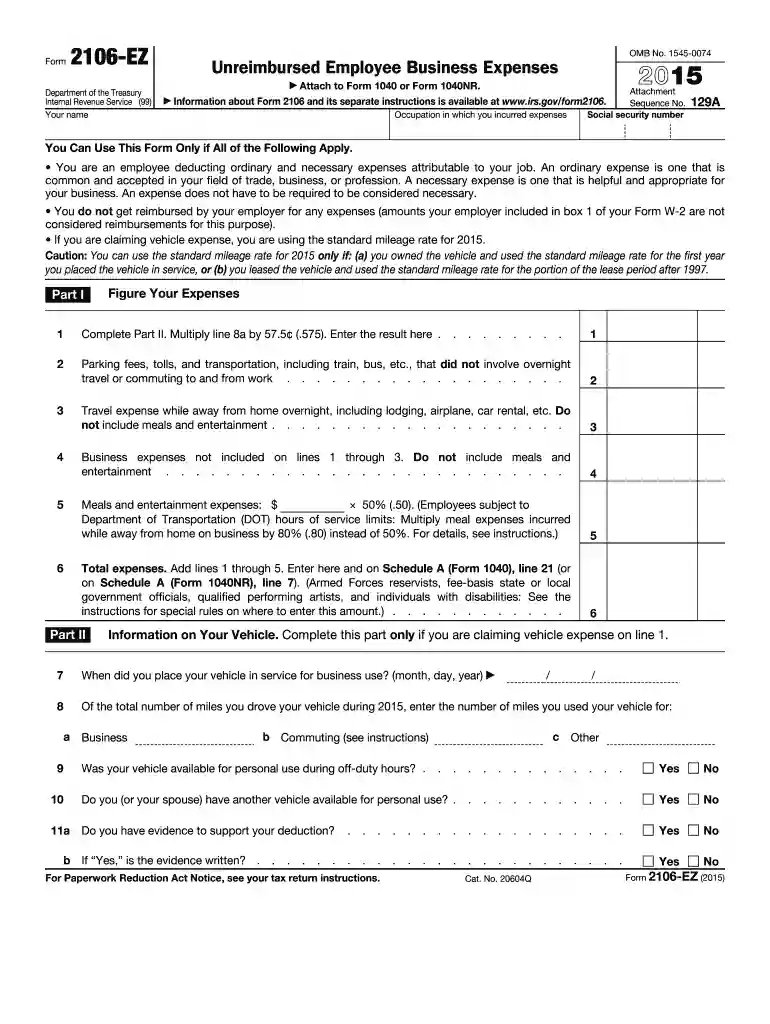
Form 2106-EZ, "Unreimbursed Employee Business Expenses," was designed specifically for employees who incurred business expenses related to their job and could not claim reimbursement from their employer. This simplified version of Form 2106 was intended to help employees easily deduct expenses such as travel, lodging, and meals, ultimately reducing their taxable income. The form was particularly beneficial for those whose job required frequent travel or specific professional expenses.
To use Form 2106-EZ, specific criteria need to be met:


Preparing Form 2106-EZ requires:
The IRS provided instructions and guidance for the correct completion of Form 2106-EZ. Key guidelines included ensuring that all calculations are accurate and checking eligibility requirements, as improper filing could lead to penalties. The standard mileage rate for vehicle expenses is also set according to IRS rules, important for those claiming vehicle-related deductions.
Failure to comply with IRS rules for filing Form 2106-EZ can result in:
While Form 2106-EZ was specifically for unreimbursed employee business expenses, its use was phased out after Tax Year 2017 due to tax law changes. Alternatives to consider may include the full Form 2106 or exploring other deductions within the scope of new tax amendments post-2017. Employees must ensure compliance with the newest IRS guidelines to determine any available deduction routes, possibly seeking professional tax advice for complex situations.
The application process for Form 2106-EZ required attaching the completed form to your standard tax return. There was no separate approval process; processing times were consistent with regular IRS processing schedules. Accuracy in form completion significantly influenced processing efficacy and prevented potential delays in tax return outcomes.
Filing deadlines aligned with standard tax return deadlines. For the year 2015, returns, including those with attached Form 2106-EZ, were due on April 18, 2016, extending only if a formal extension request was filed with the IRS. Adjustments and amendments required diligent attention to any extended deadlines.
We've got more versions of the 2015 form 2106 ez form. Select the right 2015 form 2106 ez version from the list and start editing it straight away!
At DocHub, your data security is our priority. We follow HIPAA, SOC2, GDPR, and other standards, so you can work on your documents with confidence.
You Can Use This Form Only if All of the Following Apply. You are an employee deducting ordinary and necessary expenses attributable to your job.Read more
oc25coaEZ[x] - oc35coaEZ[x], rt1925, 0, 1000, 0, 5.3.3.8. 2238, DECOAI82ex, delta(3,5)-delta(2,4)-dienoyl-CoA isomerase (n-C8:2), oc35coaEZ[x] -Read more
Attach Form 2106 or 2106-EZ. . . . . . . . . . . . . . . . . . . . Gross. 25. 25. Income. Health savings account deduction. Attach Form 8889. . . . . . . . 26.Read more


