




01. Edit your irs form 2106 online
Type text, add images, blackout confidential details, add comments, highlights and more.

Type text, add images, blackout confidential details, add comments, highlights and more.

Draw your signature, type it, upload its image, or use your mobile device as a signature pad.

Send unreimbursed employee business expenses via email, link, or fax. You can also download it, export it or print it out.
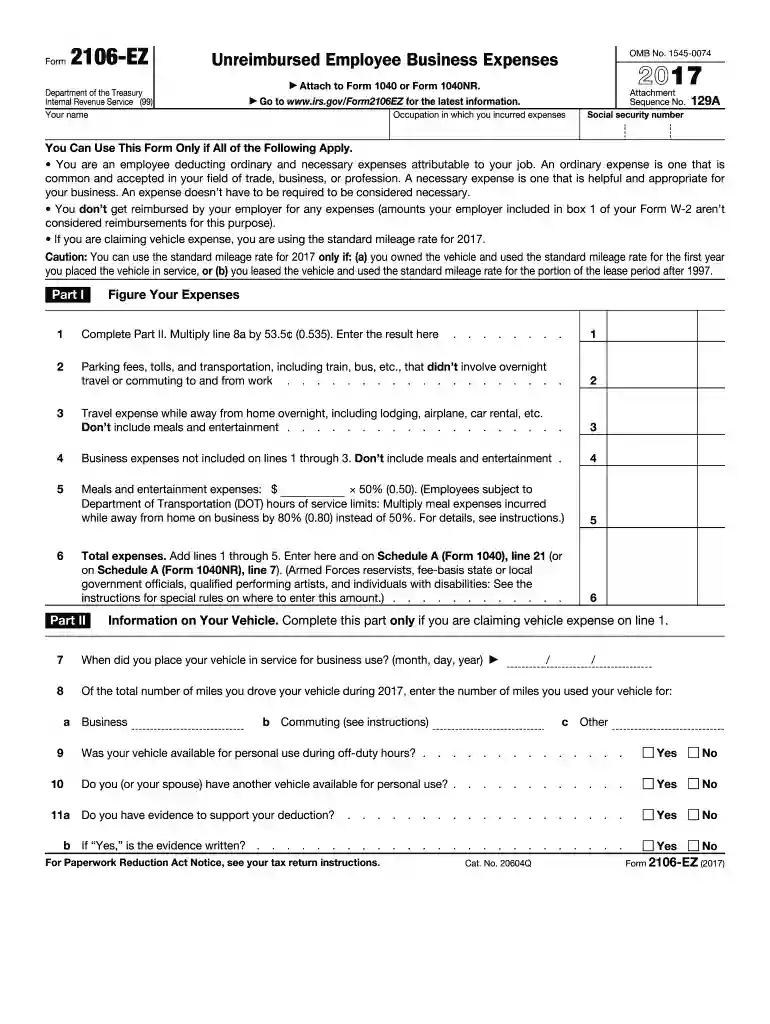
The IRS Form 2106-EZ, officially known as the "Unreimbursed Employee Business Expenses," is designed for employees who want to deduct job-related expenses that weren't reimbursed by their employer. This form is streamlined for individuals who meet certain criteria, allowing for deductions of expenses like vehicle mileage and other non-entertainment business expenses. It plays a significant role in tax filing as it helps to lower taxable income by accurately reporting eligible out-of-pocket costs.
Successfully filling out Form 2106-EZ requires following specific steps, ensuring all necessary details are accurately recorded.
Form 2106-EZ is generally utilized by specific groups of employees who encounter regular business expenses not covered by their employer.
To utilize Form 2106-EZ, taxpayers must meet certain conditions outlined by the IRS. Careful attention to these eligibility criteria ensures proper usage.


Understanding IRS rules and timelines is crucial for complying with requirements and maximizing deductions through Form 2106-EZ.
Getting access to Form 2106-EZ is straightforward, with multiple procurement options available to taxpayers.
Taxpayers have options regarding the submission of Form 2106-EZ, with digital and physical formats both available.
While Form 2106-EZ operates under federal tax law, state adaptations and rules can affect usage.
We've got more versions of the irs form 2106 form. Select the right irs form 2106 version from the list and start editing it straight away!
At DocHub, your data security is our priority. We follow HIPAA, SOC2, GDPR, and other standards, so you can work on your documents with confidence.
Form 2106-EZ, unreimbursed employee business expenses.Read more
Feb 8, 2018 For impairment-related work ex- penses, use the appropriate business form (1040 Sched- ules C, C-EZ, E, and F; Form 2106, Employee Business.Read more
You can use Form 2106-EZ instead of. Form 2106 to claim your unreimbursed employee business expenses if you meet all the requirements listed above Part I of theRead more


