







Definition and Purpose
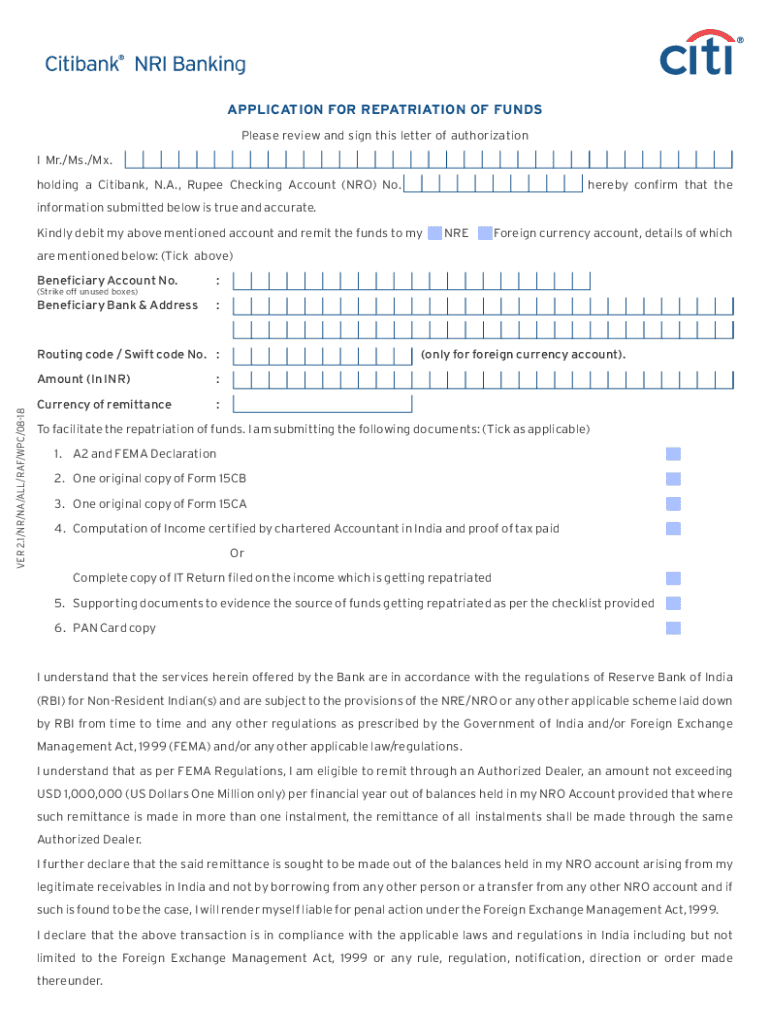
The "Application for Repatriation of Funds - Investment" is a form required to transfer funds from a non-residential account, such as a Citibank NRO account, to a foreign currency account. This application is typically utilized by individuals looking to invest their funds outside their current location while complying with international financial regulations.
- The form is used to authorize financial institutions to debit an account for the purpose of repatriating funds.
- It typically includes confirmation of the account holder's identity and requires necessary documentation for verification.
- The form is crucial for compliance with foreign exchange management rules like those outlined by Reserve Bank of India regulations, particularly for U.S. citizens managing investments abroad.
Key Elements of the Application Form
Understanding the critical elements of the application form is essential for proper completion and submission.
Identity Confirmation
- This section verifies the identity of the applicant by requiring personal details such as full name, account number, and residential status.
- Government-issued identification details may be required for further verification.
Authorization to Debit Account
- Authorization to debit funds is a critical part of the application, allowing the bank to process the repatriation of funds.
- The applicant must clearly specify the amount being repatriated and confirm this authorization through a signature.
Compliance Declarations
- Applicants declare the legitimacy of their funds and compliance with relevant legal and financial regulations.
- This may include acknowledging potential risks such as currency exchange fluctuations and processing delays.
Steps to Complete the Application
Completing the "Application for Repatriation of Funds - Investment" involves several detailed steps to ensure accuracy and compliance.
-
Gather Required Information
- Compile personal and financial details, including account numbers and identification documents.
-
Fill Out Personal Details
- Enter full name, address, and other identifying information in the designated sections.
-
Specify Repatriation Details
- Clearly state the amount to be repatriated and the destination foreign currency account details.
-
Provide Authorization
- Sign the form to authorize the debit of funds and confirm compliance with all terms and conditions.
-
Attach Necessary Documentation
- Include copies of identification, bank statements, and any additional documents required by the issuing organization.
-
Review and Submit
- Carefully review all entries, sign the form, and submit it to the appropriate financial institution for processing.
Required Documents
When submitting the application, specific documents must accompany the form to ensure validation and processing.
- Identification Documents: Passport or a government-issued ID to confirm the identity.
- Account Statements: Recent bank statements from the account being debited.
- Proof of Address: Utility bills or rental agreements to confirm the address.
These documents ensure the legitimacy and accuracy of the application.
Filing Methods
The form can be submitted through several channels to accommodate different needs.
Online Submission
- Most banks offer online portals for document submission, allowing for convenience and quick processing.
- Digital verification tools may be in place to ensure security and accuracy.
Mail or In-person
- Paper applications can be physically mailed or delivered to a branch office, often preferred for applicants who need additional assistance or verification.
Legal and Compliance Considerations
Adherence to legal requirements is a crucial component of the repatriation application process. The applicant needs to understand and comply with international and local regulations.
- Reserve Bank of India Regulations: Compliance with regulations, especially for repatriation from India, safeguards against violations and potential penalties.
- Declaration of Legitimate Funds: Applicants must declare that all funds are sourced from legitimate means, reducing the risk of legal action due to misrepresentation.
Examples of Uses
The application is used in various scenarios, providing insight into its multifaceted functionality.
- Investors: Individuals looking to reinvest abroad will use this form to access their savings or investment returns.
- Retirees: Those retiring overseas might repatriate funds to support their financial needs in the new country.
These use cases illustrate the diverse purposes for which this application can be applied.
Penalties for Non-Compliance
Failure to comply with the requisite legal and regulatory standards can result in various penalties, emphasizing the importance of accuracy and adherence.
- Financial Penalties: Banks and regulatory bodies may levy fines for non-compliance or misrepresentation in the application process.
- Legal Consequences: Severe breaches could lead to legal action, emphasizing the necessity of thorough compliance and accuracy throughout the application process.
Both individuals and businesses must take care to accurately complete and submit the application to avoid these potential drawbacks.




