



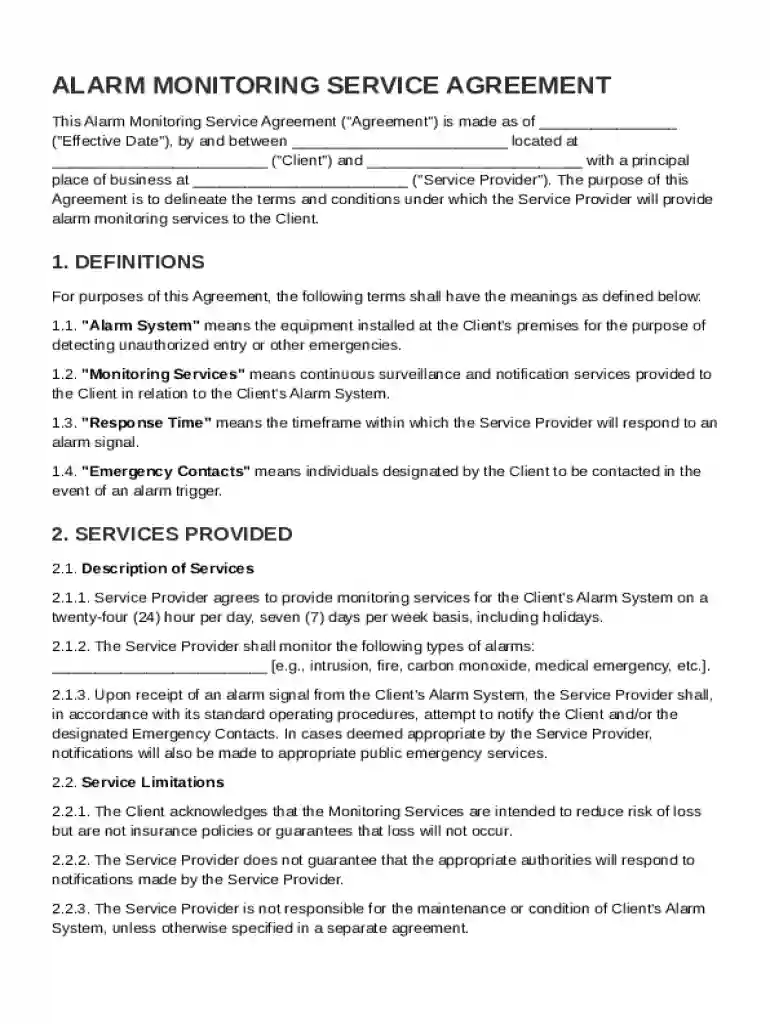
01. Edit your form online
Type text, add images, blackout confidential details, add comments, highlights and more.

Type text, add images, blackout confidential details, add comments, highlights and more.

Draw your signature, type it, upload its image, or use your mobile device as a signature pad.

Send it via email, link, or fax. You can also download it, export it or print it out.
The Alarm Monitor Contract Template is a standardized document designed to outline the terms and conditions between a client and a service provider for monitoring alarm systems. This contract ensures both parties clearly understand their roles, responsibilities, and obligations. It details the specifics of services provided, response protocols in case of alarm activation, and defines boundaries regarding liability and confidentiality. This template serves as a legal document that helps prevent misunderstandings and conflicts by explicitly stating every aspect of the alarm monitoring agreement.
Service Description: Provides a detailed account of the alarm monitoring services included, such as 24/7 monitoring, emergency response coordination, and regular system checks.
Client and Service Provider Obligations: Outlines the responsibilities of both the client and the service provider. This includes maintaining the equipment in working order and promptly responding to alerts.
Payment Terms: Specifies the payment structure for the services, including fees, billing cycles, and late payment penalties.
Termination Clauses: Describes the conditions under which either party can terminate the agreement, including notice periods and potential penalties.
Liability and Insurance: Limits the liability of the service provider in case of system failure or breaches and may specify insurance requirements for added protection.
Download the Template: Start by downloading the template from a trusted source, like DocHub, ensuring it matches your operational requirements.
Fill in Client and Provider Information: Enter the names, addresses, and contact details for both parties involved in the agreement.
Detail the Services Provided: Clearly outline the available alarm monitoring services, including any customization based on the client's specific needs.
Set Payment Terms: Define the fees, payment methods, and schedules. Ensure clarity to avoid future payment disputes.
Establish Termination Conditions: Set the clauses for contract termination, including notice period requirements from either party.
Include Legal Terms and Conditions: Incorporate necessary legal language to outline liabilities, indemnifications, and other critical legal considerations.
Review and Sign: Both parties should thoroughly review the contract before signing. Consider involving legal counsel to verify compliance and sufficiency of coverage.
Typically, the Alarm Monitor Contract Template is utilized by security companies and alarm service providers who offer monitoring services. Clients include homeowners, businesses, and institutions needing security monitoring. Additionally, real estate agencies and property management firms may use these contracts when providing security as part of their package to tenants or homebuyers. This form ensures that all parties know monitoring responsibilities and terms, facilitating smoother operations and fewer disputes.

Alarm monitoring contracts may face variations based on state laws and regulatory requirements across the United States. Important aspects include:
Licensing Requirements: Some states require alarm service providers to have specific licenses. Check local regulations to ensure compliance.
Consumer Protection Laws: States may have laws regulating the contract’s content to protect consumers, such as cancellation periods or limits on automatic contract renewals.
Insurance Mandates: Certain jurisdictions might mandate specific insurance coverage levels for alarm monitoring companies. Businesses should confirm these stipulations to avoid penalties.
To ensure the Alarm Monitor Contract Template is legally enforceable:
Tailor the Contract to Your Needs: While starting from a template is efficient, make sure alterations tailor the contract to meet specific operational structures and legal requirements.
Include Mandatory Legal Disclosures: Some areas require specific disclaimers, e.g., stating that alarm monitoring is not a substitute for police protection.
Consult Legal Professionals: To verify legal compliance, consult with legal experts familiar with contract law and alarm industry regulations in your jurisdiction.
Residential Use: A homeowner hires a security company to monitor their alarm system. The contract specifies terms, monitoring fees, and the process if the alarm triggers, such as notifying emergency services.
Commercial Applications: A retail business installs an alarm system. This contract defines the scope of monitoring services, from regular checks to emergency response protocols tailored for retail operations.
Property Management: A management firm offering properties with security systems uses the template to provide standardized protection services to tenants, delineating each party's responsibilities.
Digital Advantages: Utilizing a digital version through a platform like DocHub offers easy customizing, sharing, and storing. It ensures quick editing and collaboration without physical meetings.
Paper Copies: Necessary for clients preferring traditional document handling. A paper contract may still be required for instances needing notarization or when a physical signature carries more weight in legal disputes.
Choosing between digital and paper should align with company policy, client preferences, and operational requirements for security and reliability.
At DocHub, your data security is our priority. We follow HIPAA, SOC2, GDPR, and other standards, so you can work on your documents with confidence.

Nov 29, 2023 MONITORING CENTER CERTIFICATE: Subscriber agrees to pay NewVision the sum of $ per year for the term of this agreement, for an
Enter Alarm 1 High Submenu. Press a twice to skip ALR.L Alarm 1 Low value. ALR.L is for below ALR.H for above. Step 36. Set the Alarm 1 High value (ALR.H).
Contractor will establish a method of remote connectivity (air card, dedicated transport facility, etc.) to connect the DAS alarms to their offsite location.


