




01. Edit your form online
Type text, add images, blackout confidential details, add comments, highlights and more.

Type text, add images, blackout confidential details, add comments, highlights and more.

Draw your signature, type it, upload its image, or use your mobile device as a signature pad.

Send it via email, link, or fax. You can also download it, export it or print it out.
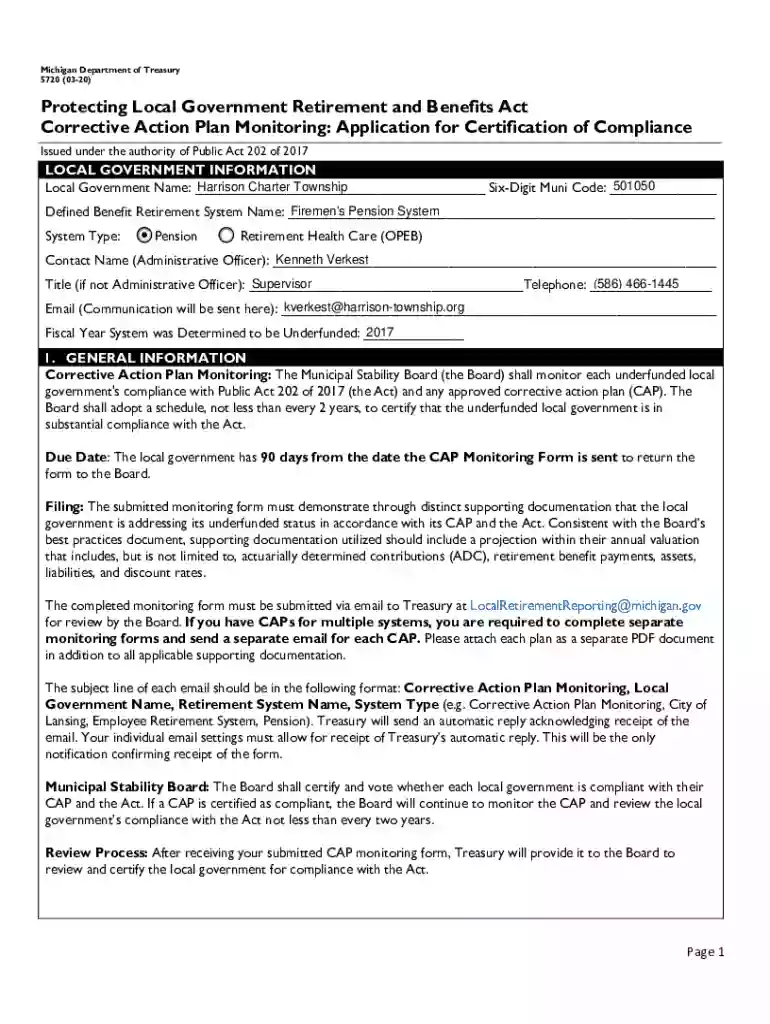
The Michigan Documents Treasury5597, related to the Protecting Local Government Retirement and Benefits Act, serves as a crucial instrument for ensuring that local government entities in Michigan adequately meet their retirement and benefits commitments. This document is central to monitoring compliance with state legislation aimed at preserving pension funds and other retirement benefits. It specifically targets underfunded pension plans, guiding municipalities in adopting corrective actions to address funding deficiencies and achieve sustainability certifications. By providing a structured framework, the form supports local governments in their strategic financial planning, enabling them to maintain fiscal health while securing future obligations to retirees.
When utilizing the Treasury5597 form, government entities follow a systematic approach to declare their compliance status and outline corrective action plans. The form requires a detailed account of the existing funding status of retirement systems, including actuarial valuations, current financial obligations, and any shortfalls. Local governments must articulate the measures they intend to implement to improve funding levels, ensuring these actions align with the Protecting Local Government Retirement and Benefits Act. Practical steps might include revising budget allocations, seeking additional revenue sources, or restructuring existing financial commitments – all documented within this form to guarantee transparency and accountability.
Completing the Treasury5597 form brings multiple advantages to municipalities. First and foremost, it facilitates the identification and resolution of underfunded pension statuses, mitigating long-term fiscal risks. By adhering to a standardized state mandate, local governments demonstrate their commitment to financial responsibility and the well-being of their retirees. Additionally, through this form, municipalities can receive guidance and resources from state authorities, aiding them in navigating complex financial frameworks. In practice, the structured approach of the form also promotes inter-departmental collaboration, essential for crafting a comprehensive strategy that encompasses diverse financial inputs and interests.
Gather Required Financial Data: Start by collating comprehensive financial records, including current pension fund valuations, projected obligations, and revenue sources.
Assess Funding Gaps: Identify any discrepancies between assets and liabilities, paying particular attention to actuarial reports that may indicate underfunding.
Develop Corrective Action Plans: Create a detailed strategy for addressing identified funding shortfalls. This should include steps such as reallocating budget resources, adjusting benefit structures, or initiating new funding streams.
Complete the Form: Enter all relevant data into the Treasury5597 form, ensuring accuracy and completeness. Provide detailed explanations for all corrective actions planned.
Review and Approve: Before submission, review the form for errors or omissions. Engage key stakeholders for approval to ensure the plan is viable and supported by leadership.
Submit to State Authorities: File the completed form with the appropriate Michigan state agencies, adhering to submission deadlines.
The primary users of the Michigan Documents Treasury5597 are financial officers and administrators within local government entities responsible for managing retirement and benefit plans. These may include townships, municipalities, counties, and other local administrative bodies obligated to fulfill retirement funding requirements. Additionally, external auditors, financial consultants, and legal advisors might interact with this document to ensure compliance and accuracy in reported financial information.


To properly complete and submit the Treasury5597 form, local governments should prepare:
Failure to comply with the requirements outlined in the Treasury5597 form can lead to several repercussions for local governments. Non-compliant entities may face increased scrutiny from state regulators, which could result in the imposition of financial audits or sanctions. Continued underfunding without a corrective plan might jeopardize future state funding opportunities and erode trust with constituents dependent on retirement benefits. More critically, unresolved funding gaps could ultimately impact the financial stability of the retirement system, leading to potential legal consequences.
In practice, a small township discovered through its actuarial valuations that its firemen's pension fund was underfunded by 20%. Using the Treasury5597, the township outlined a corrective action plan that included reducing non-essential expenditures to increase pension allocations, raising local taxes slightly to boost revenue, and initiating a phased reduction in ancillary programs to reallocate funds to the pension system. Over a two-year period, these actions restored the pension fund to an acceptable funding level as required by state standards.
We've got more versions of the michigan documents treasury5597, Protecting Local Government Retirement and - Michigan form. Select the right michigan documents treasury5597, Protecting Local Government Retirement and - Michigan version from the list and start editing it straight away!
| Versions | Form popularity | Fillable & printable |
|---|---|---|
| 2020 | 4.8 Satisfied (80 Votes) |
Managing your forms with DocHub this way is very easy once you have downloaded its extension for Google Chrome. Navigate to the Chrome Web Store and install DocHub - Sign PDF from Gmail to get it. Give our tool access to your Google account, and then open an email with the michigan documents treasury5597, Protecting Local Government Retirement and - Michigan attached and point to the file with your cursor - the DocHub extension key will automatically appear there. Click on it to open your document in our editor. Make any necessary edits, complete the blanks, and click Sign to create your legally-binding eSignature.
When you choose analog methods of completing your michigan documents treasury5597, Protecting Local Government Retirement and - Michigan, you can easily download your file for printing. Search DocHub’s Forms & Templates catalog to get the exact file template you need and open it for editing or download it on your gadget in the format of your liking. It is possible to complete your form electronically and put your handwritten signature on it right after printing or eSign your file with DocHub.
At DocHub, your data security is our priority. We follow HIPAA, SOC2, GDPR, and other standards, so you can work on your documents with confidence.


