




01. Edit your ncrf 31 form online
Type text, add images, blackout confidential details, add comments, highlights and more.

Type text, add images, blackout confidential details, add comments, highlights and more.

Draw your signature, type it, upload its image, or use your mobile device as a signature pad.

Send ncrf 31 via email, link, or fax. You can also download it, export it or print it out.
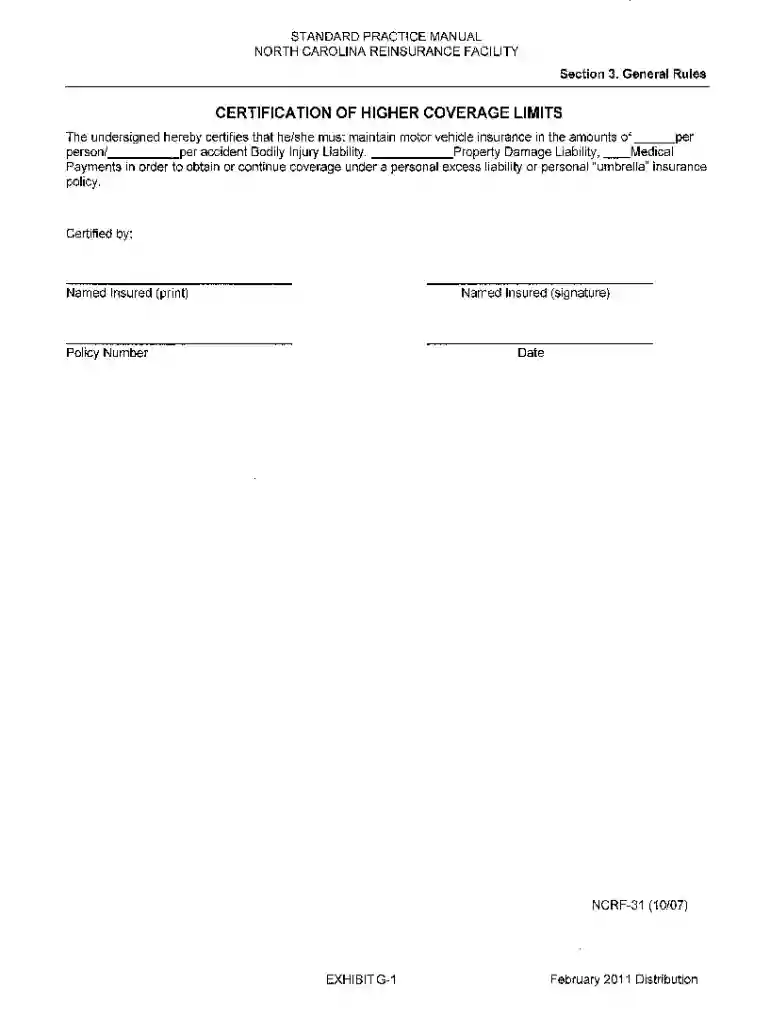
The NCRF-31 Certification of Higher Coverage Limits - NCRB is a specialized form used within the insurance sector, particularly relating to the North Carolina Reinsurance Facility (NCRF). This form serves the purpose of certifying higher coverage limits for insurance policies beyond the standard offerings. The certification is crucial for policyholders who require coverage exceeding typical insurance limits, providing an official document that attests to this need.
Using the NCRF-31 form involves a straightforward process, but understanding its correct application is essential for effectiveness.
Obtaining this certification requires contacting the appropriate insurance entities and following specific steps to ensure compliance with the NCRB.
Completing the form requires attention to detail to ensure all regulatory requirements are met.
The form is predominantly used by individuals and businesses requiring higher insurance coverage than standard policies provide.


Understanding the form's key components is essential for accurate completion and submission.
Legal compliance is integral to the effective use of the NCRF-31 form.
There are specific state-related rules and guidelines applicable exclusively within North Carolina.
We've got more versions of the ncrf 31 form form. Select the right ncrf 31 form version from the list and start editing it straight away!
You should use only reliable software solutions with strong security compliance to sign your paperwork electronically. DocHub is just the type of editor you need! It stores data on Amazon Web Servers and complies with all necessary security criteria and eSignature regulations, so it’s a reliable way to eSign your NCRF-31 Certification of Higher Coverage Limits - NCRB or other forms using this tool.
You can get and modify your NCRF-31 Certification of Higher Coverage Limits - NCRB online by using DocHub. Its simple but feature-rich design enables you to start effective work immediately after you register your account. Create your account and add your document, and then our user interface will guide you via our stress-free form completion experience.
At DocHub, your data security is our priority. We follow HIPAA, SOC2, GDPR, and other standards, so you can work on your documents with confidence.
Jul 1, 2025 Starting July 1, 2025, for all new or renewed policies on or after that date, the minimum limits for bodily injury will be increased to $50,000Read more
Sep 30, 2022 The amendments to law made upto 31st May of the Calendar Year for December Examinations and upto. 30th November of the previous Calendar YearRead more


