







Definition & Meaning
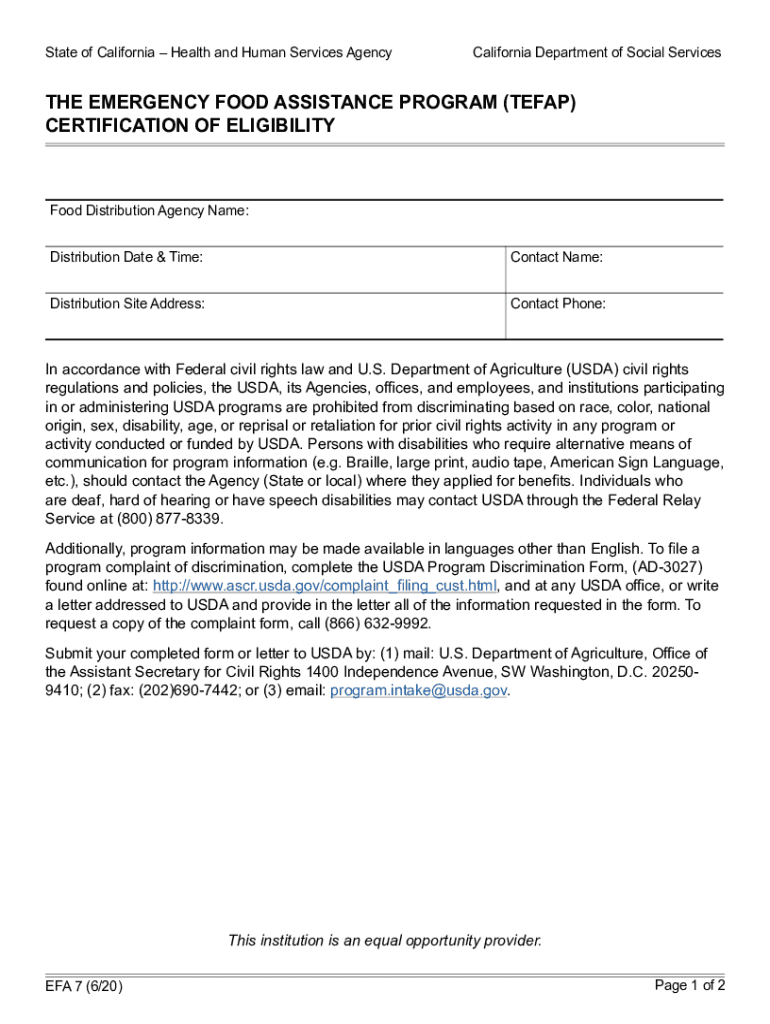
The EFA-7 (6 20) form, formally known as The Emergency Food Assistance Program (TEFAP) Certification of Eligibility EFA-7 (6 2), is a critical document used in the administration of TEFAP, which is primarily overseen by the California Department of Social Services in the United States. This form serves as a certification mechanism for applicants who wish to demonstrate their eligibility for receiving emergency food assistance. It aligns with federal and state guidelines ensuring that only those who meet the income and residency criteria benefit from this vital program.
How to Use the EFA-7 Form
To effectively utilize the EFA-7 form, applicants must understand its primary function of certifying eligibility for food assistance. Prospective recipients should complete the form by providing accurate personal information, including household details and income levels. It's essential for applicants to meticulously fill out each section to avoid delays in processing. Upon completion, the form should be submitted to the designated local agency responsible for TEFAP distribution. This process aims to maintain a smooth and efficient experience for those seeking support through the program.
Steps to Complete the EFA-7 Form
-
Gather Required Information: Before filling out the form, collect necessary details such as household income, number of dependents, and any relevant identification.
-
Fill Out Personal Details: Enter all personal data including name, address, and contact information.
-
Declare Household Income: Accurately document all sources of income for household members, ensuring compliance with specified income limits.
-
Sign the Certification: Complete the self-declaration section with a signature, affirming that the information provided is true.
-
Submit the Form: Send the completed form to your local TEFAP agency, either by mail, in person, or through designated online portals if available.
The emphasis on accuracy and completeness can greatly expedite the application process and ensure timely delivery of food assistance to eligible individuals.
Key Elements of the EFA-7 Form
The EFA-7 form encompasses several key elements fundamental to processing eligibility for TEFAP:
- Applicant Information: Details concerning the personal identity of the applicant.
- Household Composition: Information related to the size and makeup of the household.
- Income Verification: Fields that require detailed income disclosures from the past months.
- Self-Declaration Section: A crucial part where the applicant confirms the accuracy of their information.
- Non-Discrimination Policy Acknowledgment: Although not directly part of the eligibility, applicants must acknowledge understanding of the program’s non-discrimination policies.
These components collectively facilitate a comprehensive evaluation of each applicant’s need for assistance.
Eligibility Criteria
Eligibility for TEFAP via the EFA-7 form hinges on several critical criteria:
-
Income Limitations: Households must demonstrate income levels at or below a certain threshold, typically set by federal guidelines.
-
Residency: Proof of residency within the state or region where the application is made is required.
-
Household Size: The number of individuals living in the household affects eligibility, as it relates to income thresholds.
By meeting these eligibility criteria, applicants solidify their position to receive food assistance, helping to alleviate food insecurity.


Form Submission Methods
Applicants have multiple options when it comes to submitting the EFA-7 form:
-
Online Submission: Many local agencies offer digital submission to streamline processing; applicants should check if this option is available in their area.
-
Mail: Traditional submission via postal service is another viable method, ensuring that all pages and required documentation are included.
-
In-Person: For those who prefer personal interaction or need assistance, forms can be submitted directly to agency offices.
Selecting the most convenient method of submission ensures quick commencement of the eligibility review process.
Required Documents
Forms cannot be completed in isolation, and applicants should gather supporting documents such as:
-
Proof of Income: Documents such as pay stubs or benefit statements that confirm household income.
-
Identification: Official photo identification to verify identity and residency.
-
Proof of Residency: Documents like utility bills that confirm residency.
Having these documents on hand simplifies the form completion process and expedites verification by program administrators.
State-Specific Rules
While the EFA-7 form is used within the framework of federal guidelines, state-specific rules can affect its application:
-
Income Thresholds: Income requirements may vary slightly depending on state-specific cost of living adjustments.
-
Program Administration: Each state has its administrative processes influencing how quickly applications are processed.
-
Supplementary Assistance Programs: Some states may offer additional food assistance programs for which the EFA-7 form can initiate eligibility evaluation.
Understanding these nuances helps applicants effectively navigate the process in their respective regions.
Legal Use of the EFA-7 Form
Legally, the EFA-7 form is a binding document used to declare eligibility under TEFAP. Applicants must provide truthful and accurate information; any discrepancies can lead to legal challenges or disqualification. The form abides by non-discrimination laws, ensuring equal access to assistance regardless of race, gender, or disability. Familiarity with these legal provisions reinforces the importance of complying with all requirements during the application process.




