The illinois tax 2026

Get Form
illinois state income tax Preview on Page 1

Here's how it works

01. Edit your illinois state income tax online
Type text, add images, blackout confidential details, add comments, highlights and more.

02. Sign it in a few clicks
Draw your signature, type it, upload its image, or use your mobile device as a signature pad.

03. Share your form with others
Send 2022 form il 1040 instructions via email, link, or fax. You can also download it, export it or print it out.

Definition and Purpose of the Illinois Tax

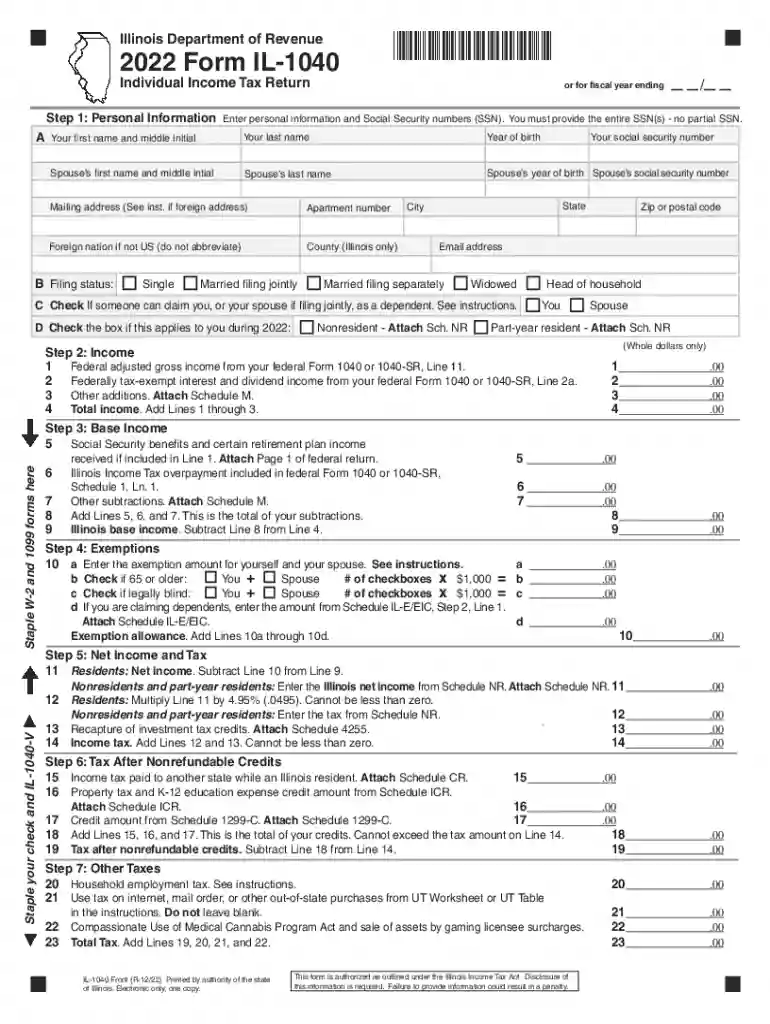
The Illinois tax, formally known as the Form IL-1040, is the official document used by residents of Illinois to file their state individual income tax returns. This form is essential for taxpayers to report their annual income, claim exemptions and deductions, calculate tax liabilities, and determine any refund or amount owed to the state. It includes detailed sections for personal information, income details, tax credits, and more. The form also provides guidance on selecting the correct filing status, understanding certain tax credits, and accurate income reporting.

Key Components of Form IL-1040

Form IL-1040 consists of multiple parts designed to capture various financial aspects of a taxpayer's life. Essential components include:

  • Personal Information: Basic details such as name, Social Security Number, and address.
  • Income Reporting: Sections to report wages, salaries, tips, interest, dividends, and other forms of income.
  • Exemptions and Deductions: Information on personal exemptions and available standard or itemized deductions.
  • Tax Liability: Calculations to determine the tax owed based on reported income and applicable credits.
  • Payment and Refund Options: Opportunities to apply tax overpayments to the following year or request direct deposit for refunds.

Each section requires careful attention to detail, ensuring that all entered information aligns with federal returns and other documentation.

How to Obtain the Illinois Tax Form

Taxpayers can acquire the Illinois tax form, IL-1040, through various platforms to facilitate easy access and filing. The state makes these forms available in a few primary ways:

  • Online Resources: Download from the official Illinois Department of Revenue (IDOR) website. PDF formats are typically accessible for printing or electronic completion.
  • Local Tax Offices: Pick up physical copies at Illinois tax service offices.
  • Library and Community Centers: Some public libraries and local government facilities may distribute forms during tax season.

Availability online ensures the widest access, allowing individuals to prepare and file their taxes promptly.

Steps to Complete the Illinois Tax Form

Properly completing Form IL-1040 is crucial. Here’s a step-by-step guide to navigating this tax return effectively:

  1. Gather Required Documents: Collect W-2s, 1099s, previous year’s tax return, and any other income or deduction documentation.
  2. Fill Out Personal Information: Ensure name, Social Security Number, and filing status are correctly entered.
  3. Report All Income: Accurately record wages, self-employment earnings, interest income, dividends, and other relevant incomes.
  4. Determine Exemptions: Identify any applicable exemptions and enter these amounts.
  5. Calculate Tax Liability: Use schedules to determine the base tax amount, considering deductions and credits.
  6. Choose Payment or Refund Option: Decide on whether to carry forward any tax overpayment or request a refund.
  7. Review and Verify: Double-check for accuracy before submission, ensuring all figures are correct and documentation is complete.

Taxpayers can also utilize professional tax software or services for assistance with complex returns or unique tax situations.

Important Terms Related to Illinois Tax

Understanding specific tax terms is essential for correctly completing and understanding Form IL-1040:

  • Adjusted Gross Income (AGI): Your total income minus specific deductions, essential for determining tax liability.
  • Credit: A dollar-for-dollar reduction in tax liability, including credits for income tax withheld and various qualified expenses.
  • Deduction: An amount subtracted from gross income to determine taxable income.
  • Withholding: The amount of income tax your employer withholds from your pay and pays to the government.

These terms form the foundation of tax calculations and can significantly affect the final tax bill or refund.

State-Specific Rules for the Illinois Tax

Illinois tax rules can differ from federal regulations and understanding these nuances protects taxpayers from errors:

  • Filing Threshold: Illinois residents must file a return when income meets or exceeds specific state-set thresholds.
  • Exemption Amount: The state provides specific exemption values differing from federal deductions.
  • Property Tax Credit: Illinois offers a property tax credit for residents who pay qualifying property taxes.

State-specific regulations require attention as they impact overall tax outcomes, ensuring compliance with state mandates.

Examples of Using the Illinois Tax Form

Several scenarios highlight the variety in completing an IL-1040 form:

  • Self-employed Individuals: Must report comprehensive income, including business revenues and expenses meticulously.
  • Retirees: Take into account pensions and Social Security, with specific credits or deductions applicable to their situation.
  • Students: Consider educational credits and part-time job income, ensuring accurate tuition reporting.

Each scenario demands tailored attention to detail, reflecting differing income streams and applicable credits or exemptions.

Filing Deadlines and Important Dates

Meeting critical deadlines is vital for Illinois tax compliance:

  • Annual Filing Deadline: Generally April 15th, matching the federal tax filing deadline unless holidays or weekends extend this date.
  • Extension Requests: Taxpayers can file for an extension if unable to meet the deadline, typically granting additional time to file but not to pay taxes owed.
  • Estimated Tax Payments: Required quarterly for individuals with substantial income not subject to withholding.

Timely filing and payments prevent penalties and ensure legal compliance.

Types of Taxpayer Scenarios

Various taxpayer scenarios require different completion tactics for the Illinois tax form:

  • High-income Earners: Must navigate multiple income sources, higher brackets, and phased-out deductions.
  • Businesses and Partnerships: Involve complexities associated with business income and deductions.
  • Low-income Individuals: May qualify for state tax relief programs and credits enhancing refunds or reducing tax liability.

Understanding these scenarios ensures each taxpayer finds the most effective strategies for filing their state taxes.


decoration image ratings of Dochub

See more the illinois tax versions

We've got more versions of the the illinois tax form. Select the right the illinois tax version from the list and start editing it straight away!
Versions Form popularity Fillable & printable
2023 4.8 Satisfied (28 Votes)
2022 4.8 Satisfied (197 Votes)
2021 4.8 Satisfied (197 Votes)
2020 4.3 Satisfied (202 Votes)
2019 4.3 Satisfied (216 Votes)
2018 4.2 Satisfied (112 Votes)
2017 4.4 Satisfied (293 Votes)
2016 4.4 Satisfied (113 Votes)
2016 4.4 Satisfied (609 Votes)
2014 4 Satisfied (36 Votes)
2013 4 Satisfied (34 Votes)
2011 4 Satisfied (39 Votes)
be ready to get more

Complete this form in 5 minutes or less

Get form

Got questions?

We have answers to the most popular questions from our customers. If you can't find an answer to your question, please contact us.
Contact us
Illinois has a flat 4.95 percent individual income tax rate. Illinois has a 9.5 percent corporate income tax rate. Illinois also has a 6.25 percent state sales tax rate and an average combined state and local sales tax rate of 8.86 percent.
The Chicago sales tax rate is 10.25%. This includes State 6.25%, County 1.75%, City 1.25% and Special 1%. Therefore, all Illinois orders are charged Chicagos sales tax rate.
Insufficient state income taxes lead to high taxes at the local level. Local governments must make up for inadequate state support for essential services, such as education, so people experience high sales and property taxesIllinois 2017 property taxes were second highest nationally.
What is the average salary in United States of America? If you make $100,000 a year living in the region of Illinois, United States of America, you will be taxed $27,368. That means that your net pay will be $72,632 per year, or $6,053 per month. Your average tax rate is 27.4% and your marginal tax rate is 36.2%.
Illinois has a flat income tax of 4.95%, which means everyones income in Illinois is taxed at the same rate by the state. No Illinois cities charge a local income tax on top of the state income tax, though. How many allowances should you claim? Most people claim 0-5 allowances, check W-4 rules for details.

Security and compliance

At DocHub, your data security is our priority. We follow HIPAA, SOC2, GDPR, and other standards, so you can work on your documents with confidence.

Learn more
ccpa2
pci-dss
gdpr-compliance
hipaa
soc-compliance
be ready to get more

Complete this form in 5 minutes or less

Get form

People also ask

Illinois sales tax overview The Illinois (IL) state sales tax rate is currently 6.25%. Depending on local municipalities, the total tax rate can be as high as 11%.
Total Tax Liability on $100,000 Federal income tax: Approximately $17,500 (before any credits or deductions) Illinois state tax: $4,950. Social Security tax: $6,200. Medicare tax: $1,450.

Related links