




01. Edit your form online
Type text, add images, blackout confidential details, add comments, highlights and more.

Type text, add images, blackout confidential details, add comments, highlights and more.

Draw your signature, type it, upload its image, or use your mobile device as a signature pad.

Send it via email, link, or fax. You can also download it, export it or print it out.
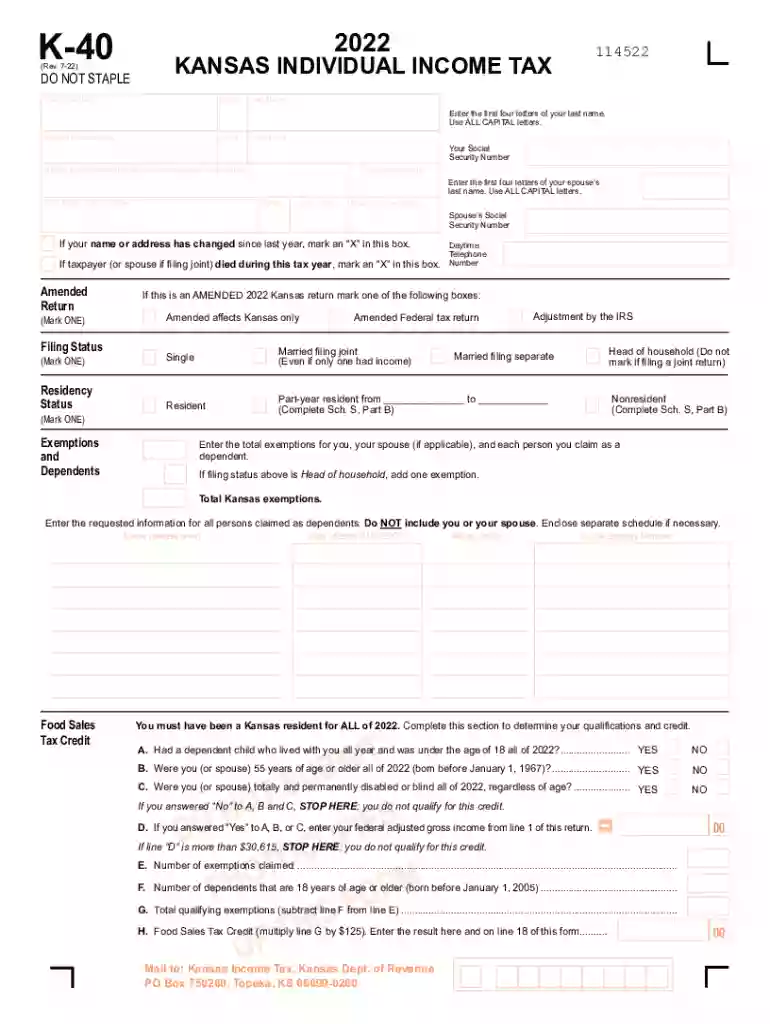
The K-40 Individual Income Tax Return is a tax form used by residents of Kansas to report their income, claim deductions and credits, and calculate their tax liability. This document is essential for anyone seeking to obtain a refund of taxes withheld, regardless of the total income amount. The primary function of the form is to reconcile a taxpayer's fiscal responsibilities and receive any potential refunds due based on their financial activities within the state.
To obtain the K-40 Individual Income Tax Return, taxpayers have various options. The form is publicly accessible and can be downloaded or requested through several channels:
Filling out the K-40 Individual Income Tax Return involves several critical steps. Proper execution ensures compliance and accuracy in reporting income and tax liabilities.
Timely submission of the K-40 Form is imperative. There are multiple methods available to taxpayers to file their returns efficiently.
File the K-40 by April 15 annually to avoid penalties. If the deadline falls on a weekend or public holiday, it extends to the next business day.
Filing the K-40 form in accordance with legal guidelines ensures compliance with Kansas tax laws. This includes adhering to income reporting standards, accurate exemption claims, and timely submission.
The K-40 Form applies to a varied populace, reflecting diverse financial situations. Here are some typical scenarios and user applications:


Utilizing tax preparation software can streamline the completion and filing of the K-40 Form. This technology supports accuracy and efficiency.
Failure to properly file the K-40 Form can result in penalties. Kansas tax law enforces various consequences for deviations, such as late filing or inaccurate disclosures.
Although non-exhaustive, this comprehensive guide provides insight into handling the K-40 form, emphasizing regulatory compliance, accurate completion, and ensuring potential refund claims are met.
We've got more versions of the K-40 Individual Income Tax Return Rev. 7-22. You must file a Kansas individual income tax return to receive any refund of taxes withheld, regardless of the amount of total income. form. Select the right K-40 Individual Income Tax Return Rev. 7-22. You must file a Kansas individual income tax return to receive any refund of taxes withheld, regardless of the amount of total income. version from the list and start editing it straight away!
| Versions | Form popularity | Fillable & printable |
|---|---|---|
| 2023 | 4.2 Satisfied (60 Votes) | |
| 2022 | 4.5 Satisfied (51 Votes) | |
| 2021 | 4.8 Satisfied (30 Votes) | |
| 2020 | 4.4 Satisfied (91 Votes) | |
| 2019 | 4.4 Satisfied (201 Votes) | |
| 2018 | 4.3 Satisfied (59 Votes) | |
| 2015 | 4.1 Satisfied (52 Votes) | |
| 2014 | 4 Satisfied (51 Votes) | |
| 2013 | 4 Satisfied (51 Votes) | |
| 2012 | 4.2 Satisfied (53 Votes) | |
| 2011 | 4.3 Satisfied (40 Votes) | |
| 2003 | 4 Satisfied (20 Votes) |
At DocHub, your data security is our priority. We follow HIPAA, SOC2, GDPR, and other standards, so you can work on your documents with confidence.
The outline focuses primarily on topics of broad general interest income tax accounting rules, determination of gross income, allowable deductions,Read more
Tax Credit. You must have been a Kansas resident for ALL of 2022. Complete this section to determine your qualifications and credit. A. Had a dependent childRead more


