




01. Edit your 2022 form 8880 online
Type text, add images, blackout confidential details, add comments, highlights and more.

Type text, add images, blackout confidential details, add comments, highlights and more.

Draw your signature, type it, upload its image, or use your mobile device as a signature pad.

Send form 8880 2022 via email, link, or fax. You can also download it, export it or print it out.
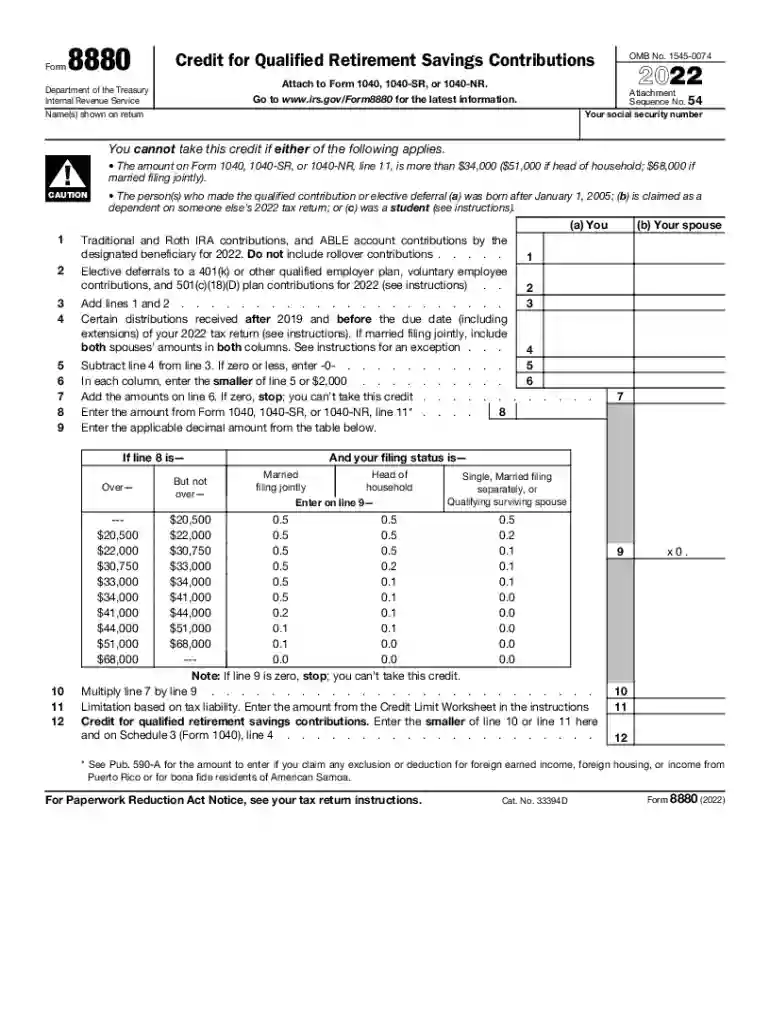
Form 8880, also known as the Credit for Qualified Retirement Savings Contributions, is designed to enable eligible taxpayers to claim the saver’s credit. This credit applies to individuals who have made contributions to qualified retirement plans, such as a 401(k) or IRA, within the tax year. The purpose of the saver’s credit is to incentivize middle- and lower-income households to save for retirement by offering a nonrefundable tax credit. The form outlines various criteria that taxpayers must meet, including income limits and age restrictions, ensuring that only those who truly benefit from it are able to claim the credit.
To qualify for the saver’s credit via Form 8880, taxpayers must meet specific eligibility requirements:


Form 8880 can be sourced through several methods:
Completing Form 8880 involves several key steps:
Several aspects are critical when completing Form 8880:
Several real-world examples illustrate who might use Form 8880 effectively:
The completed Form 8880 can be submitted through:
We've got more versions of the 2022 form 8880 form. Select the right 2022 form 8880 version from the list and start editing it straight away!
| Versions | Form popularity | Fillable & printable |
|---|---|---|
| 2025 | 4.3 Satisfied (21 Votes) | |
| 2024 | 4.7 Satisfied (27 Votes) | |
| 2023 | 4.2 Satisfied (22 Votes) | |
| 2022 | 4.5 Satisfied (32 Votes) | |
| 2021 | 4.8 Satisfied (105 Votes) | |
| 2020 | 4.2 Satisfied (62 Votes) | |
| 2019 | 4.2 Satisfied (132 Votes) | |
| 2018 | 4.2 Satisfied (154 Votes) | |
| 2017 | 4.2 Satisfied (108 Votes) | |
| 2016 | 4.3 Satisfied (189 Votes) | |
| 2015 | 4.3 Satisfied (40 Votes) | |
| 2013 | 4 Satisfied (46 Votes) | |
| 2003 | 4.3 Satisfied (36 Votes) |
At DocHub, your data security is our priority. We follow HIPAA, SOC2, GDPR, and other standards, so you can work on your documents with confidence.


