




01. Edit your form online
Type text, add images, blackout confidential details, add comments, highlights and more.

Type text, add images, blackout confidential details, add comments, highlights and more.

Draw your signature, type it, upload its image, or use your mobile device as a signature pad.

Send it via email, link, or fax. You can also download it, export it or print it out.
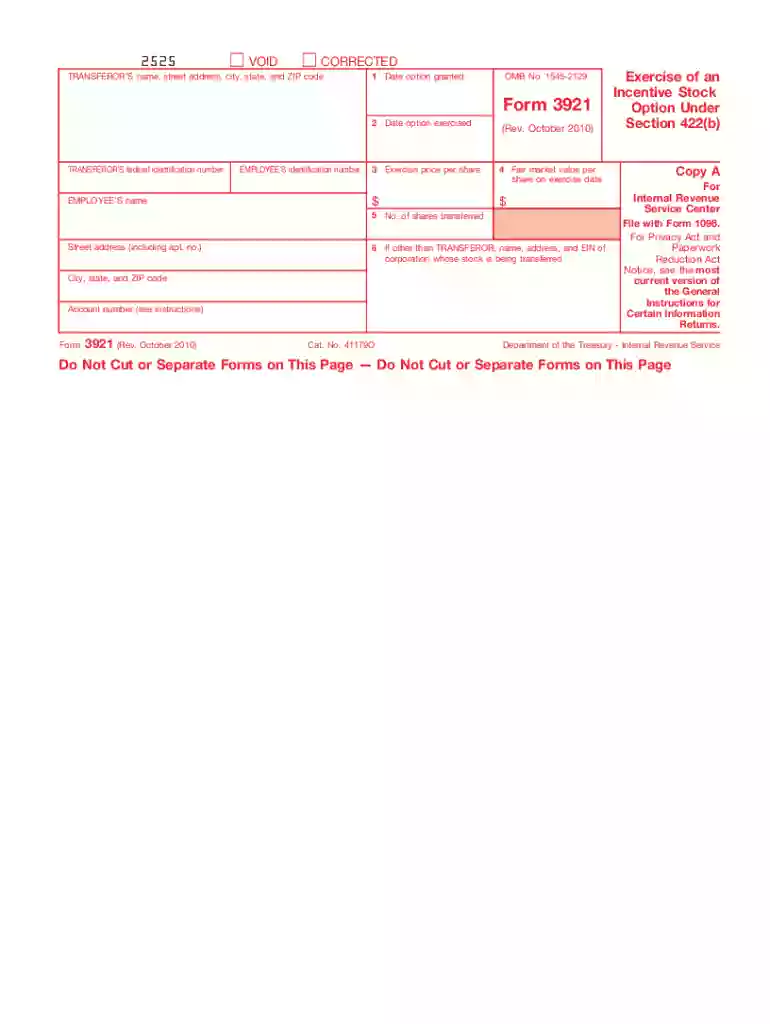
Form 3 is used to report the exercise of an Incentive Stock Option (ISO) granted under Internal Revenue Code Section 422(b). When an employee exercises an ISO, this tax form is necessary to detail specific information regarding the transaction. The form includes critical details such as the date the stock option was granted, the date it was exercised, the fair market value at exercise, and the exercise price. It's essential for the accurate reporting of capital gains or losses upon the eventual sale of the stock.
To use Form 3 effectively, both the issuer of the stock option and the recipient need to understand its requirements. The issuer must complete the form after an employee exercises an ISO and provide a copy to the employee and the IRS. Users should verify all details meticulously to ensure the correct reporting of taxable events. This process includes double-checking dates, exercise price, and other numerical inputs. Employees receiving the form must use the information to help prepare their tax returns, particularly when selling shares and calculating potential capital gains.
Gather Information: Obtain all necessary details related to the stock option, including grant date, exercise date, and fair market value at exercise.
Fill Out Recipient Information: Enter the recipient’s name, address, and taxpayer identification number.
Complete the Option Details: Include the number of shares transferred, dates relevant to the transaction, exercise price per share, and the per-share fair market value on the exercise date.
Review and Validate Entries: Carefully review each section for accuracy. Errors in dates or values could lead to incorrect tax reporting.
Distribute Copies: Provide a copy to the employee who exercised the option, and file another copy with the IRS.
The issuer must issue Form 3921 to the IRS and the employee by February 28 if filing on paper or by March 31 if filing electronically, for exercises that occurred in the previous calendar year. Filing after these deadlines may result in penalties. The deadline specifics are critical as they synchronize with broader IRS tax filing timelines and ensure that employees have adequate information for timely personal tax filing.
Before completing Form 3921, ensure you have the following documents:
These documents are essential for validating the entries on Form 3921 and ensuring compliance with IRS regulations.
Failure to accurately file Form 3921 can result in substantial penalties. These can vary based on the lateness and scale of the error. For small businesses, penalties may start at $50 per form for minor delays but can reach significant amounts as timelines extend. The IRS imposes heavier penalties for intentional or fraudulent non-compliance. It is important for businesses to adhere strictly to deadlines and accuracy requirements.
Form 3 is legally required under the U.S. tax code for companies that offer ISOs to employees. Its completion ensures tax compliance and aids both the IRS and taxpayers in monitoring potential gains from such stock options. It serves a critical tax reporting function, enabling the IRS to track both the granting and exercising of ISOs, which might have tax consequences for both parties involved.
Consider an employee, John, who was granted an ISO to purchase 1,000 shares at $10 per share. In 2010, when the market price was $15, John exercised his right to purchase the shares. Form 3921 was used to document this transaction, listing crucial details such as the grant and exercise dates, and the fair market and exercise prices. John will use these details to calculate potential capital gains when he decides to sell the shares. This highlights the form's value in preemptively establishing transparency and accuracy for both corporate and individual tax accounting purposes.
We've got more versions of the form 3921 2010 form. Select the right form 3921 2010 version from the list and start editing it straight away!
At DocHub, your data security is our priority. We follow HIPAA, SOC2, GDPR, and other standards, so you can work on your documents with confidence.
You have received this form because your employer (or transfer agent) transferred your employers stock to you pursuant to your exercise of an incentive stock.Read more
May 2, 2017 Do not use these forms to report wages subject to U.S. income tax withholding. Instead, use Form W-2 to show U.S. income tax withheld. TreatmentRead more
(2) Each statement required by this paragraph (a) to be furnished to any person must be furnished to such person on Form 3921, Exercise of an Incentive StockRead more


