
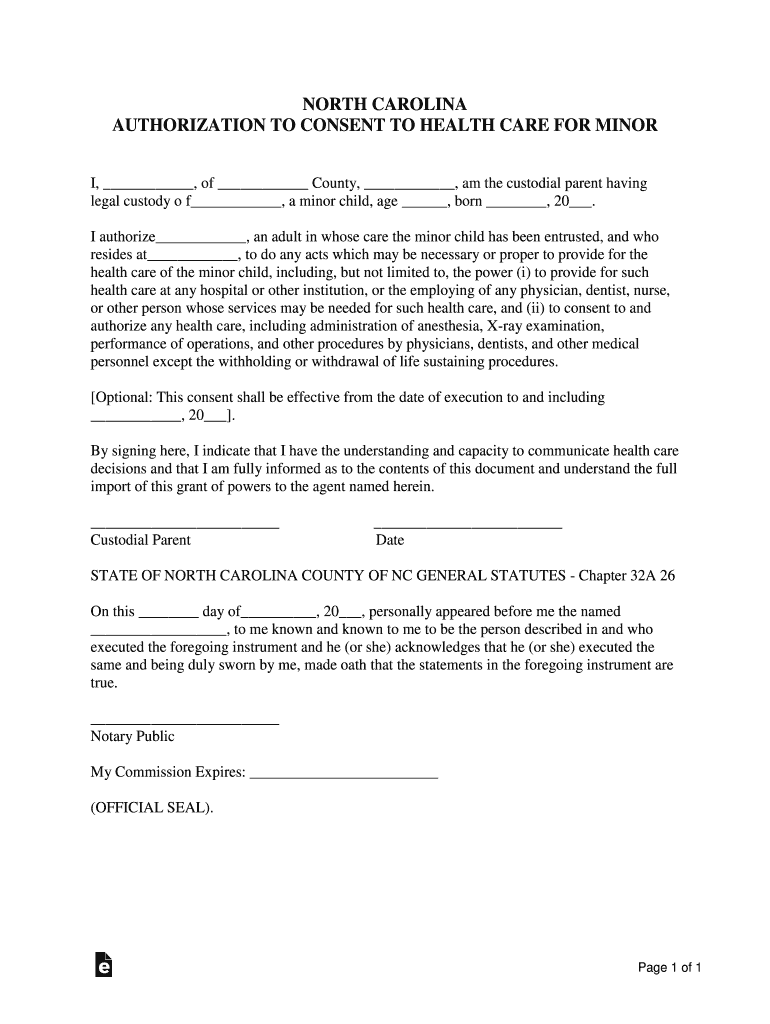







Definition and Meaning
The North Carolina Minor Child Power of Attorney Form is a legal document designed to grant a designated adult caregiver the authority to make health care decisions on behalf of a minor child. This form is essential when a parent or legal guardian needs to ensure that their child’s medical care can continue seamlessly in their absence. It empowers the caregiver to consent to necessary medical procedures, excluding decisions to withdraw life-sustaining treatment.
Key Features
- Authority Delegation: Specifies the caregiver's authority to make crucial medical decisions.
- Scope and Limitations: Clearly outlines what decisions are permissible, barring certain critical actions like life support withdrawal.
- Temporary Arrangement: Typically used for temporary delegation during instances such as parental travel.
How to Use the North Carolina Minor Child Power of Attorney Form
Understanding how to correctly use this form is crucial for ensuring its legality and functionality. The form's primary purpose is to temporarily transfer decision-making power for medical matters.
Process Overview
- Identify Caregiver: Parents must clearly identify the trusted adult who will be authorized.
- Detail Child Information: Include all relevant details about the child, such as full name and birth date.
- Notarization: Ensure the form is notarized to validate the transfer of authority legally.
- Information Sharing: Share a copy with the child's physician to ensure they're aware of the assigned authority.
Practical Example
Consider a parent taking an extended job assignment overseas. They would use this form to assign a nearby relative the ability to manage any health care needs for their child in their stead.
How to Obtain the North Carolina Minor Child Power of Attorney Form
Acquiring this form is a straightforward process when needing to delegate authority legally.
Steps to Obtain
- Online Access: The form can be downloaded from legal resource websites or the local government portal.
- Legal Assistance: Consult a family law attorney to ensure that the form meets all legal requirements specific to your needs.
- Government Offices: Visit local family services offices which might provide physical copies.
Steps to Complete the North Carolina Minor Child Power of Attorney Form
Filling out this form accurately is vital for ensuring it serves its intended purpose without legal issues.
Completion Steps
- Fill Out Participant Details: Include details about both the parent(s) and the appointed caregiver.
- Define Health Care Authority: Specify the extent and limitations of the caregiver's decision-making power.
- Execute the Document: Have all parties involved sign the document in the presence of a notary public.
- Final Review: Verify all information is accurate and complete before finalizing with a notary.
Key Elements of the North Carolina Minor Child Power of Attorney Form
This form has several critical elements that must be understood and completed correctly.
Essential Components
- Personal Information: The names and details of the child, parent(s), and caregiver.
- Health Care Instructions: Detailed descriptions of authorized health decisions and any limits.
- Signatures and Notary: Legal signatures from all parties and certification by a notary public.
State-Specific Rules for the North Carolina Minor Child Power of Attorney Form
The legal framework in North Carolina has specific requirements that ensure the form's enforceability.
Local Guidelines
- Duration Limits: The form is typically effective for a limited period, often six months, unless otherwise specified by state law.
- Specific Language: Ensure that the wording adheres to North Carolina statutes to prevent disputes or legal challenges.
- Notarization Requirement: Regardless of the form’s content, notarization is mandatory to affirm its validity.
Important Terms Related to the North Carolina Minor Child Power of Attorney Form
Understanding the terminology associated with this form is critical for parents and caregivers.
Definitions and Examples
- Custodial Parent: The parent with whom the child legally resides and who possesses primary decision-making authority.
- Health Care Decisions: Includes routine medical checkups, emergency treatments, and non-emergency procedures as specified by the form.
Examples of Using the North Carolina Minor Child Power of Attorney Form
Practical scenarios help illustrate how this form can be applied effectively.
Typical Use Cases
- Medical Emergencies: A caregiver uses the form to authorize emergency treatment while the parent is unreachable due to travel.
- Routine Health Appointments: Assigning a trusted adult to take the child to regular medical checkups and vaccinations in the parent's absence.




