




01. Edit your illinois schedule nr online
Type text, add images, blackout confidential details, add comments, highlights and more.

Type text, add images, blackout confidential details, add comments, highlights and more.

Draw your signature, type it, upload its image, or use your mobile device as a signature pad.

Send schedule nr illinois via email, link, or fax. You can also download it, export it or print it out.
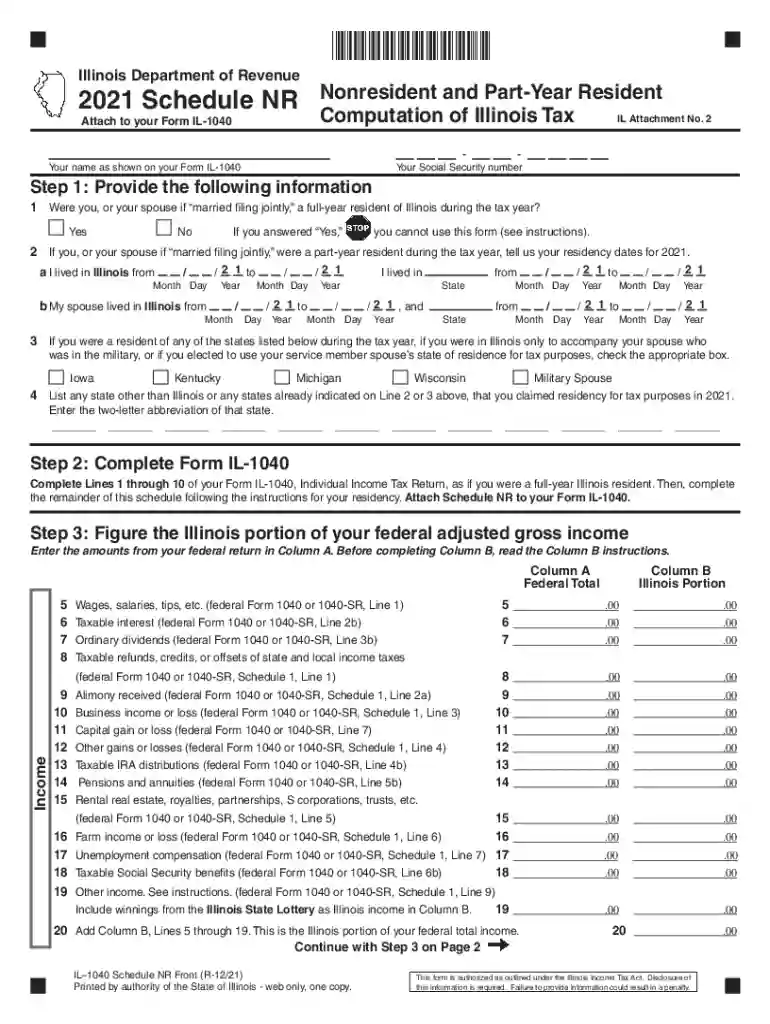
Schedule NR is a tax form utilized by nonresidents and part-year residents to determine their Illinois state tax obligations. It specifically calculates the Illinois portion of the federal adjusted gross income. This form differentiates between income earned within the state and elsewhere, enabling taxpayers to accurately declare what should be taxed by Illinois authorities. It plays a crucial role for individuals who have financial ties to Illinois but do not reside within the state for the entire tax year.
Illinois Schedule NR can be downloaded from the Illinois Department of Revenue’s official website. It is readily available for taxpayers who need to report income sourced from Illinois. For those using tax preparation software like TurboTax or QuickBooks, Schedule NR is typically included and integrated into the suite of supported forms. Taxpayers can also request a physical copy from the Illinois Department of Revenue, or visit a local IRS office to obtain one in person.
Completing Schedule NR involves several steps to ensure accurate reporting:
Several critical components form the backbone of Schedule NR:
Understanding these elements is vital in completing the form accurately and effectively.
Familiarity with particular terms is indispensable when dealing with Schedule NR:
These terms facilitate easier navigation through the nuances of the form and its instructions.
Situational examples illustrate the application of Schedule NR:
These examples highlight the scenarios where Schedule NR is applicable and necessary.
Schedule NR must be filled out correctly to ensure compliance with Illinois tax laws. Legal implications include understanding residency definitions and ensuring only Illinois-source income is taxed. Incorrect filing might lead to audits, fines, or adjustments. Nonresidents should consult with tax professionals if there are uncertainties regarding income sources or state residency laws.
The typical deadline to submit Schedule NR coincides with the federal tax filing deadline, usually April 15. Taxpayers should submit it alongside their main Illinois filing. Extensions are possible but do not extend the payment deadline. Late filings can incur penalties and interest, making adherence to deadlines essential.
Separate from federal submissions, taxpayers must ensure that submissions meet Illinois state deadlines to avoid complications or potential penalties. Accurate and timely filing helps maintain compliance with state tax regulations.
We've got more versions of the illinois schedule nr form. Select the right illinois schedule nr version from the list and start editing it straight away!
At DocHub, your data security is our priority. We follow HIPAA, SOC2, GDPR, and other standards, so you can work on your documents with confidence.
Complete Lines 1 through 10 of your Form IL-1040, Individual Income Tax Return, as if you were a full-year Illinois resident. Then, complete the remainder ofRead more
Entries on Schedule 1, Ln 8r will flow to line 8 of your Form 1040-NR. Federal tax withheld from box 7 should be reported on Form 1040-NR line 25g.Read more
Preparations are underway for the 95th General Meeting on May 9-12, 2027, in Honolulu, Hawaii. Continue reading. deadlinenewsthumb2. Deadline Approaching.Read more


