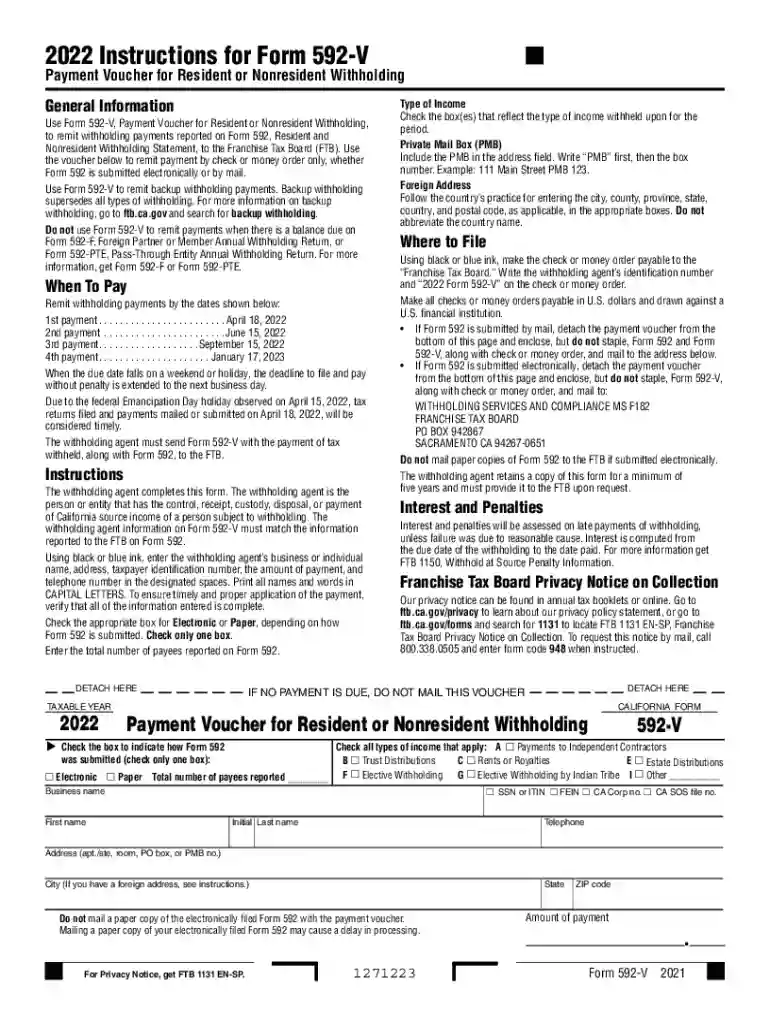
592 v form 2026

Get Form
592 v Preview on Page 1

Here's how it works

01. Edit your 592 v online
Type text, add images, blackout confidential details, add comments, highlights and more.

02. Sign it in a few clicks
Draw your signature, type it, upload its image, or use your mobile device as a signature pad.

03. Share your form with others
Send ca 592 q via email, link, or fax. You can also download it, export it or print it out.

Definition and Purpose of Form 592-V

Form 592-V, known as the Payment Voucher for Resident or Nonresident Withholding, serves a critical function in remitting withholding payments to the Franchise Tax Board (FTB) in California. It is utilized by entities required to withhold taxes on California source income paid to nonresidents. By using this form, payers accurately record and transmit the withheld taxes, ensuring compliance with state tax regulations.

  • Contextual Use: This form is specifically intended for cases where withholding is necessary, such as payments made to nonresident partners, members, shareholders, or beneficiaries.
  • Purpose: It ensures that the correct amount of withholding tax is collected and forwarded to the FTB, aligning with California tax obligations.

How to Use Form 592-V

Using Form 592-V effectively requires an understanding of when and how to complete and submit it. Here’s a step-by-step approach to using this form:

  1. Determine Necessity: Verify if the circumstances require you to withhold taxes from payments made to nonresidents or specific entities engaged in California business activities.
  2. Complete the Form: Accurately fill out the form using the details of the withholding agent and the payee. Include the withholding amount and any additional relevant information.
  3. Submission: The completed form should accompany the payment made to the FTB. It can be submitted electronically or via mail, depending on the preferred or required method.
  • Tip: Ensure all entries are correct to prevent processing delays or complications.

Steps to Complete Form 592-V

Accurately completing Form 592-V involves several detailed steps. Here's a structured guide:

Gathering Information

  • Identify Withholding Agent: Collect details about the withholding agent, including name, business address, and identification number.
  • Payee Information: Compile the payee’s details, ensuring accuracy in name, address, and tax identification number.

Completing the Form

  1. Enter Withholding Details: Specify the exact amount of withholding calculated from the payee’s income.
  2. Verify Accuracy: Double-check all entered information before proceeding to avoid corrections post-submission.
  3. Sign the Form: The withholding agent must sign the form to confirm the authenticity of the details provided.

Submission

  • Payment Method: Decide whether to make the payment electronically or by check. Each method may have specific requirements or advantages.
  • File Appropriately: Ensure the form and any accompanying payment are sent to the correct address or uploaded via official portals for electronic submissions.

Key Components of Form 592-V

Understanding the essential sections of Form 592-V is crucial for proper completion:

  • Identification Section: Captures both the withholding agent’s and payee’s critical identification details.

  • Withholding Amount Section: Documents the precise amount being remitted to the FTB as withholding tax.

  • Signature Section: Validates the form’s information and authorizes the withholding payment.

  • Attention Point: Inaccuracies in any of these sections can lead to filing errors, so meticulous attention to detail is necessary.

Legal Implications and Compliance

Form 592-V is not just a procedural document; it carries legal obligations:

  • Compliance: Failing to submit this form when required can lead to penalties, interest charges, and possible legal repercussions.
  • Verification: It serves as part of the state's audit trail for ensuring that nonresidents correctly comply with California's tax withholding requirements.

Penalties

  • Non-Compliance: Late or incorrect submissions might result in fines or interest payments, emphasizing the importance of timely and accurate filing.

State-Specific Guidelines

California's specific tax regulations govern the use of Form 592-V:

  • State Regulations: Reflects the state’s requirements for withholding on payments made to nonresidents, differing from federal tax practices.
  • Updates: Regulations and form requirements may change; thus, staying updated with the FTB’s notices is essential for ongoing compliance.

Filing Deadlines and Critical Dates

Timing is crucial when dealing with Form 592-V:

  • Filing Deadline: Typically, the form and payment are due by the 15th day of the fourth month following the end of the financial year or the tax period in question.
  • Extension: Extension requests or exceptions may apply under specific circumstances but require approval by the FTB.

Comparison: Digital vs. Paper Submission

Choosing between digital and paper submission methods depends on several factors:

  • Digital Submission: Often faster, more secure, and allows for instant acknowledgment of receipt by the FTB.

  • Paper Submission: Traditional method suitable for those preferring physical documentation but might lead to longer processing times.

  • Efficiency Tip: Evaluate your technological access and comfort level when deciding between submission methods.

Software and Integration Compatibility

Using software to manage Form 592-V submissions can streamline the process:

  • Compatibility: Check if tax preparation software like TurboTax or QuickBooks supports Form 592-V e-filing to simplify submissions.
  • Automation: Software often provides tools for calculating withholding amounts and ensuring correct form completion.

These blocks offer comprehensive insights and steps for managing Form 592-V effectively, catering to both new and experienced users navigating California's withholding tax obligations.

See more 592 v form versions

We've got more versions of the 592 v form form. Select the right 592 v form version from the list and start editing it straight away!
Versions Form popularity Fillable & printable
2023 4.5 Satisfied (45 Votes)
2022 4.8 Satisfied (175 Votes)
2021 4.4 Satisfied (206 Votes)
2020 4.4 Satisfied (219 Votes)
2019 4.4 Satisfied (105 Votes)
2018 4.1 Satisfied (35 Votes)
2017 4.4 Satisfied (534 Votes)
2016 4.4 Satisfied (39 Votes)
2015 4 Satisfied (28 Votes)
2014 4 Satisfied (50 Votes)
2013 3.9 Satisfied (28 Votes)
be ready to get more

Complete this form in 5 minutes or less

Get form

Got questions?

We have answers to the most popular questions from our customers. If you can't find an answer to your question, please contact us.
Contact us
Payment Voucher for Pass-Through Entity Withholding For taxable years beginning on or after January 1, 2020, a PTE must use Form 592-Q, Payment Voucher for Pass-Through Entity Withholding, to remit the withholding payments. For more information, get Form 592-Q.
Tax withheld on California source income is reported to the Franchise Tax Board (FTB) using Form 592. Form 592 includes a Schedule of Payees section, on Side 2, that requires the withholding agent to identify the payees, the income amounts, and the withholding amounts.
Who Certifies this Form. Form 590 is certified (completed and signed) by the payee. California residents or entities exempt from the withholding requirement should complete Form 590 and submit it to the withholding agent before payment is made.
Payment Voucher for Resident or Nonresident Withholding Use Form 592-V to remit backup withholding payments. Backup withholding supersedes all types of withholding. For more information on backup withholding, go to ftb.ca.gov and search for backup withholding.
Non-US individuals who receive certain types of income from US sourcessuch as interest, dividends, rents, royalties, and certain other types of incomeneed to fill out the W-8 BEN. The form is used to claim any applicable tax treaty benefits and to verify that the individual is not a US resident for tax purposes.

Security and compliance

At DocHub, your data security is our priority. We follow HIPAA, SOC2, GDPR, and other standards, so you can work on your documents with confidence.

Learn more
ccpa2
pci-dss
gdpr-compliance
hipaa
soc-compliance
be ready to get more

Complete this form in 5 minutes or less

Get form

People also ask

The state of California does collect personal income tax. If you live in California and/or earn income from a source in California, then you may need to file a California state income tax return.
Pass-through entities who withhold tax on behalf of nonresident owners or have been withheld upon are called withholding agents and are required to file Form 592-PTE on an annual basis to allocate withholding. PTE owners who have been withheld upon are called payees.

form 592 pte instructions