




01. Edit your 8865 instructions online
Type text, add images, blackout confidential details, add comments, highlights and more.

Type text, add images, blackout confidential details, add comments, highlights and more.

Draw your signature, type it, upload its image, or use your mobile device as a signature pad.

Send form 8865 instructions via email, link, or fax. You can also download it, export it or print it out.
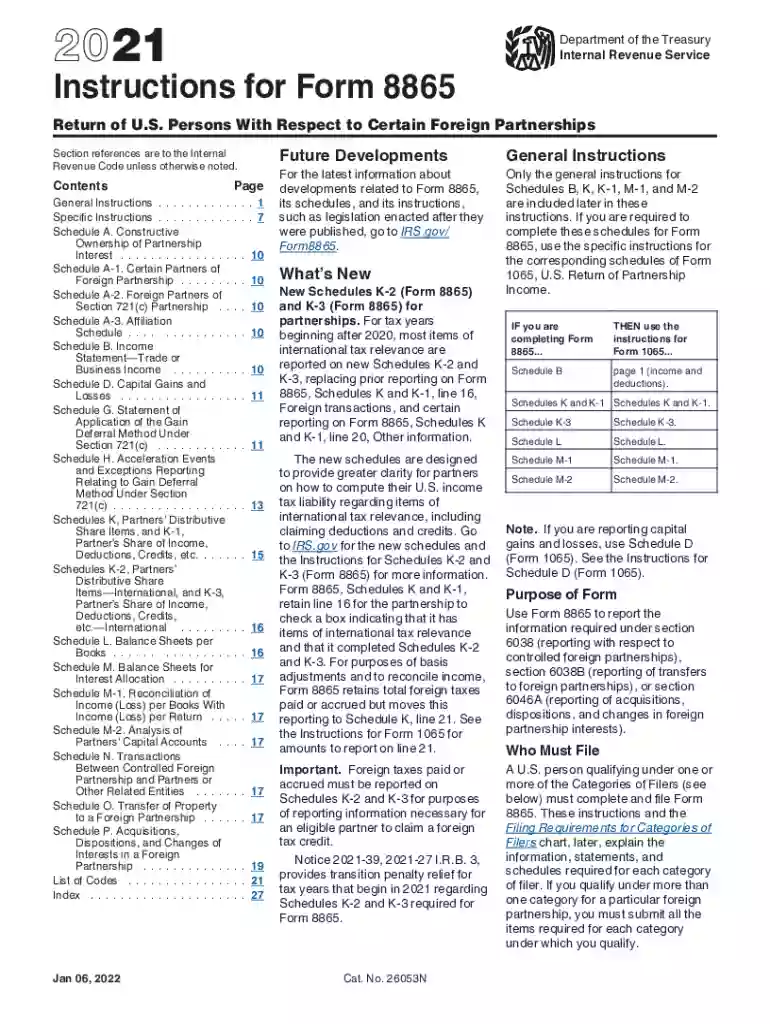
Form 8865 is utilized by U.S. persons who must report information about their interests in certain foreign partnerships. It is crucial for ensuring compliance with U.S. tax reporting requirements regarding international business engagements. The form serves multiple purposes, including reporting income gains, losses, and transactions specific to these foreign partnerships. By complying with Form 8865 instructions, taxpayers can accurately disclose their foreign affiliations to the IRS, thereby aligning with regulations on tax liabilities related to international activities.
To properly use Form 8865 instructions, it is essential to first identify your partnership category, as the form is divided into different sections based on the filer’s association with the foreign partnership. These categories dictate the schedules and details needed. Begin by gathering all required documents that detail income, financial interests, and transactions involving the foreign partnership. Following the form’s comprehensive instructions and guidelines, fill out each relevant schedule accurately. Double-check calculations and ensure that each section corresponds to the specific category applicable to your situation. Once completed, the form can be filed with your annual tax return.
Determine Filing Requirement: Identify if you have a filing requirement by evaluating your partnership interest size and activity level of the partnership.
Collect Necessary Information: Gather documents revealing the foreign partnership’s income statements, capital account, assets, liabilities, and any transactions involving the U.S. filer.
Select the Appropriate Category: Form 8865 encompasses four categories: Category 1 for U.S. persons with control, Category 2 for U.S. person ownership, Category 3 for U.S. persons transferring property, and Category 4 for certain dispositions or changes.
Complete Required Schedules: Depending on the category, complete schedules that may include Schedule O (transfer of property), Schedule P (acquisitions/dispositions), and Schedule K-1 (partner’s share of income, deductions, etc.).
Review for Accuracy: Ensure all information is correctly transcribed and calculations are precise. Pay attention to the change in foreign partnership liabilities or transactions affecting the U.S. tax liability.
Submit with Tax Return: File Form 8865 with your personal or business tax return by the applicable deadline.
Typically, U.S. persons who are partners in foreign partnerships utilize Form 8865. These include individuals or entities that meet ownership or transactional thresholds, such as controlling partners, those transferring property to partnerships, and partners involved in significant ownership changes. Corporations, partnerships, or individuals with at least 10% ownership interests in foreign partnerships often need to file. Business entities engaging in cross-border transactions or maintaining significant financial activities overseas must follow these instructions to ensure compliance.


Failure to file Form 8865 timely or inaccurately can result in significant penalties. This includes fines for each month the form is late, capped annually, which can become substantial for unaddressed obligations. The IRS may also assert penalties related to intent to evade tax or negligently overlooking reporting requirements. Moreover, unfiled forms lead to suspension of statute of limitation on assessment of any taxes associated with the foreign partnership information until the form is filed.
Form 8865 should be submitted with your tax return, typically April 15 for calendar year-end taxpayers. Seek extensions through Form 7004 for additional filing time if needed, aligning with extended individual, corporate, or trust tax deadlines. Staying informed about specific cut-off dates ensures timely compliance and avoidance of penalties tied to late filing.
Filers should submit Form 8865 electronically via IRS e-file systems, which are integrated with professional tax preparation software like TurboTax or QuickBooks. Electronic filing ensures faster processing and confirmation of receipt by the IRS. For those unable to file electronically, physically mailing the form along with your paper tax return is an option. Although less common, in-person submission can also be coordinated by visiting an IRS Service Center.
Form 8865 can be submitted digitally through approved tax software platforms, offering conveniences like automated error checks and faster processing. The digital version of the form accommodates real-time updates based on new IRS regulations, enhancing accuracy and compliance. Conversely, the paper version requires manual calculations and entries, creating opportunities for human error. However, it remains viable for taxpayers with complex filing situations requiring detailed explanations that digital forms may not accommodate seamlessly.
Proper filing involves compiling financial statements, transactional records, and evidence of foreign partnership interests. Essential documents include:
We've got more versions of the 8865 instructions form. Select the right 8865 instructions version from the list and start editing it straight away!
At DocHub, your data security is our priority. We follow HIPAA, SOC2, GDPR, and other standards, so you can work on your documents with confidence.
Mar 30, 2026 Instructions for filing Form 8865 and attaching Form 3800 and certain other forms for tax years beginning in 2023.Read more
See 55 FR 8865 (March 8, 1990) for a list of potential ways of providing an alternative water supply. (Appendix D). 8. See 40 CFR 300.430(a)(iii)(D) (TheRead more
Instructions for form 8865, return of U.S. persons with respect to certain foreign partnerships. United States. Internal Revenue Service. T 22.51:8865/INST./.Read more


