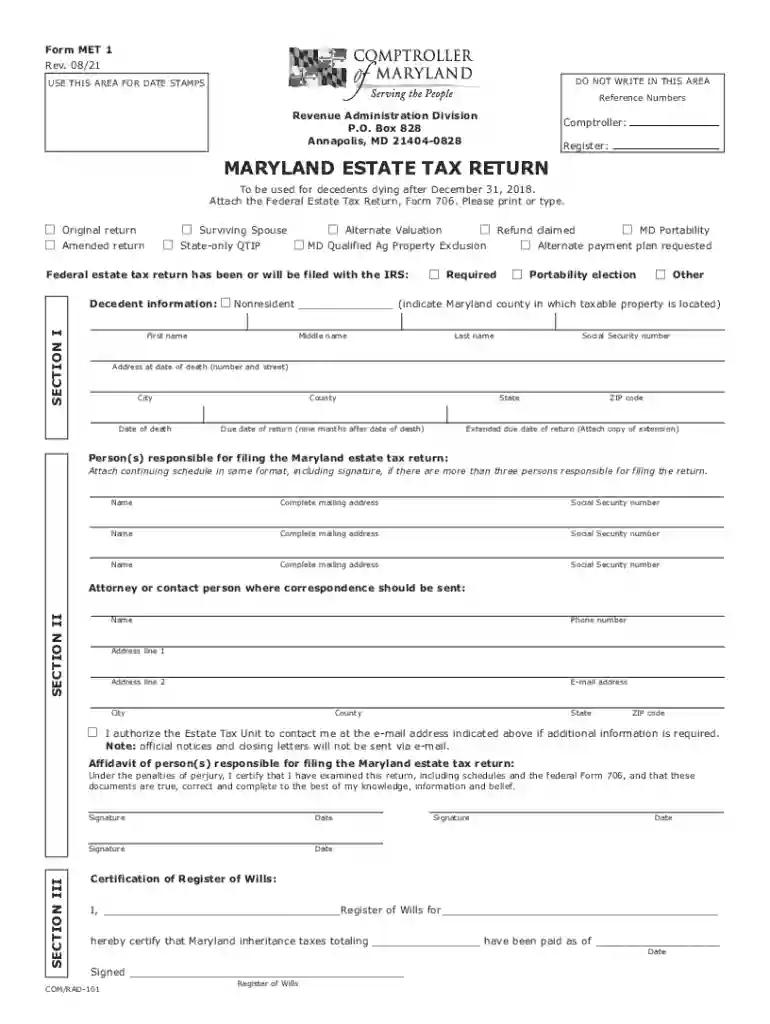
Maryland estate tax return 2026

Get Form
maryland estate tax return Preview on Page 1

Here's how it works

01. Edit your maryland estate tax return online
Type text, add images, blackout confidential details, add comments, highlights and more.

02. Sign it in a few clicks
Draw your signature, type it, upload its image, or use your mobile device as a signature pad.

03. Share your form with others
Send maryland met 1 via email, link, or fax. You can also download it, export it or print it out.

How to use or fill out Maryland Estate Tax Return with DocHub

Form edit decoration
9.5
Ease of Setup
DocHub User Ratings on G2
9.0
Ease of Use
DocHub User Ratings on G2
  1. Click ‘Get Form’ to open the Maryland Estate Tax Return (Form MET 1) in our platform's editor.
  2. Begin by indicating whether this is an original or amended return. Fill in details about the decedent, including their name, Social Security number, and address at the time of death.
  3. In Section II, provide information for the person(s) responsible for filing the return. Ensure all responsible parties sign and date the form.
  4. Complete Section III by certifying that all information provided is true and accurate. Each responsible party must sign and date this section.
  5. Move to Section IV to compute the Maryland estate tax. Follow the instructions carefully, entering values from your federal estate tax return (Form 706) as needed.
  6. Review all sections for accuracy before saving your completed form. Use our platform’s features to easily share or print your finalized document.

Start using our platform today to simplify your Maryland Estate Tax Return process for free!

See more maryland estate tax return versions

We've got more versions of the maryland estate tax return form. Select the right maryland estate tax return version from the list and start editing it straight away!
Versions Form popularity Fillable & printable
2023 4.6 Satisfied (35 Votes)
2021 4.8 Satisfied (86 Votes)
2020 4.3 Satisfied (148 Votes)
2019 4.3 Satisfied (101 Votes)
2018 4.4 Satisfied (202 Votes)
2012 4.2 Satisfied (56 Votes)
2002 4.2 Satisfied (51 Votes)
be ready to get more

Complete this form in 5 minutes or less

Get form

Got questions?

We have answers to the most popular questions from our customers. If you can't find an answer to your question, please contact us.
Contact us
Complete the federal estate tax return, Form 706, for the year of the decedents death, regardless of whether Form 706 is required to be filed with the Internal Revenue Service. Include the federal return, complete with all schedules, attachments and supporting documents when filing the Maryland estate tax return.
Its also possible for beneficiaries to owe tax if the estate generates more than $600 in gross income during administration, triggering an IRS filing requirement. In such instances, estates may pass that income to beneficiaries via Schedule K-1, which reports the amount each person must include on their tax return.
An estate tax return (Form 706) must be filed if the gross estate of the decedent (who is a U.S. citizen or resident), increased by the decedents adjusted taxable gifts and specific gift tax exemption, is valued at more than the filing threshold for the year of the decedents death, as shown in the table below.
A California Estate Tax Return, Form ET-1, is required to be filed with the State Controllers Office, whenever a federal estate tax return Form-706 is filed with the Internal Revenue Service (IRS).
The Maryland estate tax is a transfer tax imposed on the transfer of assets from an estate. It is based on the maximum credit for state death taxes allowable under 2011 of the ] Internal Revenue Code.

Security and compliance

At DocHub, your data security is our priority. We follow HIPAA, SOC2, GDPR, and other standards, so you can work on your documents with confidence.

Learn more
ccpa2
pci-dss
gdpr-compliance
hipaa
soc-compliance

People also ask

Do You Need to File a Maryland Estate Tax Return? If you die while a resident of Maryland, the personal representative or executor of your estate must file the Maryland estate tax return if your gross estate plus all taxable gifts you made in the year before your death add up to more than $5 million.
Non-probate estate: property that passes outside the probate estate, including, but not limited to jointly held assets, life estate or remainder interests in a trust or deed, trusts in which the decedent had an interest, payable on death (P.O.D.)
The estate tax return is due nine months after death, whether or not an extension to file is granted. Even if the estate is not required to file a federal estate tax return, you must complete a federal return and file it with the state return. Maryland has an estate tax and an inheritance tax.

met tax