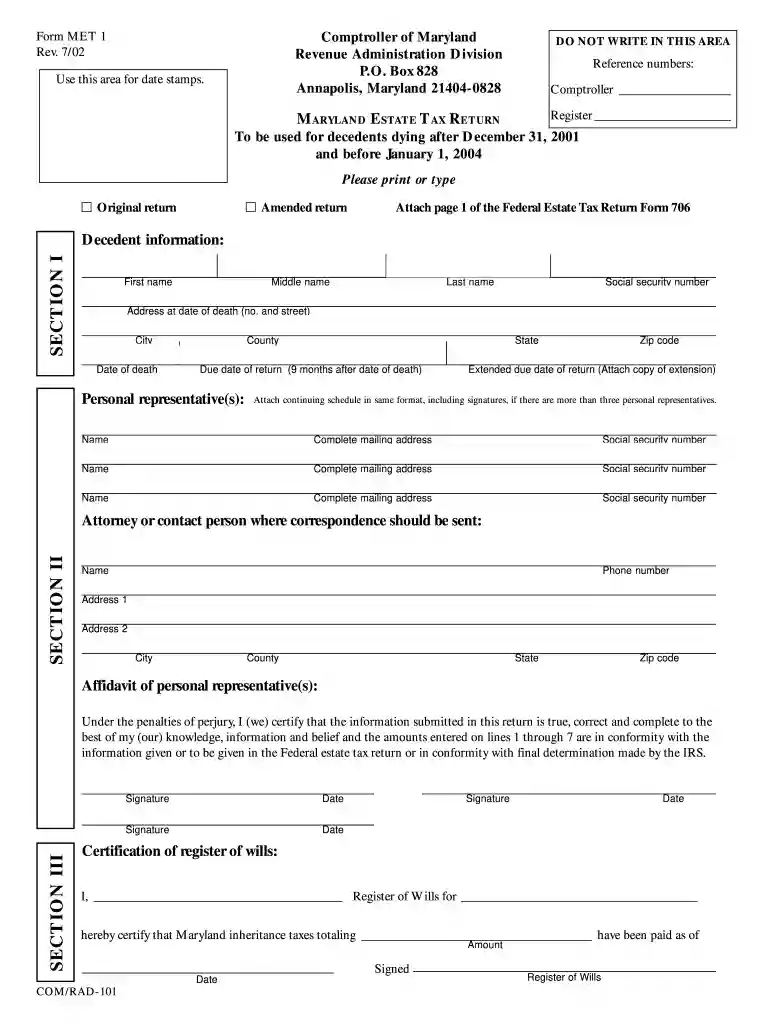
Maryland form met 1 2002-2026

Get Form
maryland form met 1 2002 Preview on Page 1

Here's how it works

01. Edit your form online
Type text, add images, blackout confidential details, add comments, highlights and more.

02. Sign it in a few clicks
Draw your signature, type it, upload its image, or use your mobile device as a signature pad.

03. Share your form with others
Send it via email, link, or fax. You can also download it, export it or print it out.

Definition & Meaning

The Maryland Estate Tax Return Form MET 1 is a critical document used for calculating the estate tax due on behalf of a decedent who passed away between December 31, 2001, and January 1, 2004. This form is specific to the state of Maryland and serves the purpose of ensuring that the estate of the deceased is properly assessed for tax purposes under Maryland law. It encompasses details like decedent information, personal representatives, and comprehensive instructions for tax computation.

Steps to Complete the Maryland Form MET 1 2002

  1. Personal Information and Identification:

    • Begin by filling in the decedent's details such as name, date of death, and social security number.
    • Provide information for personal representatives, including full name, address, and contact numbers.
  2. Computation of Maryland Estate Tax:

    • Use the worksheet provided to calculate the gross estate.
    • Deduct any applicable liabilities, debts, and administration expenses.
  3. Attachments and Supporting Documents:

    • Attach a copy of the Federal Estate Tax Return (Form 706).
    • Include any necessary schedules that contribute to calculating the estate tax.
  4. Signatures and Certification:

    • Certify and sign the form, ensuring all data is accurate.
    • Obtain signatures from all personal representatives and involved attorneys.

Who Typically Uses the Maryland Form MET 1 2002

This form is primarily used by personal representatives of the estate of a decedent, often working in conjunction with legal or tax professionals. Executors, estate attorneys, and individuals with power of attorney for the decedent's estate often complete this form. It’s especially relevant for estates where the total value exceeds the Maryland estate tax exemption threshold applicable for the decedent's year of death.


decoration image ratings of Dochub

Required Documents

  • Federal Estate Tax Return: A completed copy of Form 706 is mandatory.
  • Death Certificate: Provide a certified copy to authenticate the date of passing.
  • Financial Statements: Include balance sheets and valuations for the estate assets.
  • Legal Documents: Trust agreements and any pertinent legal decrees impacting estate distribution should accompany the form.

Filing Deadlines / Important Dates

  • The Maryland Form MET 1 must be filed within nine months following the decedent's date of death.
  • Extensions may be requested if more time is needed to compile necessary information, although late payment penalties may still apply if the tax is not paid by the original due date.

Penalties for Non-Compliance

Failure to submit the Maryland Form MET 1 or to pay the required estate tax on time could result in significant penalties. This includes fines, interest on overdue amounts, and other legal actions that Maryland state may enforce. Personal representatives may be held accountable if these obligations are neglected.

Legal Use of the Maryland Form MET 1 2002

Legally, the Form MET 1 is used to meet state-specific estate tax obligations and must be filled out accurately to reflect the decedent’s finances. It ensures compliance with Maryland tax law and verifies that all inheritance and estate distributions are correctly accounted for under state regulations.

State-Specific Rules for the Maryland Form MET 1 2002

Maryland’s estate tax regulations have specific differences compared to federal laws. The state mandates the inclusion of all assets situated in Maryland and those connected to the decedent, regardless of their location. The form also adjusts for any discrepancies in property valuations and exemptions that differ from federal guidelines.

Examples of Using the Maryland Form MET 1 2002

  • Scenario 1: An executor handling a large estate where the decedent owned numerous properties in Maryland must calculate taxes based on the gross value and attach schedules as proof.
  • Scenario 2: In a case where the decedent had numerous debts, the executor must correctly deduct these from the gross estate on Form MET 1, backed by documented evidence.

Who Issues the Form

The Maryland Comptroller's Office is responsible for issuing the Form MET 1, along with providing guidance on its completion and any estate-specific queries. They also offer resources and assistance related to the estate tax filing process.

Software Compatibility (TurboTax, QuickBooks, etc.)

While general estate management may utilize financial software like TurboTax or QuickBooks for record-keeping, the Maryland Form MET 1 itself must typically be completed manually or with the help of professional tax preparation software specializing in state-specific tax returns, ensuring compliance with local laws.

Taxpayer Scenarios (e.g., self-employed, retired, students)

  • Self-Employed Executors: Those managing personal estates need to consider all business assets when completing the Form MET 1.
  • Retired Individuals: Executors for retired decedents need to address pensions, retirement accounts, and any residual estate effects in Maryland.
  • Students: Young executors might handle small inheritances and need thorough guidance from professionals for completing the form.

By thoroughly comprehending and utilizing the Maryland Form MET 1, personal representatives ensure adherence to legal obligations and safeguard the decedent's estate from unnecessary penalties or delays.

decoration image

See more maryland form met 1 2002 versions

We've got more versions of the maryland form met 1 2002 form. Select the right maryland form met 1 2002 version from the list and start editing it straight away!
Versions Form popularity Fillable & printable
2023 4.6 Satisfied (35 Votes)
2021 4.8 Satisfied (86 Votes)
2020 4.3 Satisfied (148 Votes)
2019 4.3 Satisfied (101 Votes)
2018 4.4 Satisfied (202 Votes)
2012 4.2 Satisfied (56 Votes)
2002 4.2 Satisfied (51 Votes)
be ready to get more

Complete this form in 5 minutes or less

Get form

Got questions?

We have answers to the most popular questions from our customers. If you can't find an answer to your question, please contact us.
Contact us
Pass-through entities (PTEs) may use Form 510C to file a composite income tax return on behalf of eligible nonresident individual members . Nonresident members other than individuals may not participate in the composite return. The Maryland tax of each nonresident individual member is calculated using the rate of 5 .
A common way to avoid Inheritance Tax, or reduce the amount eventually payable, is to give money or assets to the beneficiaries of your estate while youre still alive. This will not only reduce the value of your estate once you die, but also help the assets reach your loved ones tax-free.
EXEMPTIONS FROM INHERITANCE TAX Property passing to any one person not exceeding a total of $1,000. Personal property of a non-resident with the exception of tangible property located in Maryland. Income, including gains and losses, accrued on probate assets after the date of death of decedent.
The Maryland estate tax threshold for 2025 is $5 million, and has been since 2019. This means that if you die and your total estate is worth less than $5 million, the estate owes nothing at all to the state of Maryland.
Many people worry about the estate tax affecting the inheritance they pass along to their children, but its not a reality most people will face. In 2025, the first $13,990,000 of an estate is exempt from federal estate taxes, up from $13,610,000 in 2024.

Security and compliance

At DocHub, your data security is our priority. We follow HIPAA, SOC2, GDPR, and other standards, so you can work on your documents with confidence.

Learn more
ccpa2
pci-dss
gdpr-compliance
hipaa
soc-compliance

People also ask

Spouse and Direct or Lineal Heirs For decedents dying on or after July 1, 2000, direct or lineal heirs are exempt from inheritance tax. This includes a spouse, child, grandchild, great-grandchild, stepchild, parent, or grandparent.
All business entities formed, qualified, or registered to do business in Maryland MUST file an Annual Report and, if they answer Yes to either of the following questions, MUST ALSO file a Personal Property Tax Return.

Related links