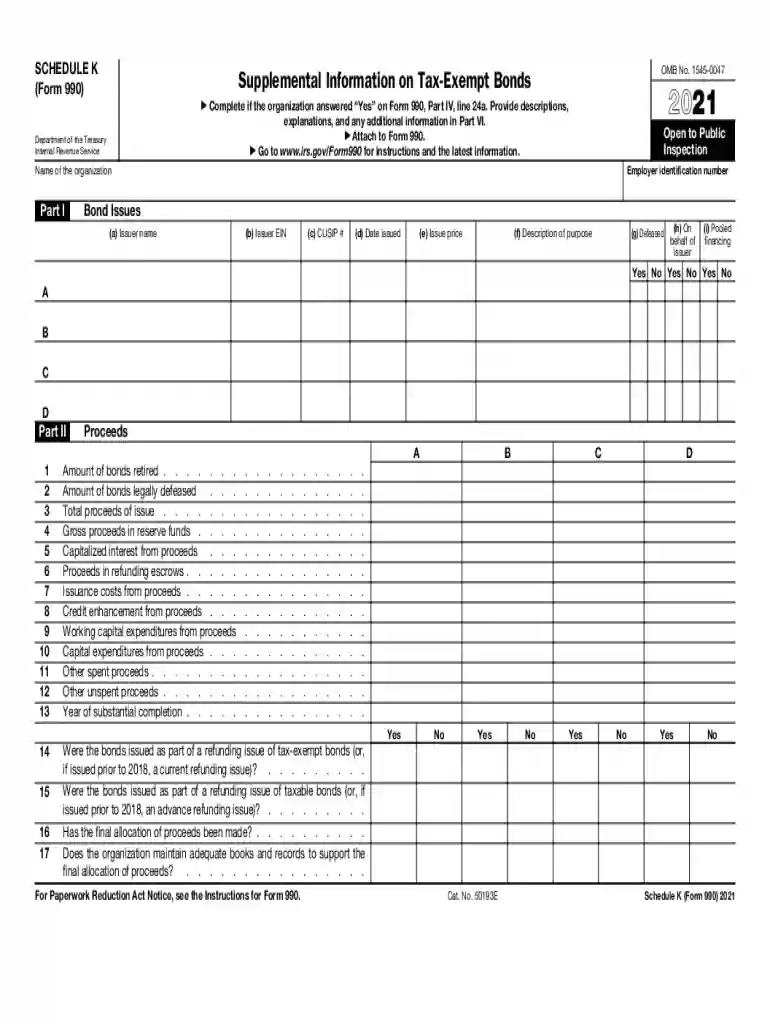
Schedule k form 2026

Get Form
schedule k form Preview on Page 1

Here's how it works

01. Edit your form online
Type text, add images, blackout confidential details, add comments, highlights and more.

02. Sign it in a few clicks
Draw your signature, type it, upload its image, or use your mobile device as a signature pad.

03. Share your form with others
Send it via email, link, or fax. You can also download it, export it or print it out.

Definition and Meaning

Schedule K (Form 990) is a form used by tax-exempt organizations to provide supplemental information on tax-exempt bonds. This form is crucial for organizations with outstanding tax-exempt bond issues, as it ensures compliance with Internal Revenue Service (IRS) regulations regarding tax-exempt financing. Schedule K includes specific sections detailing bond issues, the use of proceeds, private business use, and compliance with arbitrage rules. These elements enable organizations to demonstrate transparency and adherence to federal tax regulations.

Key Elements of the Schedule K Form

The Schedule K form is structured to capture detailed information about tax-exempt bonds. Key elements include:

  • Bond Issues: Organizations must disclose details such as issue date, amount, purpose, and description.
  • Proceeds Usage: This section looks into how the bond proceeds are spent, ensuring alignment with the original purpose.
  • Private Business Use: Organizations report any income generated from private business activities using the financed property.
  • Arbitrage Compliance: This part ensures that organizations meet arbitrage rebate requirements, which prevent profit-making from the differential in interest rates.

Steps to Complete the Schedule K Form

Completing the Schedule K form requires meticulous attention to detail. Follow these steps for accuracy:

  1. Gather Necessary Documents: Collect documents related to bond issues, use of proceeds, and arbitrage calculations.
  2. Review Instructions: Familiarize yourself with IRS guidelines specific to Schedule K.
  3. Complete Each Part: Fill out each section methodically:
    • Part I: Provide bond identifiers and description.
    • Part II: Outline the allocation and expenditure of proceeds.
    • Part III: Define the extent of private business use.
    • Part IV: Detail compliance with arbitrage rebate and yield restriction.
  4. Verify Information: Double-check all entries for accuracy.
  5. Submit to IRS: File electronically or by mail as per IRS instructions.

Important Terms Related to Schedule K Form

Understanding the terminology is essential for completing Schedule K:

  • Arbitrage: Profit achieved by exploiting the difference in interest rates.
  • Private Business Use: Use of tax-exempt bond-financed property by non-government entities.
  • Bond Issuers: These are typically governmental or nonprofit entities that issue bonds.

IRS Guidelines

The IRS provides explicit guidelines for completing Schedule K:

  • Filing Requirements: Organizations must attach Schedule K to Form 990.
  • Compliance Assurance: Detailed instructions ensure that all aspects of bond proceeds and usage comply with IRS mandates.
  • Corrective Actions: Guidelines for rectifying non-compliance are stipulated to prevent penalties.

Filing Deadlines and Important Dates

Adhering to deadlines is crucial to avoid penalties. Typically, Schedule K is due with Form 990:

  • Annual Filing: Due on the 15th day of the 5th month after the organization’s fiscal year-end.
  • Extensions: Possible through Form 8868, granting additional time for filing.

Who Typically Uses the Schedule K Form

Various entities utilize Schedule K:

  • Nonprofit Organizations: Primarily those with outstanding tax-exempt bonds.
  • Government Entities: To disclose tax-exempt financing for infrastructure and public projects.
  • Healthcare and Educational Institutions: Often rely on bond financing for facility development and expansion.
decoration image ratings of Dochub

Penalties for Non-Compliance

Failing to comply with Schedule K requirements can lead to significant repercussions:

  • Monetary Fines: IRS imposes fines based on the level of non-compliance or omission.
  • Bond Invalidity: Risk of bonds losing their tax-exempt status, leading to increased operational costs.
  • Legal Ramifications: Organizations might face legal challenges if they fail to adhere to federal tax regulations.

Who Issues the Form

The IRS is responsible for issuing Schedule K as part of the Form 990 series:

  • Distribution: Available on the IRS website in digital format for ease of access.
  • Revisions: The IRS periodically updates the form, reflecting changes in regulations and compliance needs.

Examples of Using the Schedule K Form

Consider practical applications of Schedule K:

  • Hospital Expansion: A hospital uses tax-exempt bonds to fund new building projects. Schedule K documents how funds are utilized following tax regulations.
  • University Improvements: A university issues bonds for campus upgrades. Schedule K disclosures include private business use compliance to maintain tax-exempt status.
  • Infrastructure Projects: A city administration secures bonds for road construction, utilizing Schedule K to detail spending and compliance with arbitrage restrictions.

State-Specific Rules for the Schedule K Form

While Schedule K is federally regulated, state-level nuances can exist:

  • California: Additional state reporting might be required for bond activities.
  • New York: State-specific compliance measures for arbitrage calculations.
  • Texas: Variations in how private business use is reported, depending on state guidelines.

Software Compatibility

To streamline the filing process, certain software supports Schedule K integration:

  • TurboTax: Facilitates accurate completion through guided steps for non-profit organizations.
  • QuickBooks: Offers tools for managing financial records tied to tax-exempt bonds.
  • IRS e-file System: Direct electronic submissions ensuring compliance with IRS standards.

See more schedule k form versions

We've got more versions of the schedule k form form. Select the right schedule k form version from the list and start editing it straight away!
Versions Form popularity Fillable & printable
2023 4.1 Satisfied (50 Votes)
2022 4.8 Satisfied (42 Votes)
2021 4.8 Satisfied (101 Votes)
2020 4.2 Satisfied (104 Votes)
2019 4.3 Satisfied (158 Votes)
2018 4.3 Satisfied (141 Votes)
2017 4.3 Satisfied (149 Votes)
2016 4.4 Satisfied (234 Votes)
be ready to get more

Complete this form in 5 minutes or less

Get form

Security and compliance

At DocHub, your data security is our priority. We follow HIPAA, SOC2, GDPR, and other standards, so you can work on your documents with confidence.

Learn more
ccpa2
pci-dss
gdpr-compliance
hipaa
soc-compliance