




01. Edit your form online
Type text, add images, blackout confidential details, add comments, highlights and more.

Type text, add images, blackout confidential details, add comments, highlights and more.

Draw your signature, type it, upload its image, or use your mobile device as a signature pad.

Send it via email, link, or fax. You can also download it, export it or print it out.
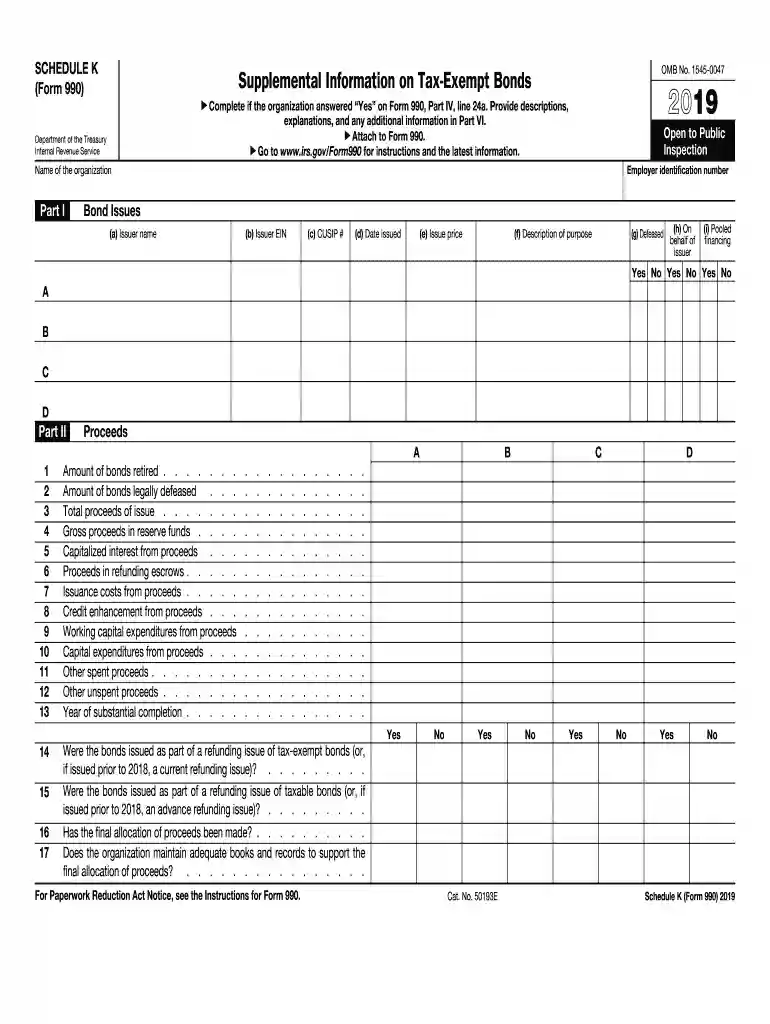
The 2020 Schedule K (Form 990) is a document used by tax-exempt organizations in the United States to provide detailed information about tax-exempt bond liabilities. Tax-exempt bonds are crucial for organizations because they offer financing at lower interest rates compared to taxable bonds. This specific form is primarily used by entities that have answered 'Yes' to certain questions on Form 990, Part IV, line 24a. The form includes sections on various aspects such as the proceeds from bonds, private business use, compliance with arbitrage regulations, and corrective procedures for any federal tax obligations.
Using the 2020 Schedule K involves gathering comprehensive details regarding bond issues, including their purpose, amounts, and intended use of the proceeds. Organizations must disclose how the bonds are being utilized and ensure that the use aligns with IRS guidelines for tax-exempt financing. The form requires:
Organizations should ensure that all necessary information is accurately captured to avoid any legal complications.
The 2020 Schedule K can be obtained directly from the IRS website or through various tax software programs that support tax-exempt organization filings. Alternatively, many organizations work with tax professionals who provide the form as part of their services. It is crucial to use an updated version to ensure compliance with any changes in tax regulations for that year.
The form comprises several critical components:
Each section requires precise information to ensure adherence to tax laws.
The IRS provides detailed instructions for completing Schedule K, emphasizing the importance of accuracy and completeness. Tax-exempt entities should be vigilant in following these guidelines to ensure transparency and compliance. The IRS instructions also highlight how to calculate private business use and establish arbitrage compliance procedures.
For organizations on a calendar year, the 2020 Schedule K is generally due on May 15, 2021, as part of the Form 990 filing. If this date falls on a weekend or holiday, the deadline may be extended to the next business day. Late filings can result in penalties, which underscores the importance of timely submission.
To properly fill out the 2020 Schedule K, organizations must have access to:
Thorough documentation facilitates accurate reporting and adherence to IRS requirements.
Organizations can submit the completed form through:
Choosing the appropriate method depends on the organization's resources and preferences.
Failing to accurately complete and submit the 2020 Schedule K can lead to severe penalties. The IRS may impose fines for incorrect or late submissions. In some cases, tax-exempt status could be jeopardized if it is determined that there has been a significant non-compliance with tax or bond regulations. This risk makes meticulous adherence to the filing requirements and deadlines crucial for maintaining compliance.
We've got more versions of the 2020 k form form. Select the right 2020 k form version from the list and start editing it straight away!
| Versions | Form popularity | Fillable & printable |
|---|---|---|
| 2024 | 4.3 Satisfied (39 Votes) | |
| 2023 | 4.1 Satisfied (50 Votes) | |
| 2022 | 4.8 Satisfied (42 Votes) | |
| 2021 | 4.8 Satisfied (101 Votes) | |
| 2020 | 4.2 Satisfied (104 Votes) | |
| 2019 | 4.3 Satisfied (158 Votes) | |
| 2018 | 4.3 Satisfied (141 Votes) | |
| 2017 | 4.3 Satisfied (149 Votes) | |
| 2016 | 4.4 Satisfied (234 Votes) |
You should use only reliable software solutions with strong security compliance to sign your documents electronically. DocHub is just the type of software you need! It stores data on Amazon Web Servers and complies with all essential security criteria and eSignature regulations, so it’s a trustworthy way to eSign your 2020 k form or other forms with this tool.
As a comprehensive document editing platform, DocHub is available on smart phones. Open DocHub in your choice of mobile browser and use our intelligent mobile-friendly toolset to complete your 2020 k form.
At DocHub, your data security is our priority. We follow HIPAA, SOC2, GDPR, and other standards, so you can work on your documents with confidence.
M. Did the partner contribute property with a built-in gain or loss? Yes. No. If Yes, attach statement. See instructions.Read more
Mar 8, 2021 As issuers prepare their Form 10-K and 20-F filings for fiscal year 2020, they should consider recent and upcoming changes to the disclosure


