




01. Edit your form online
Type text, add images, blackout confidential details, add comments, highlights and more.

Type text, add images, blackout confidential details, add comments, highlights and more.

Draw your signature, type it, upload its image, or use your mobile device as a signature pad.

Send it via email, link, or fax. You can also download it, export it or print it out.
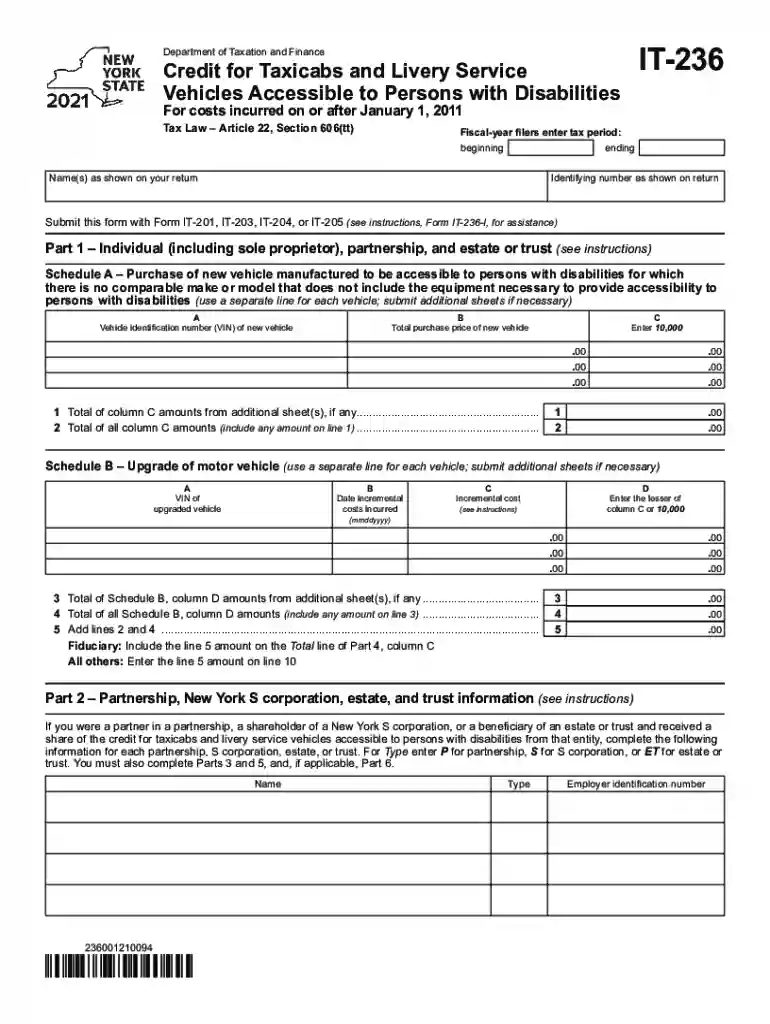
The IT-236 form is a tax document used to claim a tax credit for the purchase or upgrade of taxicabs and livery service vehicles that are accessible to persons with disabilities. Introduced effective from January 1, 2011, this form is crucial for reporting vehicle details, costs incurred, and sharing credits among individual filers, partnerships, and trusts. By allowing a claim on certain expenses, the IT-236 helps promote the conversion and upgrade of vehicles to be accessible, contributing significantly to inclusive transportation solutions.
Efficiently completing the IT-236 involves a clear understanding of its sections and requirements. It is designed to capture information critical for calculating the tax credit correctly. Follow these structured steps to ensure accuracy:
The IT-236 primarily serves those in the transportation sector, specifically operators of taxicabs and livery services aiming to make their services more inclusive. Eligibility requires that the vehicles in question be used within appropriate contexts and meet specific criteria set forth in the form guidelines. Businesses or individuals involved must have incurred expenses directly related to converting or acquiring vehicles to be accessibility-compliant.


The form’s structure is designed to guide users through multiple sections that capture the necessary data. Some primary components include:
Submitting the IT-236 can be done through various channels depending on individual preferences and resources:
The IT-236 must be submitted in tandem with annual tax filings. Delays can negate the possibility of claiming the credit, necessitating awareness of scheduling to maintain compliance. Regular updates from taxation authorities can provide guidance on precise deadlines. Failure to comply with submission regulations may result in penalties or denial of the credit claim.
There are specific legal aspects to consider when filing the IT-236. This includes ensuring all vehicle modifications meet standards for accessibility as defined by regulations. The tax credit is also contingent upon adherence to documentation accuracy and compliance with submission norms, forming a legally binding declaration of claimed expenditures.
Consider the following scenarios where the IT-236 plays a critical role:
The IRS provides detailed guidance on the utilization of the IT-236 within varied taxpayer scenarios, such as self-employed individuals adapting their vehicle for combined personal and service purposes. Understanding these directions can prevent misunderstandings and inaccuracies in credit claims, optimizing advantages under set taxation structures.
The IT-236 can be managed both digitally and on paper. These versions are compatible with common tax software such as TurboTax and QuickBooks, providing users scalable options for document preparation and submission. The digital version offers benefits in terms of convenience and integration, while paper versions cater to traditional preferences.
We've got more versions of the it 236 form. Select the right it 236 version from the list and start editing it straight away!
At DocHub, your data security is our priority. We follow HIPAA, SOC2, GDPR, and other standards, so you can work on your documents with confidence.
Mar 25, 2025 GlitchDexJP/Y:236 Methods to obtain Starting moves Evolution(s) Pokdex data Level-up moves TM/HM moves Base stats.Read more
A managerial perspective on electronic commerce. Topics include the technical infrastructure developments and their impact on organizational structure,Read more
Partnership: Enter the line 14 amount and code 236 on Form IT-204, line 147. All others: Complete Part 6. 15 Total credit (enter the amount from line 14).Read more


