




01. Edit your form online
Type text, add images, blackout confidential details, add comments, highlights and more.

Type text, add images, blackout confidential details, add comments, highlights and more.

Draw your signature, type it, upload its image, or use your mobile device as a signature pad.

Send it via email, link, or fax. You can also download it, export it or print it out.
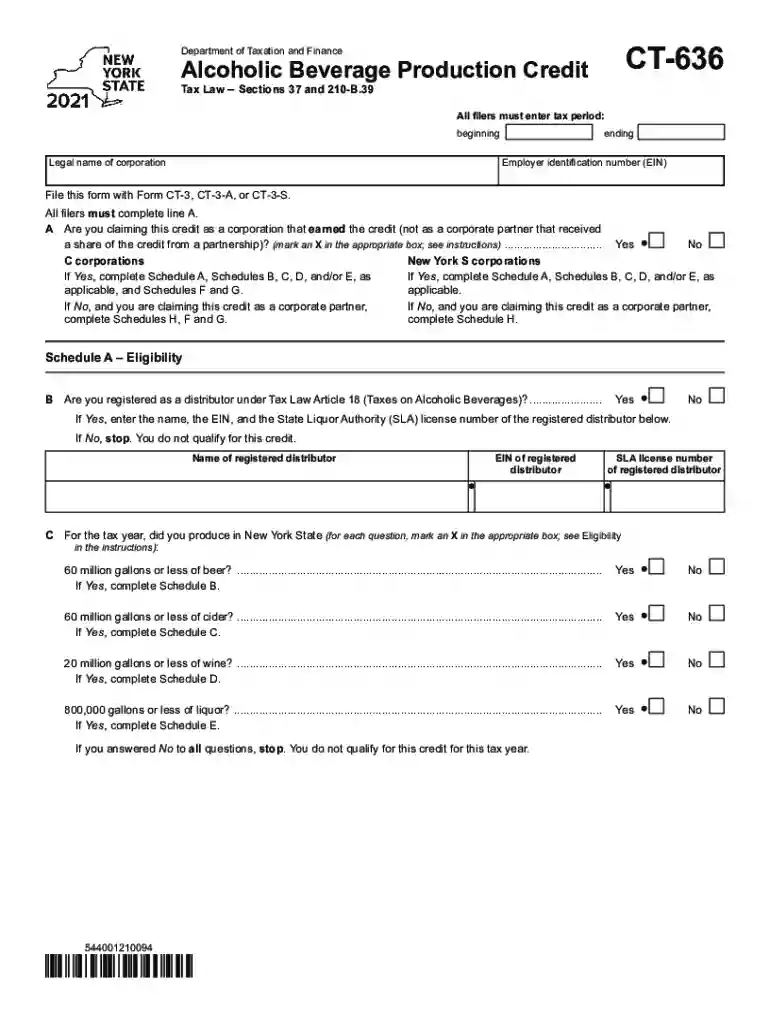
Form CT-636 is a document used by corporations in New York to claim the Alcoholic Beverage Production Credit. This credit is designed to encourage the production of alcoholic beverages such as beer, cider, wine, and liquor within the state. The form outlines the eligibility criteria, necessary schedules, and information required for corporate tax purposes. Companies engaging in production must provide details like production volumes and distributor registration.
To effectively utilize Form CT-636, corporations must carefully assess the specific credits applicable to their alcoholic beverage production activities. The form allows you to calculate credits for different categories of beverages. You should ensure that all required information, including production metrics and any distributor-related data, is accurately provided. This comprehensive approach will help maximize your credits and ensure compliance with state tax regulations.
Form CT-636 can be accessed via the New York State Department of Taxation and Finance website. It is available for download, allowing corporations to print and complete the form manually. Alternatively, businesses can acquire the form through certified tax software providers, which often have integrated systems for completing and submitting the form digitally as part of the broader corporate tax filing process.
Gather Necessary Information:
Fill Out the Form:
Include Supporting Schedules:
Review and Submit:
Form CT-636 is primarily used by corporations involved in the production of alcoholic beverages within New York State. Eligible entities can include breweries, cider houses, wineries, and distilleries. Businesses must be registered and compliant with state-specific regulations governing alcoholic beverage production to qualify for the credits outlined in the form.
Corporations need to comply with New York State's unique regulations regarding alcohol production. This includes fulfilling specific licensing requirements and adhering to production limits for certain credits. Additionally, businesses must stay updated on any changes in state law or tax guidelines that could affect the form's application or the credits available.
While Form CT-636 is managed at the state level, it's crucial for corporations to be aware of overlapping IRS regulations, ensuring their tax reporting aligns with both state and federal requirements. Proper alignment helps avoid discrepancies and ensures smooth processing of claims and credits.
We've got more versions of the ct 636 form. Select the right ct 636 version from the list and start editing it straight away!
| Versions | Form popularity | Fillable & printable |
|---|---|---|
| 2025 | 4.1 Satisfied (58 Votes) | |
| 2024 | 4.6 Satisfied (60 Votes) | |
| 2023 | 4 Satisfied (29 Votes) | |
| 2022 | 4.5 Satisfied (31 Votes) | |
| 2021 | 4.8 Satisfied (240 Votes) | |
| 2020 | 4.3 Satisfied (55 Votes) | |
| 2019 | 4.3 Satisfied (48 Votes) | |
| 2018 | 4.3 Satisfied (83 Votes) | |
| 2017 | 4.3 Satisfied (48 Votes) | |
| 2015 | 4.4 Satisfied (336 Votes) | |
| 2014 | 4 Satisfied (56 Votes) | |
| 2013 | 4.4 Satisfied (275 Votes) | |
| 2012 | 4 Satisfied (36 Votes) |
Sure, a typed name is recognized as a valid electronic signature when you create it on your form utilizing a compliant solution like DocHub. Simply import your ct 636 to our editor, click Sign in the top tool pane → Create your signature → Type your name in the proper tab, and choose how it will appear on your document.
It is a no-brainer on a computer or via a mobile phone to complete a ct 636 with DocHub. All you need to do is open any installed web browser on your smartphone and go to the DocHub site. Once authenticated, add your file and open it in editing mode. Use our toolbar to make your edits and save changes. Optionally, keep your document in your files or send it to a recipient immediately.
At DocHub, your data security is our priority. We follow HIPAA, SOC2, GDPR, and other standards, so you can work on your documents with confidence.
by J Modersohn 1999 Recommended Citation. Jennifer Modersohn, Constitutional LawFirst Amendment Rights of Direct Democracy Participants versus the States Interest inRead more
File this form with Form CT-3, CT-3-A, or CT-3-S. All filers must complete line A. A Are you claiming this credit as a corporation that earned the creditRead more


