




Here's how it works

01. Edit your dr 504 online
Type text, add images, blackout confidential details, add comments, highlights and more.

02. Sign it in a few clicks
Draw your signature, type it, upload its image, or use your mobile device as a signature pad.

03. Share your form with others
Send florida business tax application dr 1 form via email, link, or fax. You can also download it, export it or print it out.
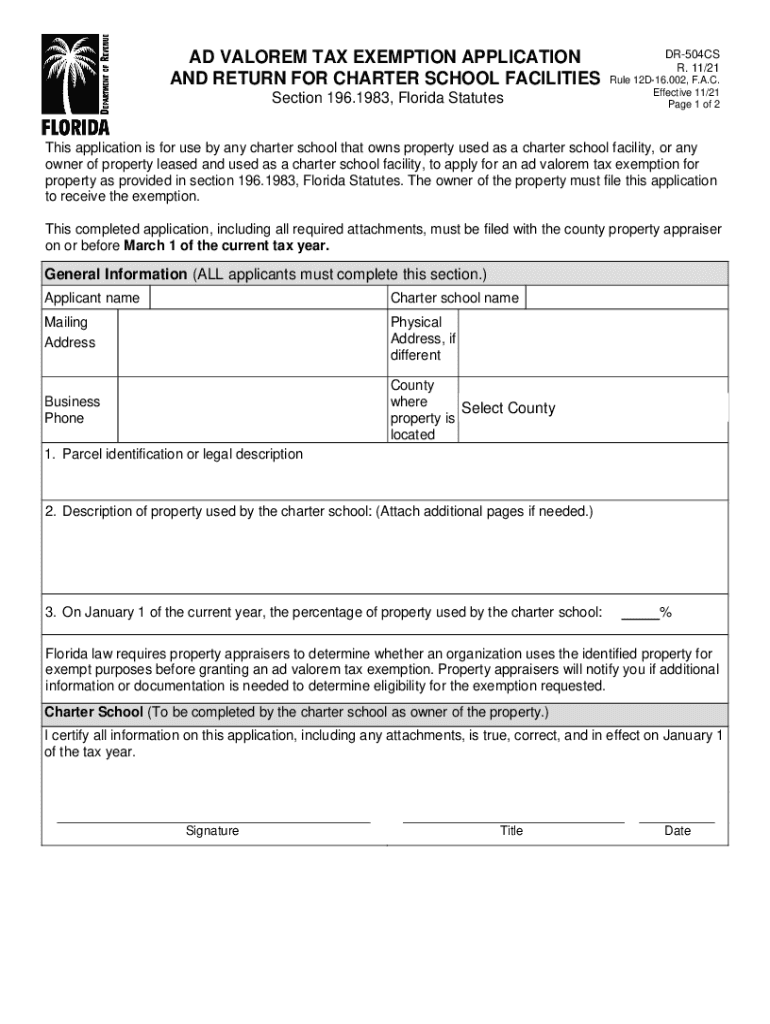
How to use or fill out Florida Revenue Form DR-504CS with DocHub

- Click ‘Get Form’ to open the Florida Revenue Form DR-504CS in our platform.
- Begin by filling out the 'General Information' section. Enter the applicant name, charter school name, mailing address, physical address (if different), business phone, and select the county where the property is located.
- Next, provide the parcel identification or legal description of the property. In the 'Description of property used by the charter school' field, include details about how the property is utilized. If necessary, attach additional pages for more information.
- Indicate the percentage of property used by the charter school as of January 1 of the current year. This is crucial for determining eligibility for tax exemption.
- Complete the certification section by signing and dating it. Ensure that all information provided is accurate and true as of January 1 of the tax year.
- If applicable, have the landlord complete their section regarding leasehold properties, certifying that required payments will be adjusted based on any exemptions received.
Start using our editor today to fill out your Florida Revenue Form DR-504CS quickly and efficiently!
Fill out florida revenue form dr 504cs online
It's free
See more florida revenue form dr 504cs versions
We've got more versions of the florida revenue form dr 504cs form. Select the right florida revenue form dr 504cs version from the list and start editing it straight away!
Got questions?
We have answers to the most popular questions from our customers. If you can't find an answer to your question, please contact us.
Contact us
Do I have to file a declaration of domicile in Florida?
While not required, we do recommend filing a Florida Declaration of Domicile. This document states that you are a Florida resident and that you maintain a residence in the state and intend to make that your permanent home.
Do I need to file a state tax return for Florida?
Since Florida does not have income tax, a Florida state income tax return does not exist.
How do you qualify for property tax exemption in Florida?
1.) You must have legal or equitable title to the real property as of January 1st of the year for which you are applying. 2.) As of January 1st of the year you apply, you must in good faith make the property on which you are applying your permanent legal residence.
Do I need to file a corporate tax return in Florida?
Corporations must file Florida Form F-1120 each year, even if no tax is due. The due date is based on the corporations tax year.
Do I need to file Dr. 405 in Florida?
Anyone who owns TPP on January 1st and who has a proprietorship, partnership, or corporation or is a self-employed agent or a contractor must file a TPP Return (Form DR-405) with the property appraiser by April 1st of each year (section 193.062, F.S.) or the first business day, should the due date fall on a weekend or
Security and compliance
At DocHub, your data security is our priority. We follow HIPAA, SOC2, GDPR, and other standards, so you can work on your documents with confidence.
Learn more


People also ask
What taxes do you have to file in Florida?
Florida State Tax: Florida does not have a state income tax. Florida Corporate Income Tax: Corporations that do business and earn income in Florida must file a corporate income tax return (unless they are exempt). Florida Property Tax: Florida Property Tax is based on market value as of January 1st that year.
At what age do seniors stop paying property taxes in Florida?
You are 65 years of age, or older, on January 1; You qualify for, and receive, the Florida Homestead Exemption; Your total Household Adjusted Gross Income for everyone who lives on the property cannot exceed statutory limits.
How much does a homestead exemption reduce your taxes in Florida?
The Homestead Exemption is a valuable property tax benefit that can save homeowners up to $50,000 on their taxable value. The first $25,000 of this exemption applies to all taxing authorities. The second $25,000 excludes School Board taxes and applies to properties with assessed values greater than $50,000.