




01. Edit your form online
Type text, add images, blackout confidential details, add comments, highlights and more.

Type text, add images, blackout confidential details, add comments, highlights and more.

Draw your signature, type it, upload its image, or use your mobile device as a signature pad.

Send it via email, link, or fax. You can also download it, export it or print it out.
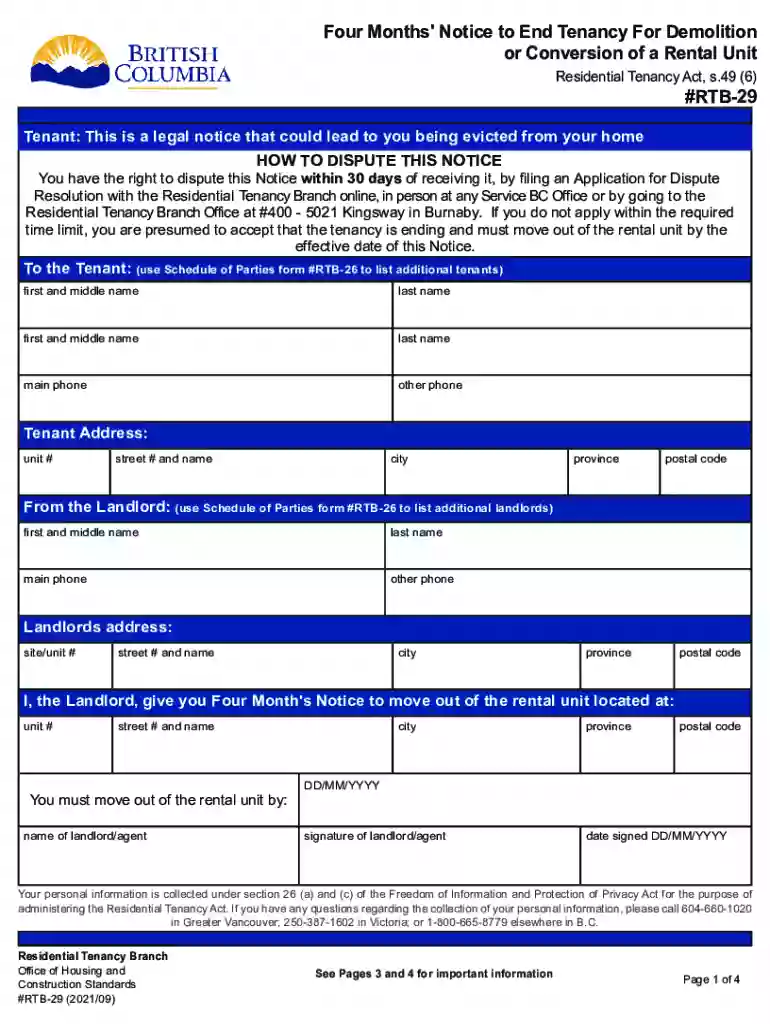
The Four Months' Notice to End Tenancy is a legal document used primarily by landlords in the United States to inform tenants about the termination of their rental agreement. This notice is typically issued when the landlord plans to demolish or convert the rental unit, necessitating the end of the current tenancy. The notice serves to officially communicate the landlord's intentions, outline the tenant's rights, and specify any requirements for dispute or compensation.
Using the Four Months' Notice to End Tenancy involves several key steps to ensure compliance with legal standards and to communicate effectively with tenants.
Completing the notice involves a structured process designed to capture all necessary details and facilitate understanding.
The effectiveness of the notice hinges on including several critical elements that address legal and practical considerations.
State laws can significantly impact the terms and enforcement of a Four Months' Notice to End Tenancy, making it crucial to understand local regulations.
Issuing a Four Months' Notice to End Tenancy carries significant legal implications that must be understood to protect both parties involved.
Practical examples of utilizing this notice can clarify common scenarios and guide landlords through potential challenges.
This notice is primarily used by landlords needing to end a rental agreement due to significant property changes but may involve other stakeholders.


We've got more versions of the Fill - Free fillable Four Months' Notice to End Tenancy ... form. Select the right Fill - Free fillable Four Months' Notice to End Tenancy ... version from the list and start editing it straight away!
Electronic document signing demands a software solution that complies with data security and eSignature regulations. DocHub is a great tool for that, as it meets all the previously mentioned requirements. Whatever method you prefer to sign your Fill - Free fillable Four Months' Notice to End Tenancy ... in DocHub, your eSignature will be legally binding and court-admissible.
It is a no-brainer on a computer or via a mobile device to fill out a Fill - Free fillable Four Months' Notice to End Tenancy ... with DocHub. All you need to do is open any installed web browser on your smartphone and proceed to the DocHub website. Once authenticated, add your document and open it in editing mode. Use our toolbar to make your edits and save adjustments. Optionally, keep your file in your files or send it to a recipient immediately.
At DocHub, your data security is our priority. We follow HIPAA, SOC2, GDPR, and other standards, so you can work on your documents with confidence.


