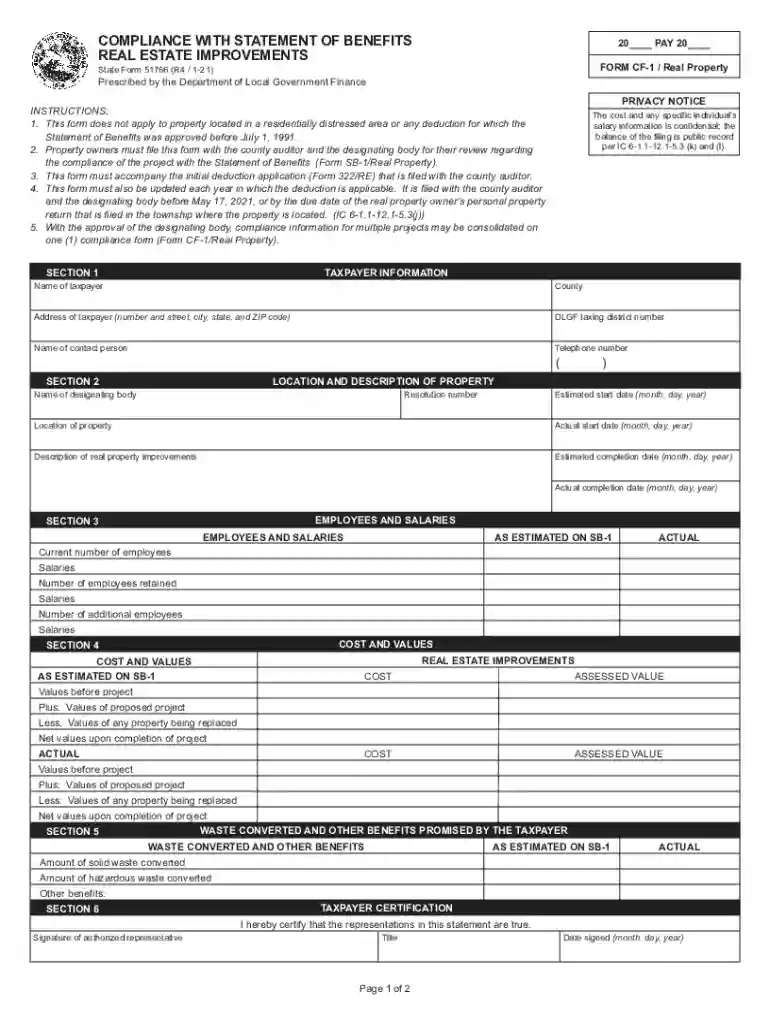
State form 51766 2026

Get Form
state form 51766 Preview on Page 1

Here's how it works

01. Edit your form online
Type text, add images, blackout confidential details, add comments, highlights and more.

02. Sign it in a few clicks
Draw your signature, type it, upload its image, or use your mobile device as a signature pad.

03. Share your form with others
Send it via email, link, or fax. You can also download it, export it or print it out.

How to use or fill out state form 51766 with our platform

Form edit decoration
9.5
Ease of Setup
DocHub User Ratings on G2
9.0
Ease of Use
DocHub User Ratings on G2
  1. Click ‘Get Form’ to open state form 51766 in the editor.
  2. Begin by filling out Section 1, which includes taxpayer information. Enter your name, county, address, DLGF taxing district number, contact person’s name, and telephone number.
  3. Proceed to Section 2 for the location and description of the property. Fill in the name of the designating body, resolution number, estimated start date, actual start date, and a detailed description of real property improvements.
  4. In Section 3, provide details about employees and salaries. Indicate the current number of employees along with their salaries, as well as any additional employees expected.
  5. Complete Section 4 by detailing costs and values associated with real estate improvements. Include values before the project, proposed project values, and net values upon completion.
  6. Finally, in Section 6, certify your information by signing and dating the form. Ensure all fields are accurately filled before submission.

Start using our platform today to easily complete state form 51766 online for free!

See more state form 51766 versions

We've got more versions of the state form 51766 form. Select the right state form 51766 version from the list and start editing it straight away!
Versions Form popularity Fillable & printable
2023 4.6 Satisfied (22 Votes)
2021 4.8 Satisfied (123 Votes)
2013 4.4 Satisfied (596 Votes)
2006 4 Satisfied (25 Votes)
be ready to get more

Complete this form in 5 minutes or less

Get form

Got questions?

We have answers to the most popular questions from our customers. If you can't find an answer to your question, please contact us.
Contact us
State form means a statement of campaign receipts and expenditures required to be filed by a candidate or political committee with the State Board of Elections.
In Indiana, tax abatement is technically defined within state law as an economic revitalization area (ERA) deduction. The process begins by designating a certain piece of real estate as an ERA. Subsequent investment on that property, within state guidelines, is then eligible for tax abatement.
The Notice of Assessment of Land and Improvements (Form 11) is an assessment notice that is sent to taxpayers by the county or township assessor. The assessed value on the Form 11 is the starting point for calculating annual property tax payments.
Personal property tax applies to tangible property such as machinery, equipment, and more that contributes to income generation. This tax is collected by state and local governments when you file your tax return, but you might be able to write off a portion of this tax.
An appeal begins with filing a Form 130 Taxpayers Notice to Initiate an Appeal with the local assessing official. The appeal should detail the pertinent facts of why the assessed value is being disputed. A taxpayer may only request a review of the current years assessed valuation.

Security and compliance

At DocHub, your data security is our priority. We follow HIPAA, SOC2, GDPR, and other standards, so you can work on your documents with confidence.

Learn more
ccpa2
pci-dss
gdpr-compliance
hipaa
soc-compliance

People also ask

The contract must be recorded and provide that the applicant is to pay the property taxes. For the Over 65 Deduction, the deduction amount equals the lesser of one-half the assessed value of the property or $14,000.
The owner of the property must file State Form 9284 / Form 136 with the County Assessor. The owner must provide all information requested on the application and accompanying information sheet. There is no filing fee. WHAT HAPPENS IF THE OWNERSHIP OR USE OF AN EXEMPT PROPERTY CHANGES?
The Petitioner must submit an SB-1 Form (Form 51767), for real property abatements, and/or a SB-1 Form (Form 51764), for personal property abatements. The filing fee for a Real Property Abatement is $400.00 and the filing fee for a Personal Property Abatement $400.00. This fee must be submitted with the petition.

Related links