







Definition & Meaning
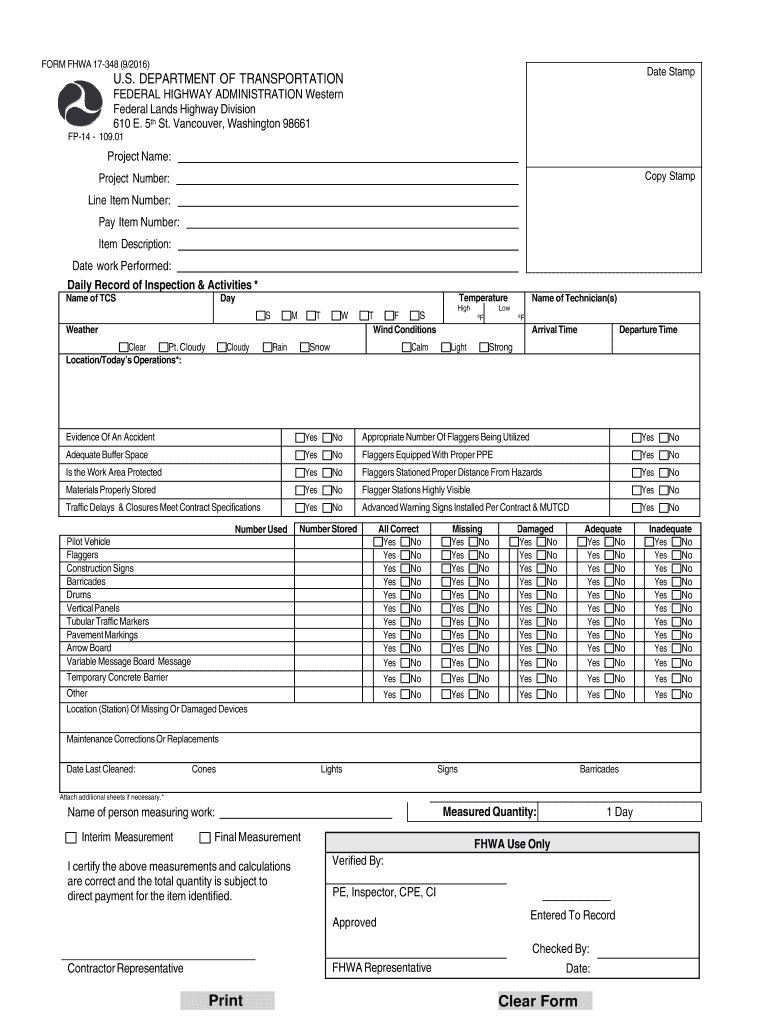
The FHWA 17-348 form is an official document issued by the U.S. Department of Transportation's Federal Highway Administration (FHWA). This form is used to meticulously record daily inspections and activities concerning highway projects. Its primary purpose is to ensure compliance with safety standards and contract specifications during the execution of construction activities. The form captures various aspects of a project, such as project details, weather conditions, and safety measures.
Key Elements of the FHWA 17-348
The FHWA 17-348 is structured to facilitate a comprehensive overview of construction progress and compliance. Essential elements include:
- Project Details: Captures the scope, location, and specific instructions relevant to the construction project.
- Weather Conditions: Records the daily weather patterns that could influence construction activities and safety.
- Technician Information: Includes data on the personnel conducting the inspections, ensuring accountability, and expertise.
- Safety Measures: Outlines the safety protocols in place to protect on-site workers and public safety.
- Traffic Control Devices: Documents the deployment and condition of traffic management systems to minimize disruption.
- Maintenance Checks: Ensures equipment and safety installations are regularly inspected and maintained.
How to Use the FHWA 17-348
Using the FHWA 17-348 involves a step-by-step process to ensure thorough documentation. Inspectors and construction managers are responsible for filling out this form. The process includes:
- Collecting Initial Data: Gather all necessary project details and input them into the form.
- Daily Updates: Record daily inspections, weather conditions, and safety measures implemented on-site.
- Technical Review: Include observations related to compliance with safety standards and resolution of any issues.
- Submission: Compile the completed forms for submission to the appropriate department or database for audit and record-keeping.
Steps to Complete the FHWA 17-348
Completion of the FHWA 17-348 requires attention to detail to ensure the accuracy of recorded data:
- Header Information: Fill in the project name, location, and date to categorize the inspection report.
- Inspector Details: Include inspector's name and credentials to validate the report's integrity.
- Observation Logs: Document observations in detail, focusing on compliance and any deviation from set standards.
- Safety Compliance: Highlight safety protocols and incidents, if any, describing corrective actions taken.
- Final Review: Reassess the completed form for completeness and accuracy before filing or submission.
Who Typically Uses the FHWA 17-348
The primary users of the FHWA 17-348 form include multiple stakeholders involved in highway construction projects:
- Construction Managers: They require regular updates on project status and safety compliance.
- Site Inspectors: Use the form to document inspections and ensure adherence to established guidelines.
- Project Engineers: Analyze data for compliance and performance purposes.
- Regulatory Authorities: Evaluate forms as a part of audits to verify compliance with federal guidelines.


Legal Use of the FHWA 17-348
Compliance with safety standards and contractual obligations forms the backbone of legal use for the FHWA 17-348. By meticulously documenting daily inspections and activities, forms serve as records in compliance verification processes. They can be crucial in legal contexts when disputes regarding construction practices or safety compliance arise. Proper use of the FHWA 17-348 helps mitigate legal risks and enforces accountability among stakeholders.
Examples of Using the FHWA 17-348
The utility of the FHWA 17-348 can be illustrated through scenarios in highway construction:
- Safety Incident Documentation: After a minor accident on-site, the form records the incident's details, responsible parties, and corrective measures.
- Weather Impact Recording: Adverse weather conditions that halt work require documentation to adjust project timelines.
- Compliance Checks: Regular documentation to ensure that all deployment of traffic control devices follows federal guidelines for the safety of the public and workers.
State-Specific Rules for the FHWA 17-348
Certain states may have additional requirements or variations in using the FHWA 17-348 due to regional regulations or environmental factors:
- California: Stringent regulations on environmental impact and worker safety may require additional documentation.
- Florida: May necessitate extra detail on weather conditions to address frequent storms.
- New York: Requires enhanced documentation for traffic control measures due to heavy population density and traffic volume.
By understanding how to effectively utilize the FHWA 17-348, stakeholders in highway projects can ensure thorough compliance with federal and state regulations, manage risks efficiently, and maintain high standards of safety and quality.




