




01. Edit your form online
Type text, add images, blackout confidential details, add comments, highlights and more.

Type text, add images, blackout confidential details, add comments, highlights and more.

Draw your signature, type it, upload its image, or use your mobile device as a signature pad.

Send it via email, link, or fax. You can also download it, export it or print it out.
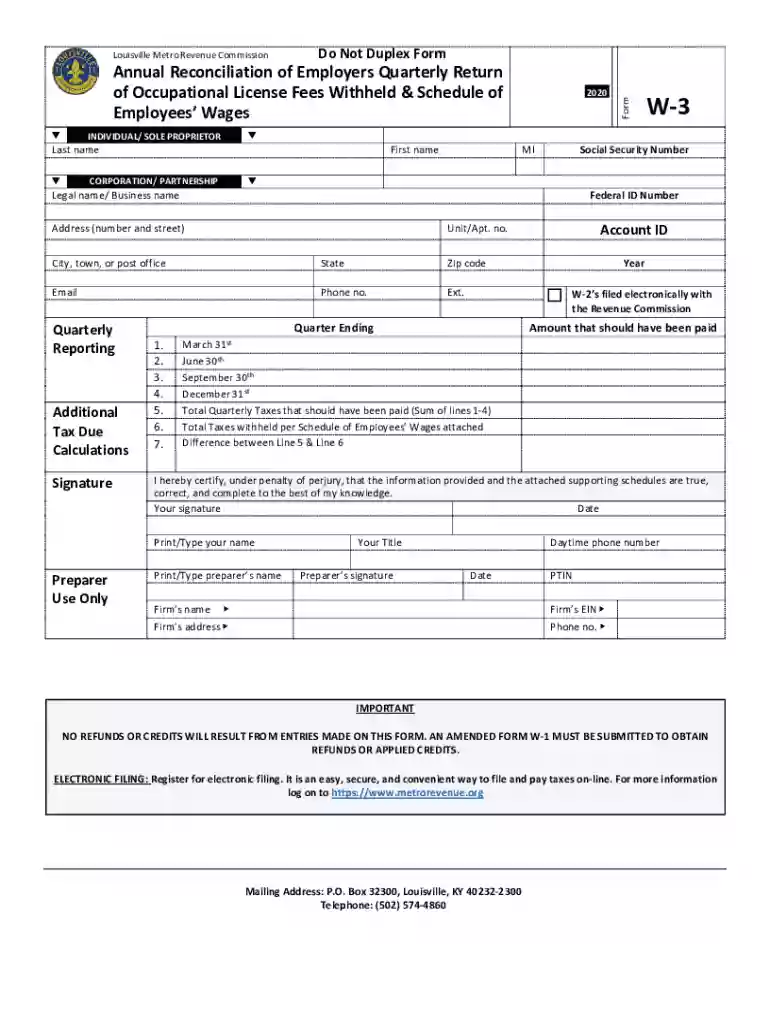
The "Do Not Duplex Form" is specifically designed for the Annual Reconciliation of Employers' Quarterly Return of Occupational License Fees Withheld and Employee Wage Schedules. This form plays a crucial role in confirming the accuracy of taxes withheld from employee wages and the reconciliation with filed quarterly returns. "Do Not Duplex" explicitly signifies that the form should not be printed on both sides of a sheet. Maintaining single-sided printing avoids errors in processing and ensures that each detail is clearly visible and unambiguous, both for recordkeeping and for compliance with specific tax regulations.
Using the "Do Not Duplex Form" involves precise attention to detail. Primarily, employers must document all quarterly tax withholdings and confirm that these match up with prior submissions for the same tax year. The process includes:
Precise adherence to these steps ensures compliance and efficiency.
Completing the "Do Not Duplex Form" involves the following steps:
The form contains several integral sections:
Each of these sections must be completed accurately to ensure compliance with tax obligations.
Ensuring the form is not duplexed (printed double-sided) prevents potential processing issues. It reduces the chances of errors in scanning or document handling, particularly in high-volume processing environments where single-sided documents facilitate quick identification without the risk of missed information. This adherence supports regulatory expectations and aids in maintaining clarity and legibility across all pages, which is crucial for both internal audits and government reviews.
This form has significant legal implications as it pertains to tax reconciliation and compliance. Employers must use it to reconcile annual tax withholdings with the Louisville Metro Revenue Commission, adhering to U.S.-centric tax laws. Misreporting or inaccuracy can lead to penalties, making it vital for employers to complete it with precision. Ensuring that each element is meticulously documented establishes proof of compliance with occupational fee withholding requirements.
Understanding the terminology associated with the form is essential:
A firm grasp of these terms ensures precise and correct completion of the form.
Consider the following scenarios:
Such examples showcase the form's application across different organizational setups and sectors.
We've got more versions of the Do Not Duplex Form form. Select the right Do Not Duplex Form version from the list and start editing it straight away!
At DocHub, your data security is our priority. We follow HIPAA, SOC2, GDPR, and other standards, so you can work on your documents with confidence.
do not form a MO:DCA-P page. This kind of data set cannot be printed without simplex or the duplex keyword-parameter value is not valid. The MMCRead more
Apr 21, 2026 A duplex incorporates different forms, including a sonnet and ghazal. Form informs the meaning, which emerges in a unique way from the duplexsRead more
by F OYu 1993 Cited by 348 The DNA:RNA hybrid duplex assumes neither an A-form nor a B-form structure in solution, but an intermediate heteromerous duplex structure.Read more


