




01. Edit your maryland form pv 2024 online
Type text, add images, blackout confidential details, add comments, highlights and more.

Type text, add images, blackout confidential details, add comments, highlights and more.

Draw your signature, type it, upload its image, or use your mobile device as a signature pad.

Send form pv maryland via email, link, or fax. You can also download it, export it or print it out.
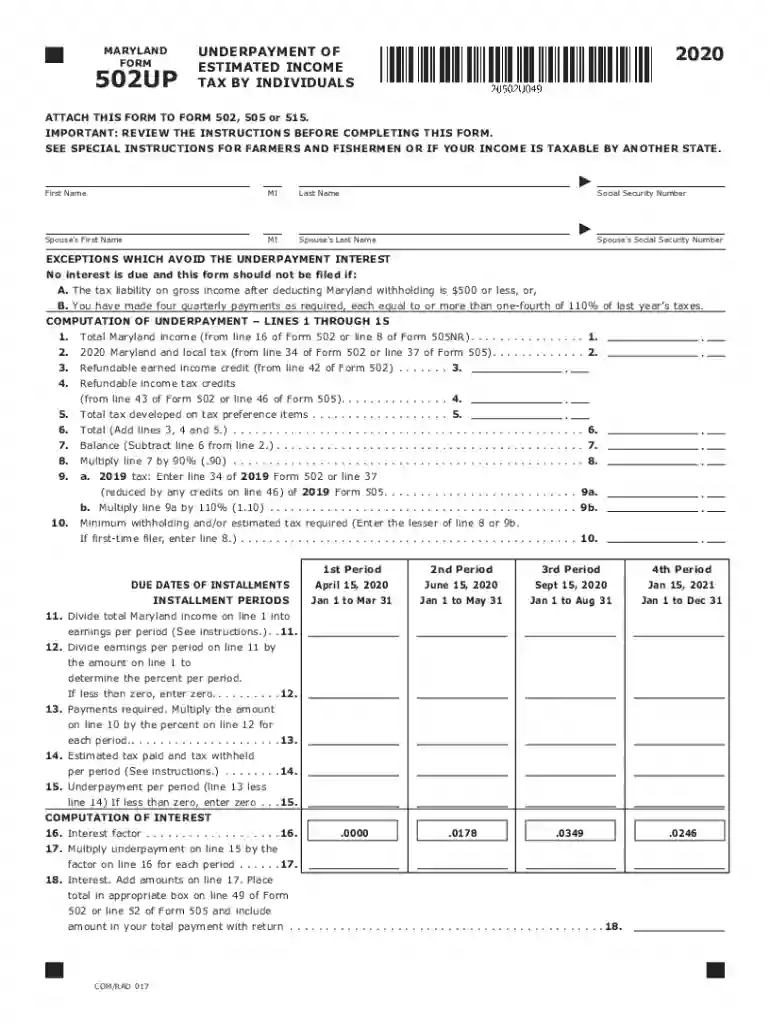
The "md estimated tax form" refers to Maryland Form 502UP, designed for individuals required to pay estimated taxes on income not covered by withholding, such as self-employment income, rental income, or investments. This form is crucial in calculating and reporting underpayments of estimated taxes to avoid penalties. Maryland residents and certain nonresidents use it to ensure their tax payments meet state requirements throughout the year, maintaining compliance with tax obligations.
Using the Maryland Form 502UP involves several strategic steps to accurately report and calculate any potential tax underpayments. First, taxpayers should gather all relevant income information and tax records, including earnings from various sources not subject to withholding. Next, complete the form by entering estimated tax payments made throughout the year, comparing them against the anticipated annual tax liability. Form 502UP serves as a tool to determine if additional payments are needed to mitigate any penalties for underpayment.
Maryland residents can access Form 502UP from the Maryland Comptroller's official website. The form is available for download and can be printed for manual completion. Alternatively, the form may be requested via mail from the Comptroller's office. For ease and convenience, various tax software platforms also offer access to this form as part of their state tax filing packages, enabling digital completion and submission.
Using Form 502UP is essential for taxpayers who might face penalties for underpayment of estimated taxes. Maryland law requires individuals with significant income not covered by traditional withholding to pay taxes quarterly. This form provides a structured method to assess payment adequacy and rectify underpayments before filing the annual return, thus reducing the risk of penalties.
Form 502UP is commonly utilized by:


Certain groups, such as farmers or fishermen, might qualify for exceptions to standard estimated payment rules, demanding careful assessment of each taxpayer's unique situation.
Maryland mandates specific dates for estimated tax payments:
Failing to submit required estimated payments may result in financial penalties. The extent of the penalty correlates with the magnitude of the underpayment and the duration it has remained unpaid. Form 502UP calculations help minimize or avoid these penalties by documenting and correcting any deficiencies in payment.
Form 502UP delivers a comprehensive approach to managing estimated tax payments, offering clarity and precision for Maryland taxpayers seeking to remain compliant and penalty-free.
We've got more versions of the maryland form pv 2024 form. Select the right maryland form pv 2024 version from the list and start editing it straight away!
| Versions | Form popularity | Fillable & printable |
|---|---|---|
| 2025 | 4.7 Satisfied (21 Votes) | |
| 2024 | 4.7 Satisfied (50 Votes) | |
| 2023 | 4.6 Satisfied (44 Votes) | |
| 2022 | 4.3 Satisfied (60 Votes) | |
| 2021 | 4.8 Satisfied (232 Votes) | |
| 2020 | 4.3 Satisfied (147 Votes) | |
| 2019 | 4.3 Satisfied (91 Votes) | |
| 2018 | 4.3 Satisfied (148 Votes) | |
| 2017 | 4.4 Satisfied (187 Votes) | |
| 2016 | 4.1 Satisfied (75 Votes) | |
| 2013 | 4.3 Satisfied (133 Votes) | |
| 2010 | 4.4 Satisfied (133 Votes) |
At DocHub, your data security is our priority. We follow HIPAA, SOC2, GDPR, and other standards, so you can work on your documents with confidence.
Check ONLY one box (1,2,3, or 4) for type of payment. If Box 1 is checked, also check box 1a., if first time estimated filer or if filing status has changed.Read more
Enter the estimated amount of your itemized deductions (excluding state and local income taxes) that exceed the amount of your standard deduction, alimonyRead more
Sep 16, 2013 This revenue procedure provides the domestic asset/liability percentages and domestic investment yields needed by for- eign life insuranceRead more


