




01. Edit your maryland penalty for underpayment of estimated tax online
Type text, add images, blackout confidential details, add comments, highlights and more.

Type text, add images, blackout confidential details, add comments, highlights and more.

Draw your signature, type it, upload its image, or use your mobile device as a signature pad.

Send maryland tax underpayment penalty via email, link, or fax. You can also download it, export it or print it out.
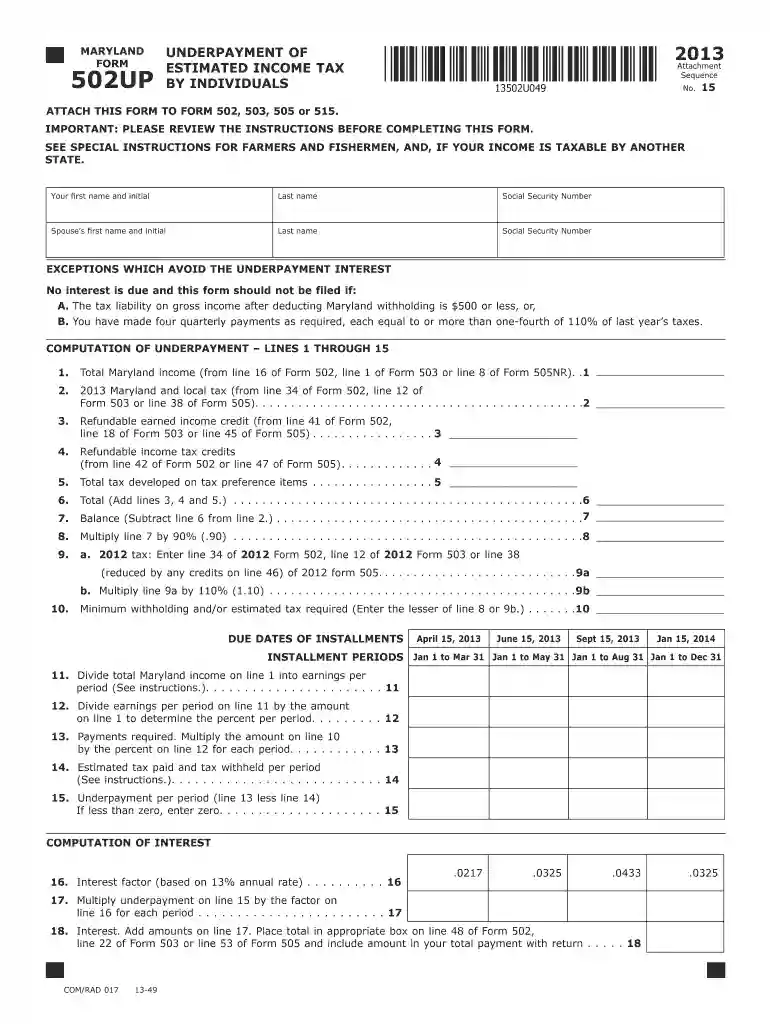
The Maryland Form 502UP for 2013, officially known as the "Underpayment of Estimated Income Tax by Individuals," was designed to report any underpayment by individuals of their estimated income tax. This form is critical for ensuring taxpayers in Maryland comply with state tax laws and avoid interest on unpaid estimated taxes. Underpayment typically occurs when taxpayers do not pay sufficient estimated taxes throughout the year or if their withholding does not cover their total tax liability.
To properly use Form 502UP, taxpayers must first determine their total tax liability for the year. The form requires detailed calculations to ascertain the amount of estimated tax payments made versus what was actually owed. If there's a discrepancy, resulting in an underpayment, the taxpayer must complete the form to calculate the interest due. Critical fields include personal information, details of estimated tax payments, and computation of any underpayment amounts. Ensuring accuracy is vital to avoid further penalties or interest.
Maryland Form 502UP is available through various channels, ensuring accessibility to all taxpayers. One can easily download the form from the Maryland Comptroller’s official website. Additionally, it may be available at local IRS offices or Maryland tax agencies. It is essential to verify that the version being used is for the 2013 tax year to ensure accuracy and compliance.
Individuals who anticipate owing taxes beyond their withheld amounts or previous estimated payments typically use Form 502UP. Common users include self-employed individuals, small business owners, retirees who receive pension income, and investors with significant dividend, interest, or capital gains income. It is also employed by those who may have not adjusted their withholding or estimated payments in response to changes in their financial situation throughout the tax year.


The form includes several key sections:
Guidance from the IRS on estimated tax payments complements Maryland Form 502UP instructions. Taxpayers are encouraged to pay quarterly estimated taxes if they expect to owe at least $1,000 beyond what is withheld during the year. The IRS provides resources to help determine expected payments and instructions to harmonize federal payments with state regulations.
For 2013, quarterly estimated payments were due on the following dates: April 15, June 15, September 15, and January 15 of the following year. Meeting these deadlines helps prevent the accumulation of significant interest due to underpayment. Filing Form 502UP with your Maryland tax return by the tax filing deadline is crucial to avoid potential penalties.
Failing to file Form 502UP when there is an underpayment may result in penalties. These can include interest charges on the unpaid tax amount, which accrue from the due date of each installment until the date of payment. In severe cases, additional fines or legal actions may be taken if tax evasion is suspected. Therefore, proactive compliance is recommended to avoid these consequences.
We've got more versions of the maryland penalty for underpayment of estimated tax form. Select the right maryland penalty for underpayment of estimated tax version from the list and start editing it straight away!
| Versions | Form popularity | Fillable & printable |
|---|---|---|
| 2025 | 4.7 Satisfied (21 Votes) | |
| 2024 | 4.7 Satisfied (50 Votes) | |
| 2023 | 4.6 Satisfied (44 Votes) | |
| 2022 | 4.3 Satisfied (60 Votes) | |
| 2021 | 4.8 Satisfied (232 Votes) | |
| 2020 | 4.3 Satisfied (147 Votes) | |
| 2019 | 4.3 Satisfied (91 Votes) | |
| 2018 | 4.3 Satisfied (148 Votes) | |
| 2017 | 4.4 Satisfied (187 Votes) | |
| 2016 | 4.1 Satisfied (75 Votes) | |
| 2013 | 4.3 Satisfied (133 Votes) | |
| 2010 | 4.4 Satisfied (133 Votes) |
At DocHub, your data security is our priority. We follow HIPAA, SOC2, GDPR, and other standards, so you can work on your documents with confidence.
When income is earned unevenly throughout the year, complete the REV-1630, Underpayment of Estimated Tax by. Individuals form, to determine if you owe estimatedRead more
Oct 15, 2013 An individual taxpayer must generally make estimated income tax payments to the state of Illinois if they reasonably expect to owe over $500Read more


