




Here's how it works
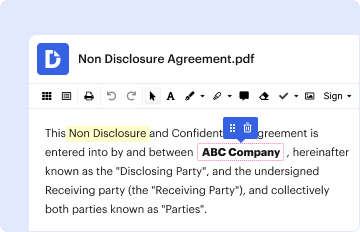
01. Edit your dochub com fillable form online
Type text, add images, blackout confidential details, add comments, highlights and more.
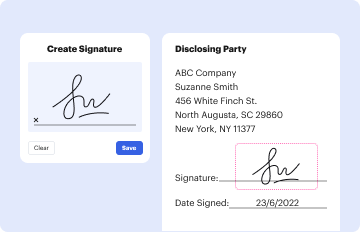
02. Sign it in a few clicks
Draw your signature, type it, upload its image, or use your mobile device as a signature pad.

03. Share your form with others
Send the document cr 143 is it or print it out via email, link, or fax. You can also download it, export it or print it out.
How to use or fill out cr 143 with our platform

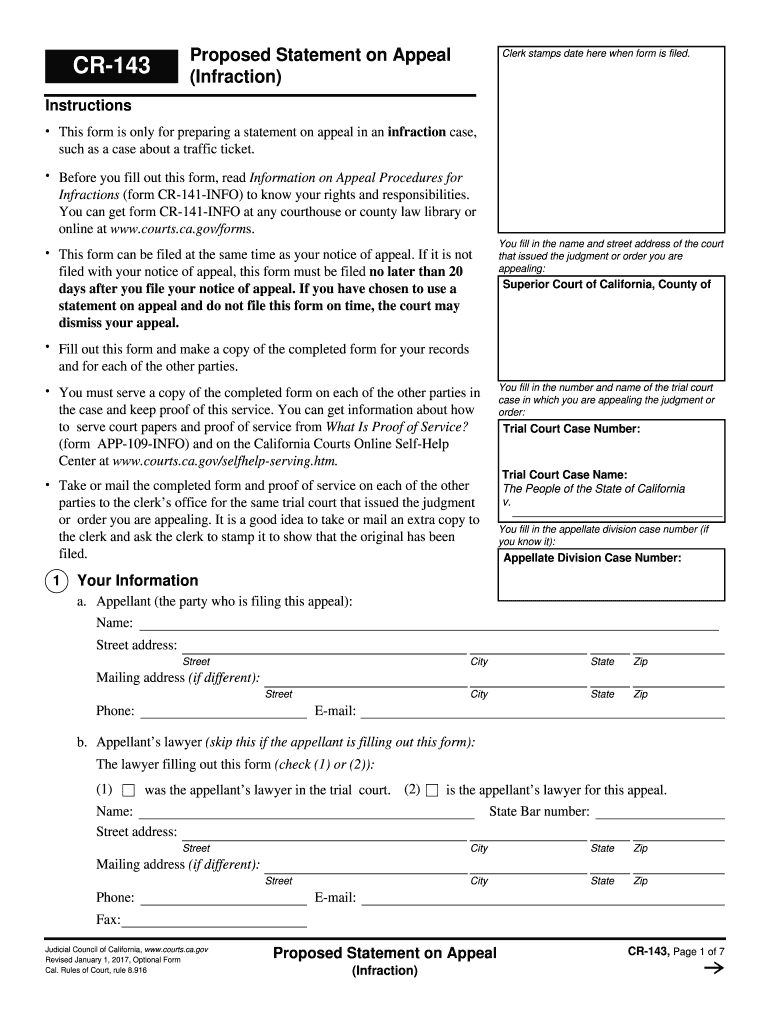
- Click ‘Get Form’ to open the CR-143 in the editor.
- Begin by entering the name and street address of the court that issued the judgment you are appealing. This is crucial for proper identification.
- Fill in the trial court case number and name, ensuring accuracy as this information links your appeal to the correct case.
- Provide your information as the appellant, including your name, address, phone number, and email. If you have legal representation, include your lawyer's details as well.
- In section 3, outline the reasons for your appeal. Clearly describe any legal errors made during the trial that you believe warrant a review.
- Complete sections regarding charges against you or your client and summarize any relevant motions made during the trial.
- Finally, review all entries for accuracy before saving or printing your completed form. Ensure you serve copies to all parties involved.
Start using our platform today to streamline your CR-143 form completion for free!
Fill out cr 143 online
It's free
It's free
See more cr 143 versions
We've got more versions of the cr 143 form. Select the right cr 143 version from the list and start editing it straight away!
Got questions?
We have answers to the most popular questions from our customers. If you can't find an answer to your question, please contact us.
Contact us
Can interim compensation table under section 143 A may be recovered as if it were a fine?
The interim compensation payable under this section may be recovered as if it were a fine under section 421 of the Code of Criminal Procedure, 1973.
What is the latest judgment of 143a?
The Supreme Court stated that an order directing the accused to pay interim compensation to the complainant shouldnt be passed mechanically but the Court will have to prima facie evaluate the merits of the case made out by the complainant and the merits of the defence pleaded by the accused in the reply to the
What is 143 of the powers of criminal courts?
143Powers to deprive offender of property used etc. for purposes of crime. (b)was intended by him to be used for that purpose, the court may (subject to subsection (5) below) make an order under this section in respect of that property.
Is 143A prospective?
Prospective or Retrospective ? Section 143A is prospective in nature and confined to cases where offences were committed after the introduction of Section 143A i.e. after 01.09. 2018.
What is the latest amendment in the Negotiable Instrument Act?
The Negotiable Instruments (Amendment) Bill, 2017 was introduced in Lok Sabha on January 2, 2018. Interim compensation: The Bill inserts a provision allowing a court trying an offence related to cheque bouncing, to direct the drawer (person who writes the cheque) to pay interim compensation to the complainant.
Security and compliance
At DocHub, your data security is our priority. We follow HIPAA, SOC2, GDPR, and other standards, so you can work on your documents with confidence.
Learn more


Related forms

Car seats are kid stuff! - California Department of Public Health
The document titled 'California’s Car Seats Are Kid Stuff!' serves as a comprehensive guide for designing, implementing, ...

Suicide Deaths California, 2000-2003 - California Department of - cdph ca
The document is a data summary from the Center for Health Statistics detailing suicide deaths in California from 2000 to ...

I am pleased to present to you the Chancellors Office report on the Telecommunications,
The document is the 14th annual report from the California Community Colleges Chancellor's Office, detailing the Telecom ...

MCP Form MCP 012 Delimit Position Request
The document is a form from the State Controller's Office of California used to request the delimitation of a position t ...

ITEM 6 RECONSIDERATION OF PRIOR STATEMENT OF DECISION FINAL
The audit report by the California State Controller's Office evaluates the costs claimed by the City and County of San F ...

Instructions for Form 8379 (Rev November 2024) Instructions for Form 8379, Injured Spouse Allocation
Instructions for Form 8379 (Rev November 2024) Instructions for Form 8379, Injured Spouse Allocation
The document provides instructions for Form 8379, which is used by an injured spouse to claim their share of a joint tax ...

El Crdito por Ingreso del Trabajo - Texas Comptroller
La Publicación 596 del IRS proporciona información sobre el Crédito por Ingreso del Trabajo (EIC) para el año 2023. Deta ...
People also ask
What is Section 143A of the Negotiable Instrument Act 1881?
Section 143A(1) of the Act is a crucial provision that allows for the grant of interim compensation to the complainant in cheque dishonour cases. This Section is generally considered to be a directory rather than mandatory as clarified in the case of Rakesh Ranjan Shrivastava vs. State of Jharkhand (2023).