




01. Edit your tubersol lot number and expiration date 2025 online
Type text, add images, blackout confidential details, add comments, highlights and more.

Type text, add images, blackout confidential details, add comments, highlights and more.

Draw your signature, type it, upload its image, or use your mobile device as a signature pad.

Send tubersol lot number and expiration date 2024 via email, link, or fax. You can also download it, export it or print it out.
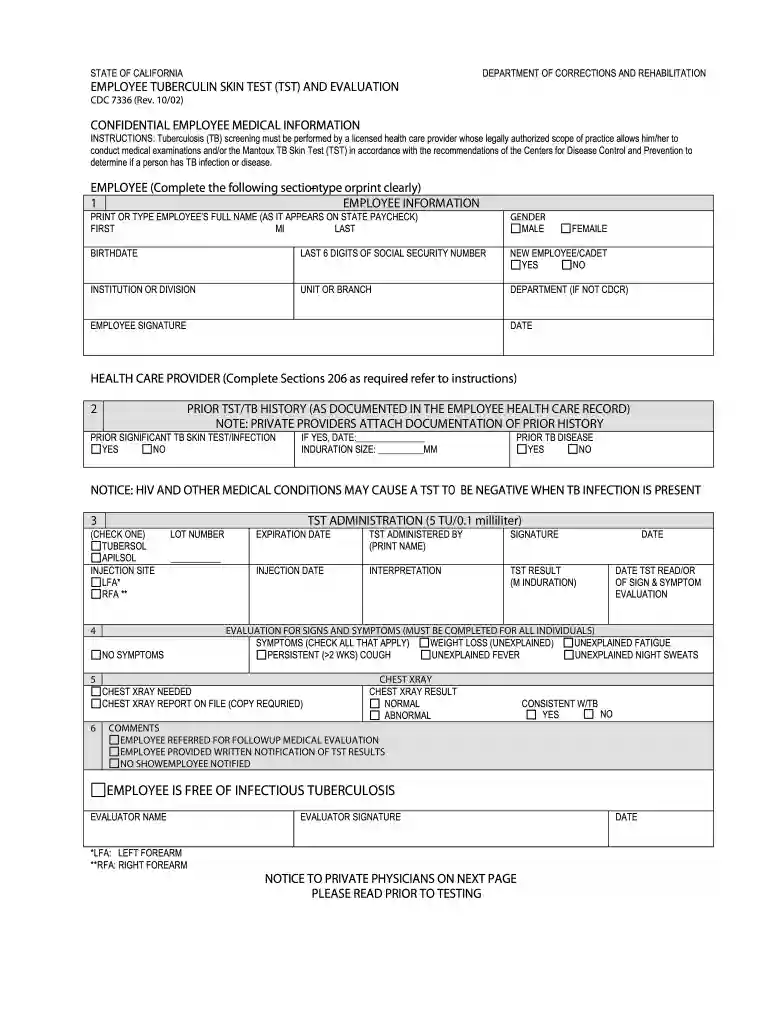
The CDC 7336 form is a critical document used primarily for recording and verifying the Tuberculin Skin Test (TST) results, which is essential in TB screening, especially in workplaces and healthcare settings in the United States. This form is specifically designed to ensure compliance with the Centers for Disease Control and Prevention (CDC) guidelines. It aids in documenting the TB screening process, assessing prior TB history, and recording the results of the TST.
The comprehensive nature of this form plays a vital role in public health initiatives to combat tuberculosis.
Filling out the CDC 7336 form requires careful attention to detail to ensure all necessary information is accurately documented. Here are the steps to complete the form:
Gather Required Information: Ensure you have all necessary details about the individual being screened, including their identification information and any relevant health history.
Fill in Employee Information: Accurately enter the employee's name, contact number, and job title, ensuring that spelling and details are correct to avoid any confusion.
Record Prior TB History: Check any prior history of tuberculosis or related treatments. This will guide healthcare providers in evaluating risk and determining next steps.
Document Test Administration: Include the date the test was administered and the name of the healthcare professional who performed the TST. It is important for maintaining proper records for future reference.
Cite Results Interpretation: Clearly indicate the observed results, including the measurement of induration, if applicable. Make note of any particular evaluations or concerns that may need further attention.
Each section must be completed meticulously to ensure compliance with health regulations.
The CDC 7336 form is a cornerstone in TB screening protocols within workplaces and healthcare systems. Its importance includes:
Standardizing Screening Practices: By using the form in accordance with CDC guidelines, organizations can ensure that TB screening processes are uniform and effective.
Facilitating Record Keeping: The form aids healthcare providers and organizations in maintaining clear documentation of testing efforts, which is essential for compliance and monitoring.
Promoting Early Detection: Quick and accurate filling out of the form facilitates timely identification of TB cases, thereby aiding in the early intervention and treatment of those infected.
When submitting the CDC 7336 form, certain documents might also be required to validate the information provided. These typically include:
Identification Documents: A government-issued ID may be necessary to verify the identity of the individual undergoing TB testing.
Medical History Records: Any previous medical records relating to TB diagnosis or treatment should be included to provide context for assessment.
Test Administration Notes: Documentation from the healthcare provider that administered the TST can supplement the form, especially in cases of abnormal findings or concerns.
Ensuring all necessary documents accompany the CDC 7336 form will facilitate smoother processing and compliance with health regulations.
Compliance with the guidelines established by the CDC is paramount when utilizing the CDC 7336 form. Key compliance elements include:
Adhering to Testing Protocols: The form should be utilized strictly under the guidelines of the CDC for administering and interpreting the Tuberculin Skin Test.
Monitoring and Reporting: Healthcare providers should monitor the results closely and report any positives or indeterminate results following protocol standards.
Training and Resources: Staff responsible for administering the TST must receive adequate training to ensure they understand how to fill out the CDC 7336 form and interpret its results correctly.
Adhering to these compliance measures helps in effectively managing tuberculosis risk within communities.
The CDC 7336 form is primarily used by:
Healthcare Providers: Physicians, nurses, and public health officials who conduct TB screenings in various settings are the primary users of this form.
Employers: Organizations required to screen employees for TB, especially in healthcare and correctional settings, frequently utilize this document.
Public Health Agencies: Local and state health departments use the form to track TB screening compliance and assist with surveillance efforts.
Understanding who utilizes the form helps in targeting training and resources appropriately.
Familiarity with key terms associated with the CDC 7336 form enhances understanding and communication regarding TB screening. Important terms include:
Tuberculin Skin Test (TST): A diagnostic tool used to determine TB infection by assessing the immune response to tuberculin.
Induration: The hardened area that forms at the injection site, which is measured to determine the test result's significance.
False Positive/Negative: Potential outcomes where test results do not accurately reflect the individual's TB status, necessitating further testing.
These terms are essential for professionals involved in TB screening and management.
We've got more versions of the tubersol lot number and expiration date 2025 form. Select the right tubersol lot number and expiration date 2025 version from the list and start editing it straight away!
At DocHub, your data security is our priority. We follow HIPAA, SOC2, GDPR, and other standards, so you can work on your documents with confidence.
May 5, 2017 Respondents should be aware that notwithstanding any other provision of law, no person shall be subject to any penalty for failing to complyRead more
This examination shall consist of an approved intradermal tuberculin test or any other test for tuberculosis infection recommended by the federal Centers for.Read more
Submit the completed Employee Tuberculin Skin Test (TST) and Evaluation (CDCR 7336) form, in a sealed envelope. Instructions: Health Care Provider (HCP).Read more


