Owner's or Seller's Affidavit of No Liens - New Hampshire 2026

Get Form
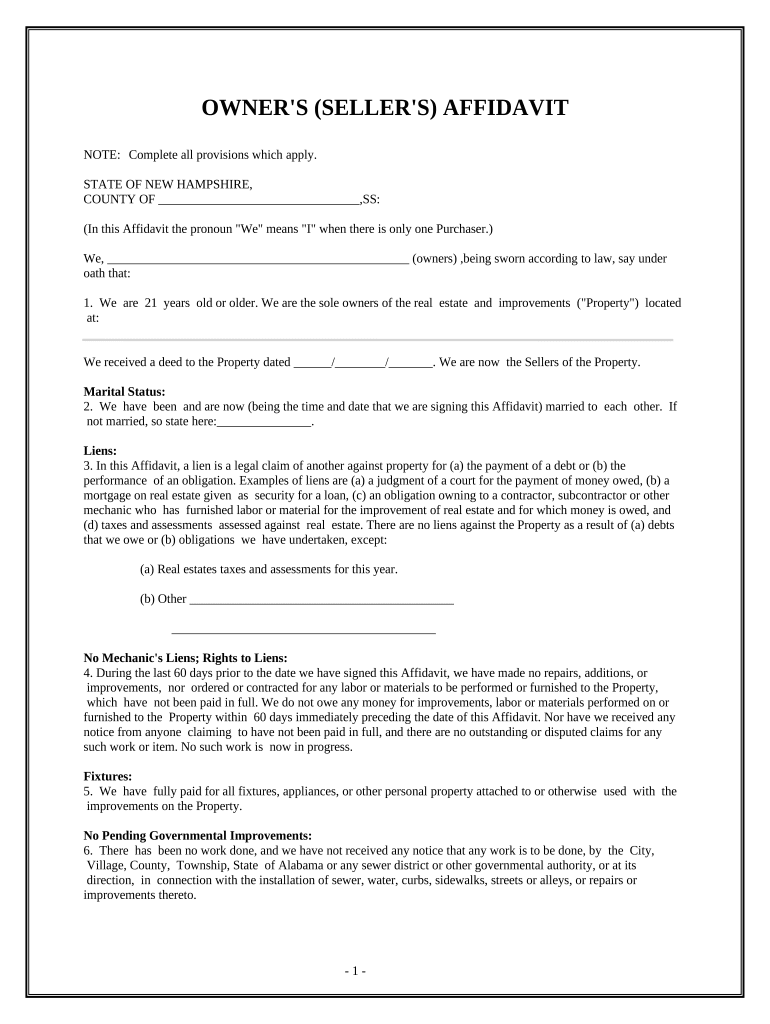
Owner's or Seller's Affidavit of No Liens - New Hampshire Preview on Page 1

Here's how it works

01. Edit your form online
Type text, add images, blackout confidential details, add comments, highlights and more.
02. Sign it in a few clicks
Draw your signature, type it, upload its image, or use your mobile device as a signature pad.
03. Share your form with others
Send it via email, link, or fax. You can also download it, export it or print it out.

How to use or fill out Owner's or Seller's Affidavit of No Liens - New Hampshire with our platform

Form edit decoration
9.5
Ease of Setup
DocHub User Ratings on G2
9.0
Ease of Use
DocHub User Ratings on G2
  1. Click ‘Get Form’ to open the Owner's or Seller's Affidavit of No Liens in the editor.
  2. Begin by filling in your name as the owner(s) and the property address where indicated. Ensure that you provide accurate details regarding your ownership.
  3. Indicate your marital status. If you are married, confirm this; otherwise, specify your status clearly.
  4. In the liens section, declare any existing liens against the property. If there are none except for real estate taxes, state that clearly.
  5. Complete the sections regarding repairs and improvements made within the last 60 days, confirming no outstanding payments are due.
  6. Review and fill out all remaining sections concerning structural defects, lawsuits, bankruptcy status, and easements as applicable.
  7. Finally, sign and date the affidavit at the bottom. Ensure a notary public witnesses your signature for validation.

Start using our platform today to easily complete your Owner's or Seller's Affidavit of No Liens for free!

be ready to get more

Complete this form in 5 minutes or less

Get form

Got questions?

We have answers to the most popular questions from our customers. If you can't find an answer to your question, please contact us.
Contact us
Following is a brief outline of the lien process. A Notice of Delinquency is forwarded to the owner(s) of each delinquent tax account. If the account remains unpaid, a Notice of Impending Lien is mailed to all records owner(s), by certified mail, return receipt requested, at least 30 days prior to the lien date.
Is New Hampshire a Tax Lien State? Again, if you dont pay your property taxes, the past-due amount becomes a lien on your home. Each state has a different tax sale process to collect delinquent taxes. New Hampshire is generally considered a tax deed state.
To sign and file a quit claim deed in New Hampshire, the form must be filed at the County Recorders Office where the real estate is located. Additionally, the deed must be signed in the presence of a notary public by the grantor(s) only, as per N.H. Rev. Stat. 477:3-a and N.H. Rev.
To attach a judgment lien, you must follow these steps. Get a certified copy. First, youll need a certified copy of the judgment. Prepare an affidavit. Record with register of deeds.
In California, paying someone elses taxes, even if done in good faith, is considered a gesture of goodwill or a means of avoiding a tax lien, but no matter the motive, payment does not transfer legal ownership.

Security and compliance

At DocHub, your data security is our priority. We follow HIPAA, SOC2, GDPR, and other standards, so you can work on your documents with confidence.

Learn more
ccpa2
pci-dss
gdpr-compliance
hipaa
soc-compliance
be ready to get more

Complete this form in 5 minutes or less

Get form

People also ask

In order to have a mechanics lien in New Hampshire, the lien claimant must file an Ex Parte Petition to Secure Mechanics Lien with the court. This may be done without notice of this action to the owner or other parties (Notice of Attempt to Lien must be given previously if lien claimant is not the general contractor).
HOA Property Foreclosure In New Hampshire, six months worth of HOA fees have super lien status. Super liens have priority over all other liens when it comes to the proceeds from foreclosed properties.
A lien secures the governments interest in your property when you dont pay your tax debt. A levy actually takes the property to pay the tax debt. If you dont pay or make arrangements to settle your tax debt, the IRS can levy, seize and sell any type of real or personal property that you own or have an interest in.

Related links