Renunciation of Legacy in Favor of Other Family Members 2026

Get Form
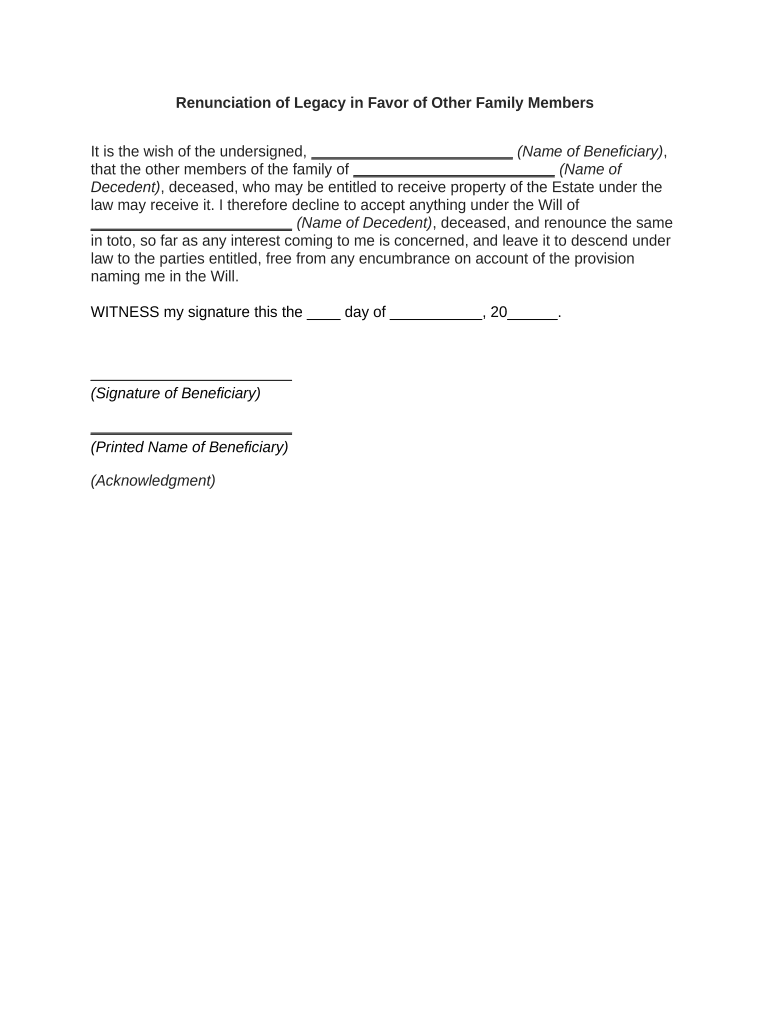
Renunciation of Legacy in Favor of Other Family Members Preview on Page 1

Here's how it works

01. Edit your form online
Type text, add images, blackout confidential details, add comments, highlights and more.
02. Sign it in a few clicks
Draw your signature, type it, upload its image, or use your mobile device as a signature pad.
03. Share your form with others
Send it via email, link, or fax. You can also download it, export it or print it out.

How to use or fill out Renunciation of Legacy in Favor of Other Family Members with DocHub

Form edit decoration
9.5
Ease of Setup
DocHub User Ratings on G2
9.0
Ease of Use
DocHub User Ratings on G2
  1. Click ‘Get Form’ to open the Renunciation of Legacy in Favor of Other Family Members in our editor.
  2. Begin by entering your name in the designated field for the beneficiary. This identifies you as the individual renouncing the legacy.
  3. Next, input the name of the decedent, which is essential for clarifying whose estate you are renouncing. Ensure accuracy to avoid any legal complications.
  4. In the section stating your intention to decline acceptance, confirm that you wish to renounce all interests under the Will. This is a crucial declaration that must be clear and unequivocal.
  5. Finally, sign and date the document where indicated. Your signature validates your decision and should be followed by your printed name for clarity.

Start using our platform today to easily complete your Renunciation of Legacy form for free!

be ready to get more

Complete this form in 5 minutes or less

Get form

Got questions?

We have answers to the most popular questions from our customers. If you can't find an answer to your question, please contact us.
Contact us
Disclaiming an inheritance allows the assets to pass to another beneficiary who can protect them from being claimed by creditors. Additionally, for individuals receiving government benefits, such as Medicaid, an inheritance could disqualify them from receiving these benefits.
A legacy is a gift in a will, often money or property, passed to a legatee. There are multiple types of legacies: general, specific, residuary, demonstrative, universal, and particular. In family law, legacies play an important role in inheritance planning, ensuring loved ones are provided for after death.
There are two options if you do not want to receive a gift left to you in a Will: Disclaim the inheritance. Arrange for a deed of variation changing the terms of the Will.
The accretion of renounced successions refers to the process of redistributing the share of an estate that an heir has chosen to renounce. An heir may renounce their share if the debts of the estate exceed its assets or if the complexities of settling the estate are deemed not worth the potential benefits.
In cases of succession, the rule is that heirs cannot be forced to inherit and may thus renounce, waive or disclaim the succession. While the testator is still alive, an heir may renounce their succession right in advance under an agreement with the testator.
be ready to get more

Complete this form in 5 minutes or less

Get form

People also ask

The renunciation of inheritance is the act through which a person explicitly and clearly expresses their desire to reject the portion of the estate that corresponds to them in the succession. Only those with the capacity to dispose of their property can renounce an inheritance.
The purpose of the renunciation form is to defer the right to serve as the representative to another person. No one can be forced to sign a renunciation. But if the heirs cannot agree, then a petition must be filed with the Register of Wills to decide who will serve.

Related links