




01. Edit your form online
Type text, add images, blackout confidential details, add comments, highlights and more.

Type text, add images, blackout confidential details, add comments, highlights and more.

Draw your signature, type it, upload its image, or use your mobile device as a signature pad.

Send it via email, link, or fax. You can also download it, export it or print it out.
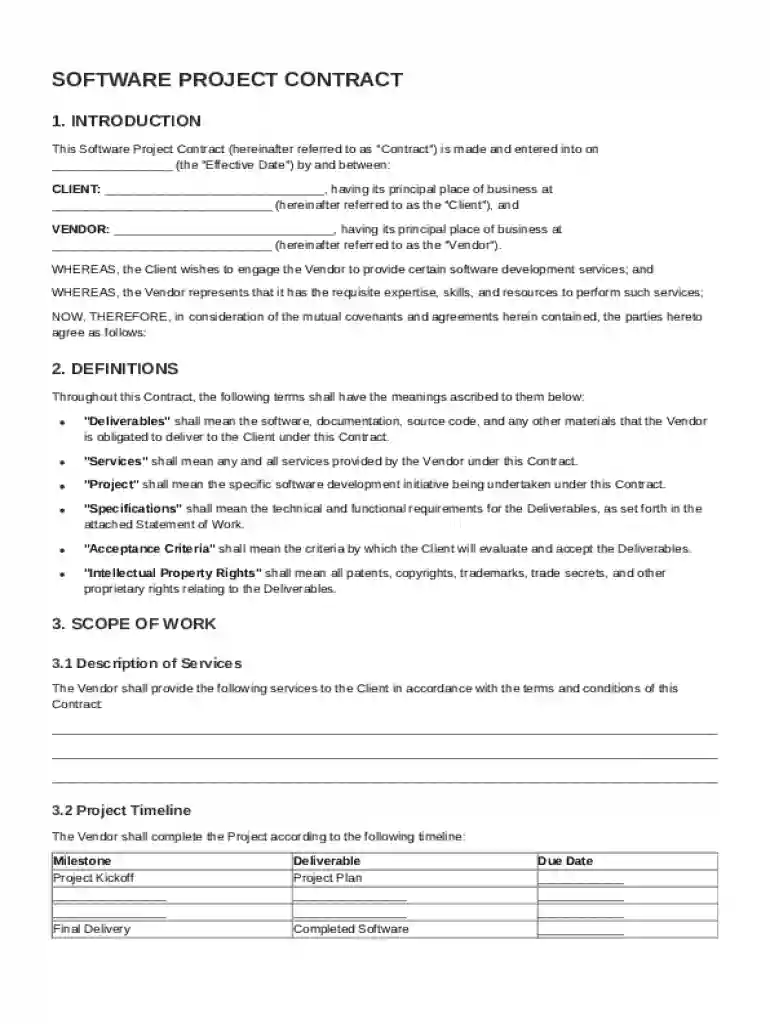
The Software Project Contract Template serves as an essential legal framework outlining the terms and responsibilities for a software development engagement between a client and a vendor. This document provides a comprehensive structure that defines crucial aspects such as the scope of work, project timeline, payment terms, and intellectual property rights. By using this template, both parties are equipped with a clear understanding of their obligations, ensuring a mutual agreement is set from the onset of the project. One of its primary functions is to mitigate potential disputes by preemptively addressing concerns related to confidentiality, liability, and termination conditions.
The contract's essence lies in its ability to standardize the expectation-setting process, offering a blueprint that caters to diverse software development projects. It also facilitates communication by setting definitive guidelines on how changes during the project will be managed, thus minimizing project disruptions. Additionally, having a robust contract template ensures compliance with legal norms, which is vital in safeguarding both parties' interests.
Understanding the core elements within a Software Project Contract Template is crucial for effectively utilizing the document. Here are some of the main components:
Scope of Work: Clearly delineates the functionalities to be developed, including deliverables, milestones, and any exclusions. This section ensures that the project evolves within predefined boundaries.
Project Timeline: Details the phases of the project along with expected completion dates, enabling effective project management and accountability.
Payment Terms: Outlines how and when payments will be made, which may include installments or milestone-based payments, emphasizing transparency in financial transactions.
Intellectual Property Rights: Specifies who will own the software or any related intellectual property upon completion, safeguarding the proprietary rights of the client or vendor.
Confidentiality Obligations: Ensures that sensitive information shared during the project remains protected, highlighting the non-disclosure commitments of each party.
Warranties and Liability Limitations: Provides assurances regarding the quality and functionality of the delivered software, while limiting the liability in case of unforeseen issues.
Termination Conditions: Covers scenarios under which the contract can be terminated, ensuring clarity on what conditions necessitate a cessation of the agreement.
Dispute Resolution: Describes methods for resolving conflicts, whether through mediation, arbitration, or court, to facilitate an amicable resolution process.
Leveraging the Software Project Contract Template involves a few systematic steps to ensure it meets the specific needs of a project:
Identify and Define Objectives: Begin by clearly articulating the project's goals and expected outcomes. This clarity helps in customizing the template to fit the project's unique requirements.
Customize Template Sections: Modify each section to reflect specific project details, from the scope of work to payment schedules. Ensure precision in language to avoid any misunderstandings.
Engage All Stakeholders: Involve all parties who will be part of the project. This collaboration ensures that everyone is on the same page regarding responsibilities and expectations.
Legal Review: Seek legal advice to fill gaps specific to local jurisdictions or industry standards. A legal expert can provide insights that enhance the contract's robustness.
Iterate and Finalize: Review the finalized document with all stakeholders, making amendments based on feedback, before obtaining signatures from authorized representatives.
Maintain and Update: Monitor the contract’s effectiveness throughout the project's lifecycle, making necessary amendments to accommodate any agreed-upon changes.
By following these steps, project stakeholders can effectively utilize a Software Project Contract Template to streamline project execution.
A variety of parties find immense value in using a Software Project Contract Template, primarily within industries that rely heavily on software development.
Software Development Companies: These entities utilize the template to formalize agreements with clients, securing clear terms and conditions for software deliverables.
Corporate Clients: Companies engaging software vendors to develop custom applications rely on these templates to protect their interests and define project expectations.
Freelance Developers: Independent software developers may use the template for agreements with clients, ensuring all project details are documented.
Project Managers: Those responsible for overseeing development projects utilize the template to maintain contractual consistency and ensure compliance with project timelines and budgets.
Legal Teams: Legal professionals may assist in drafting, reviewing, and negotiating terms within the template to ensure that all clauses protect their client's interests.
By leveraging the template, users across these roles can effectively manage software development engagements with minimized risk and enhanced clarity.


The legal use of a Software Project Contract Template necessitates proper execution and compliance with applicable laws. Attention to legal protocols is vital to uphold the contract's validity and enforceability.
Ensure Compliance: Review the document against federal, state, and local regulations relevant to software development and ensure it aligns with legal standards.
Include Essential Clauses: Vital clauses such as indemnification, force majeure, and compliance with industry-specific regulations must be incorporated to cover all legal bases.
Document Signatures: Authentication through authorized signatures is crucial — either electronic or handwritten, depending on the legal requirements that govern the agreement's enforceability.
Digital Accessibility: Make electronic versions of the contract accessible, facilitating easier reference by all parties through platforms such as DocHub, which supports legally binding electronic signatures.
By meeting these legal needs, a Software Project Contract Template gains more efficacy and offers legal protection to all parties.
Understanding the terminology within a Software Project Contract Template is crucial for accurate interpretation and execution. Here are some commonly used terms:
Deliverables: The tangible or intangible outputs from a project, ultimately presented to the client upon completion.
Milestones: Predefined points within the project timeline that signify progress stages towards completing deliverables.
Indemnification: A clause promising protection against losses or damages incurred as a result of the other's action or inaction.
Force Majeure: A contract provision that alleviates liability for natural or unforeseen catastrophic events that impede contractual obligations.
Change Order: A formal request to alter the original contract terms, usually involving scope, deliverables, or timeline adjustments.
Understanding these terms fosters better clarity and ensures that each element of the contract is correctly applied during project execution.
Successfully completing a Software Project Contract Template involves executing it with meticulous attention to detail. Follow this structured approach:
Gather Relevant Information: Collect all necessary project-specific data, including participant details, project timeline, and payment structure.
Fill Template Sections: Utilize the drafted content sections, modifying them to align with project particulars, ensuring each contract element is addressed.
Review for Accuracy: Thoroughly examine the document for errors or missing details, correcting any discrepancies to maintain clarity and coherence.
Engage Stakeholders: Share the draft with all involved parties for review and feedback, ensuring recommendations align with project objectives.
Incorporate Feedback: Implement agreed-upon revisions to achieve desired modifications, streamlining the contract's process.
Finalize and Sign: Secure final approval from all parties and execute the contract using signatures—digital or physical, as the legal context requires.
By adhering to these steps, project participants can ensure that the Software Project Contract Template is accurately completed and legally binding.
Explore practical scenarios where a Software Project Contract Template has been effectively implemented:
Custom Software Development for Retail: A retail giant seeks a novel inventory management system. The vendor utilizes the template to outline milestones, specify data security protocols, and define intellectual property rights, ensuring a secure and transparent agreement.
Mobile Application Creation for Healthcare: A healthcare provider needs a patient engagement app. The contract template helps to stipulate privacy regulations aligned with HIPAA, setting a clear precedent on confidentiality obligations.
Enterprise Software Integration: An enterprise requires custom software to integrate with existing systems. By employing a structured contract, both the client and the vendor establish clear guidelines on deliverables and timelines, minimizing integration risks.
These examples illustrate the varied applications of a Software Project Contract Template in achieving clarity and alignment between stakeholders while executing software development projects.
At DocHub, your data security is our priority. We follow HIPAA, SOC2, GDPR, and other standards, so you can work on your documents with confidence.

Aug 1, 2016 Licensed Software: means the enclosed SOFTWARE/FIRMWARE, EXAMPLES, PROJECT. TEMPLATE and all the related documentation and design tools
A standardized agreement serves as a legally binding document outlining the terms and conditions between a client and a software development provider.


