Ct landlord 2026

Get Form
ct landlord Preview on Page 1

Here's how it works

01. Edit your form online
Type text, add images, blackout confidential details, add comments, highlights and more.
02. Sign it in a few clicks
Draw your signature, type it, upload its image, or use your mobile device as a signature pad.
03. Share your form with others
Send it via email, link, or fax. You can also download it, export it or print it out.

How to use or fill out ct landlord with our platform

Form edit decoration
9.5
Ease of Setup
DocHub User Ratings on G2
9.0
Ease of Use
DocHub User Ratings on G2
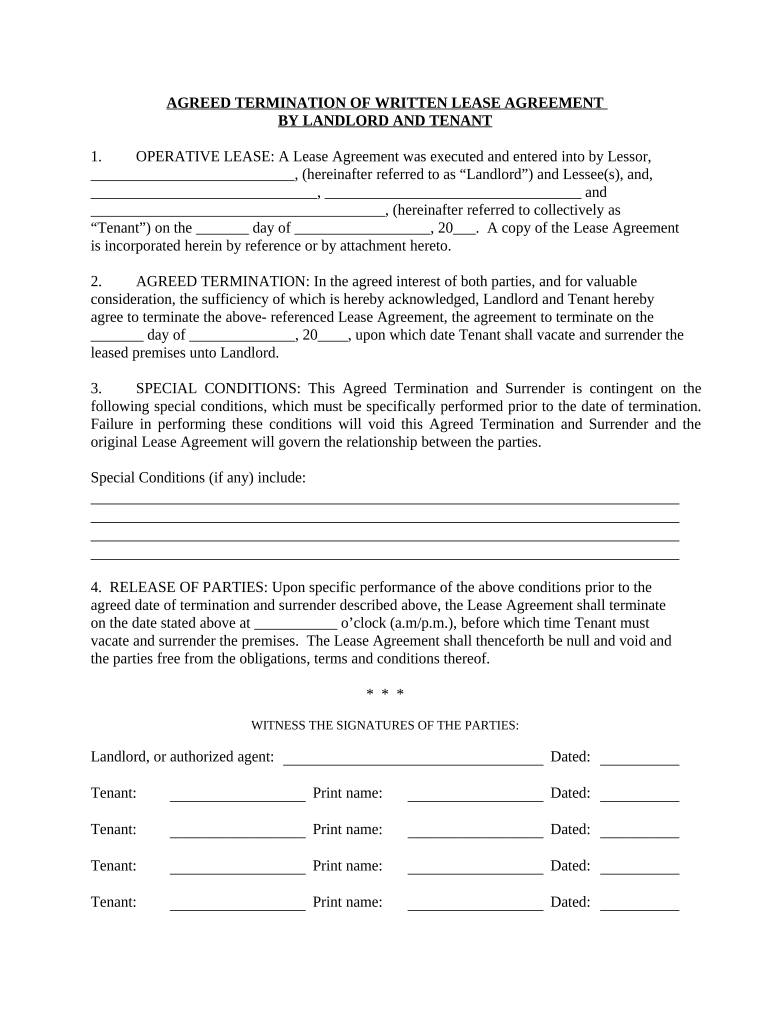
  1. Click ‘Get Form’ to open the ct landlord document in the editor.
  2. Begin by filling in the names of the Landlord and Tenant(s) in the designated fields. Ensure accuracy as these names will be referenced throughout the document.
  3. Enter the date when the original Lease Agreement was executed. This is crucial for establishing the timeline of your agreement.
  4. Specify the agreed termination date in both sections provided. This indicates when the Tenant must vacate the premises.
  5. If there are any special conditions that need to be met before termination, list them clearly in the designated area to avoid any misunderstandings.
  6. Finally, ensure all parties sign and date where indicated. This finalizes your agreement and releases both parties from their obligations under the original Lease Agreement.

Start using our platform today for free to streamline your document editing and signing process!

be ready to get more

Complete this form in 5 minutes or less

Get form

Got questions?

We have answers to the most popular questions from our customers. If you can't find an answer to your question, please contact us.
Contact us
Connecticut does not have strict rent control laws like some other states. Instead, it emphasizes lease agreements and common law principles to guide rent practices. Landlords can increase rent, but they must provide reasonable notice and cannot raise it for discriminatory reasons.
While theres no legal cap on how much a private landlord can increase rent, there are still a few things to consider before going ahead with the uptick.
Connecticut is considered a less landlord-friendly state because tenants have more rights and fewer restrictions compared to other states.
ing to data from the Zillow Observed Rent Index, year-over-year rent growth exploded from just under 2% in February 2021 to nearly 16% in February 2022 before falling back down. By mid-2023, rent growth had slowed to pre-pandemic rates, averaging 3.4% annually over the past year.
In Connecticut, security deposits are capped at two months rent. Landlords must return the full deposit within 30 days after a tenant moves out, minus any properly itemized deductions for damages beyond normal wear and tear. There are also rules around rent increases.

Security and compliance

At DocHub, your data security is our priority. We follow HIPAA, SOC2, GDPR, and other standards, so you can work on your documents with confidence.

Learn more
ccpa2
pci-dss
gdpr-compliance
hipaa
soc-compliance

People also ask

If the rent increase does not seem reasonable to you: If your town has a fair rent commission, you can file a complaint with that commission. If you dont know if your town has a commission, call town hall and ask.
Landlords in Connecticut cant discriminate against tenants based on protected characteristics, enforce illegal rent control or excessive late fees, enter a rental unit without proper notice or just cause, forcibly evict tenants without following legal procedures, or fail to maintain the property to required safety and
Connecticut does not have a state law that caps rent increases at a specific percentage. Rent hikes must not be discriminatory or retaliatory and should be fair under the circumstances. Consider checking landlord legal guidelines in Connecticut for additional insights.

Related links