




01. Edit your form online
Type text, add images, blackout confidential details, add comments, highlights and more.

Type text, add images, blackout confidential details, add comments, highlights and more.

Draw your signature, type it, upload its image, or use your mobile device as a signature pad.

Send it via email, link, or fax. You can also download it, export it or print it out.
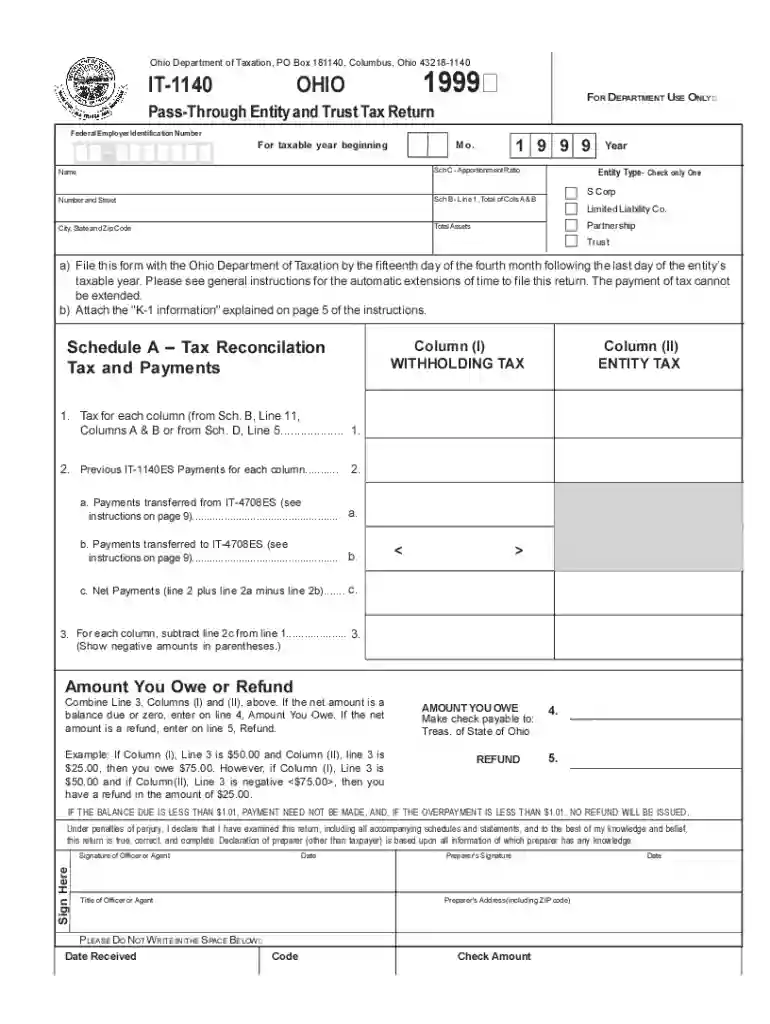
The It-1140 form, specifically for Ohio, serves as a Pass-Through Entity and Trust Tax Return. It is a tax document used to report and reconcile tax obligations for entities such as partnerships, S-corporations, and trusts that pass income to individual members or beneficiaries. Unlike corporations taxed at the entity level, these entities distribute income, and taxes are accounted for at the individual recipient level. The form encompasses detailed sections to capture income, deductions, credits, and allocate income among individual beneficiaries or members.
Gather Necessary Information: Start by collecting all relevant financial documents, such as income statements, balance sheets, and records of distributions to members or beneficiaries.
Select Entity Type: Clearly indicate your entity type at the beginning of the form. You need to match this with the existing structure of your organization, like partnership or S-corporation.
Income Reporting: Include all income received by the entity. This can be from various sources like sales revenue, dividends, or interests.
Deduction and Credits: List all allowable deductions and any applicable credits. This helps determine the taxable income of the entity.
Calculate Apportionment Ratios: For entities doing business in multiple states, calculate the apportionment ratio to determine the Ohio taxable income.
Complete Payment Coupon: Fill out estimated tax payment coupons, if required, for future years' obligation compliance.
Pass-through entities, including partnerships, S-corporations, and some trusts, use the It-1140 form. These entities are defined by their structure where income is "passed through" to the individual members. Typically, owners or managers responsible for tax compliance within these organizations would be the individuals completing this form.


Ohio imposes specific guidelines and tax rates for pass-through entities and has unique rules regarding the apportionment of income. Regulations also include details on how to handle nonresident member taxes and specific apportioning formulas that all users must adhere to when filing.
Failing to file the It-1140 correctly or on time can result in significant penalties. Ohio may impose late filing fees, interest on owed taxes, and potential fines for incorrect accounting or failure to appropriately report all income and deductions. Compliance is paramount to avoid financial and legal repercussions.
We've got more versions of the It-1140 form. Select the right It-1140 version from the list and start editing it straight away!
At DocHub, your data security is our priority. We follow HIPAA, SOC2, GDPR, and other standards, so you can work on your documents with confidence.


