Delaware landlord notice 2026

Get Form
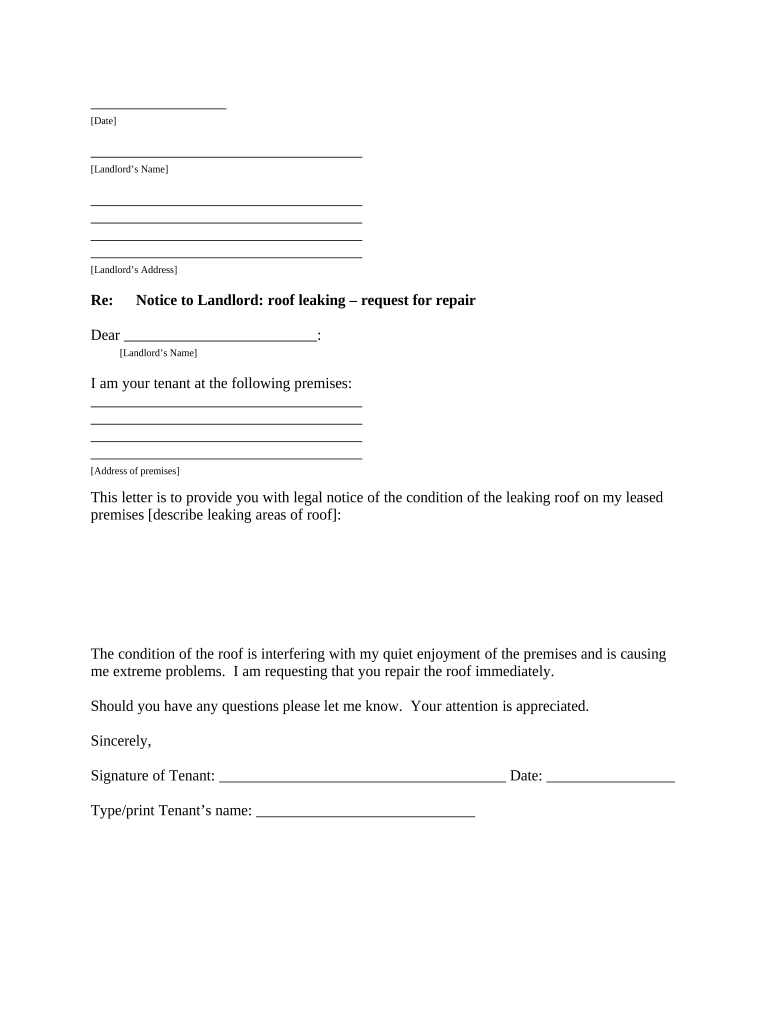
delaware landlord notice Preview on Page 1

Here's how it works

01. Edit your form online
Type text, add images, blackout confidential details, add comments, highlights and more.
02. Sign it in a few clicks
Draw your signature, type it, upload its image, or use your mobile device as a signature pad.
03. Share your form with others
Send it via email, link, or fax. You can also download it, export it or print it out.

How to use or fill out Delaware Landlord Notice with our platform

Form edit decoration
9.5
Ease of Setup
DocHub User Ratings on G2
9.0
Ease of Use
DocHub User Ratings on G2
  1. Click ‘Get Form’ to open the Delaware Landlord Notice in the editor.
  2. Begin by entering the date at the top of the form. This is essential for record-keeping and legal purposes.
  3. Fill in your landlord’s name and address in the designated fields. Ensure accuracy to avoid any miscommunication.
  4. In the body of the notice, clearly state your concerns regarding the leaking roof. Describe specific areas affected to provide clarity.
  5. Include your address as a tenant, ensuring that it matches your lease agreement for verification.
  6. Sign and date the document at the bottom, then type or print your name as required.
  7. For proof of delivery, select how you will deliver this notice to your landlord and sign accordingly.

Start using our platform today to easily complete and send your Delaware Landlord Notice for free!

be ready to get more

Complete this form in 5 minutes or less

Get form

Got questions?

We have answers to the most popular questions from our customers. If you can't find an answer to your question, please contact us.
Contact us
Landlord Notice Requirement: Must give at least 2 months notice, aligned with rental periods, under Section 21. This remains the statutory minimum until the Renters Rights Bill is enacted. Tenants Notice Requirement: Must give at least 1 months notice (if rent is paid monthly) or 4 weeks notice (if paid weekly).
A landlord who wants to end a month-to-month tenancy, but does not have legal cause to evict the tenant, can give the tenant a written 30-day notice to move. This notice must explain to the tenant that the landlord is terminating the tenancy and that the tenant must move out of the rental unit by the end of 30 days.
- 3-Day Notice: Non-payment of rent or lease violations. - 30-60 Day Notice: For no-fault evictions. Landlords can file if the tenant fails to comply with the notice.
The Delaware 5-day notice to quit for non-payment informs a tenant that they have defaulted in their rent payment and they risk lease termination. The form states that the tenants lease will be terminated if the tenant doesnt pay all rent due within five days of receiving the notice.
Delaware Eviction Time Estimates ActionDuration Eviction hearing No designated time Issuance/service of writ of possession 10+ days Time to quit after writ is posted 24 hours Total 1-3 months3 more rows Jul 14, 2025

Security and compliance

At DocHub, your data security is our priority. We follow HIPAA, SOC2, GDPR, and other standards, so you can work on your documents with confidence.

Learn more
ccpa2
pci-dss
gdpr-compliance
hipaa
soc-compliance

People also ask

Landlords of owner-occupied units must obtain lead certificates for their rental properties; this law took effect on January 1, 2024. Under the new rental registry law, once the rental registry is in place, all landlords must register by providing basic contact information.
In Delaware, the eviction process starts with a written notice from the landlord. For late rental payments, landlords issue a 5-Day Notice to Pay. If the tenant doesnt pay within this period, eviction proceedings can start. For month-to-month tenancy, a 60-day notice is required to end the lease agreement.
As a tenant you are more than likely an Assured Shorthold Tenant. As such the landlord should issue you with a 2 month written notice. If the landlord has not provided you with written notice or has given less than 2 months notice, then you do not have to leave the accommodation.

Related links