Temporary Lease Agreement to Prospective Buyer of Residence prior to Closing - Vermont 2026

Get Form
Temporary Lease Agreement to Prospective Buyer of Residence prior to Closing - Vermont Preview on Page 1

Here's how it works

01. Edit your form online
Type text, add images, blackout confidential details, add comments, highlights and more.
02. Sign it in a few clicks
Draw your signature, type it, upload its image, or use your mobile device as a signature pad.
03. Share your form with others
Send it via email, link, or fax. You can also download it, export it or print it out.

How to use or fill out Temporary Lease Agreement to Prospective Buyer of Residence prior to Closing - Vermont

Form edit decoration
9.5
Ease of Setup
DocHub User Ratings on G2
9.0
Ease of Use
DocHub User Ratings on G2
  1. Click ‘Get Form’ to open it in the editor.
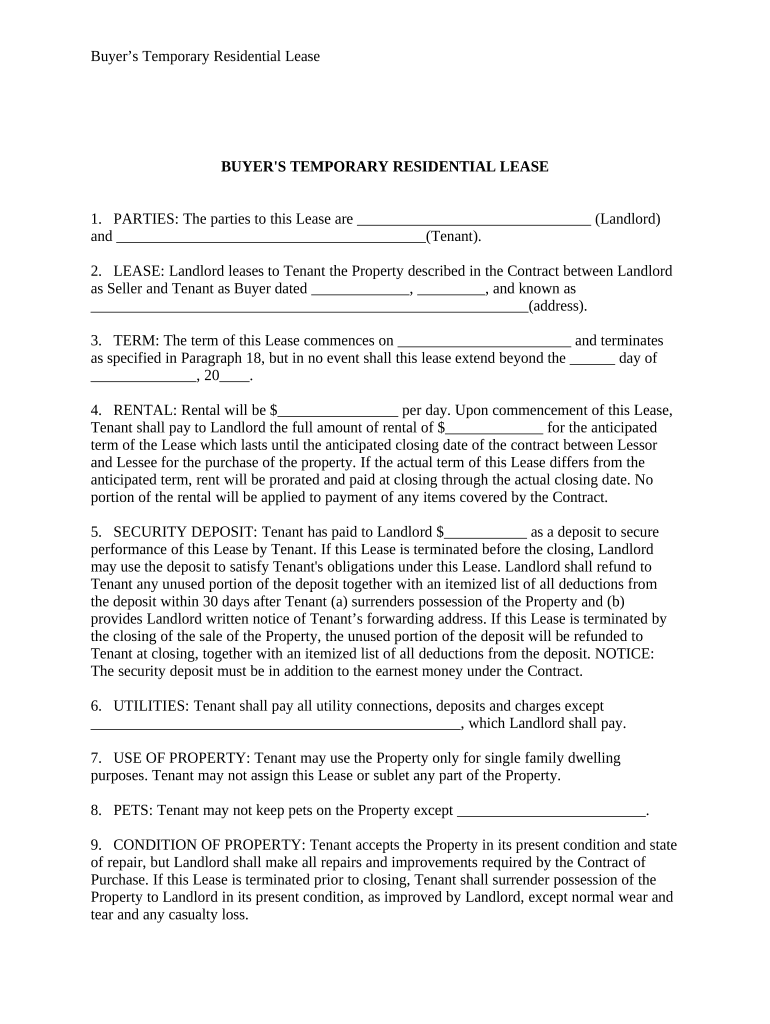
  2. Begin by filling in the parties involved in the lease. Enter the names of the Landlord and Tenant in the designated fields.
  3. Specify the property address as described in the contract between Landlord and Tenant. Ensure accuracy for legal purposes.
  4. Indicate the lease term by entering the start date and termination date, ensuring it does not exceed specified limits.
  5. Fill in the rental amount per day and total rental due upon commencement. Remember that any changes in lease duration will require prorating.
  6. Complete security deposit details, including amount paid and conditions for its return or use.
  7. Review utility responsibilities, specifying which utilities are covered by Tenant and Landlord.
  8. Address any special provisions or restrictions, such as pet policies or alterations to property.

Start using our platform today to easily complete your Temporary Lease Agreement online for free!

be ready to get more

Complete this form in 5 minutes or less

Get form

Got questions?

We have answers to the most popular questions from our customers. If you can't find an answer to your question, please contact us.
Contact us
It is important to remain open to changes during the review process to finalize a lease that satisfies all parties involved. Once you docHub an agreement, the tenant must sign the lease document first. By signing first, the tenant contractually binds themself to your property and cannot reverse their decision.
While occupancy allows early access to the unit, it comes with added financial responsibilities that do not build equity. Closing, on the other hand, marks the true milestone of ownership but requires careful financial preparation.
Occupancy refers to the act of possessing or using a property or space, particularly in the context of real estate, leases, or housing agreements. It typically pertains to the right or condition of a person or entity living in or using a property, whether for residential, commercial, or industrial purposes.
If a buyer wants to occupy the property before closing day and the seller agrees to allow the buyer to take possession of the home early, the two parties would draft a pre-occupancy agreement to specify the conditions of the agreement.
The 2 biggest signs are not keeping up with basic maintenance. And asking for illegal terms in the lease agreement.

Security and compliance

At DocHub, your data security is our priority. We follow HIPAA, SOC2, GDPR, and other standards, so you can work on your documents with confidence.

Learn more
ccpa2
pci-dss
gdpr-compliance
hipaa
soc-compliance

People also ask

Interim occupancy is the period of time between when your unit is ready for occupancy and when the entire building is registered. During this time, you will pay occupancy fees and wont own your unit yet. Final closing happens when the entire building is registered, and you will obtain legal title to your unit.
Early possession or occupancy is a request made by a homebuyer to move into a property before the closing date. While this request may seem convenient, it can pose docHub risks to the seller. However, there are also benefits that come with allowing early possession.
You would, at a minimum, forfeit any earnest money you put down on the home. However, it is possible the seller could also take you to court. As a buyer, you can back out of the deal at closing and even after signing the contract, but you will lose money. Sellers also face consequences for backing out of the contract.

Related links