Fireplace Contractor Agreement - Self-Employed 2026

Get Form
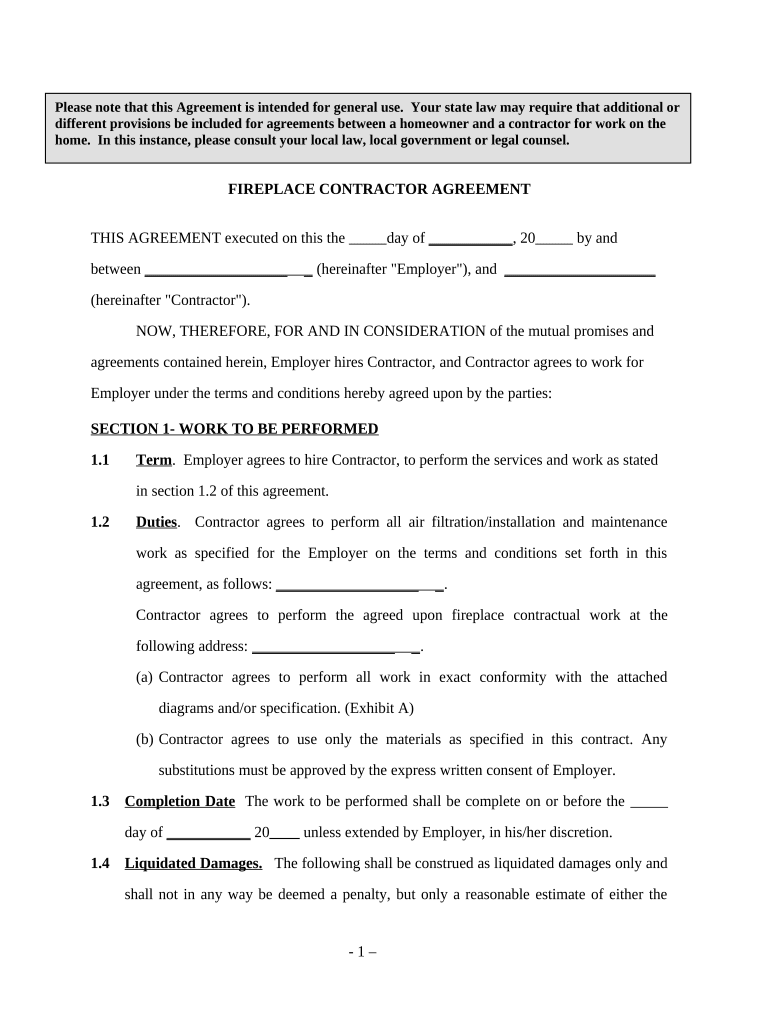
Fireplace Contractor Agreement - Self-Employed Preview on Page 1

Here's how it works

01. Edit your form online
Type text, add images, blackout confidential details, add comments, highlights and more.
02. Sign it in a few clicks
Draw your signature, type it, upload its image, or use your mobile device as a signature pad.
03. Share your form with others
Send it via email, link, or fax. You can also download it, export it or print it out.

How to use or fill out Fireplace Contractor Agreement - Self-Employed with our platform

Form edit decoration
9.5
Ease of Setup
DocHub User Ratings on G2
9.0
Ease of Use
DocHub User Ratings on G2
  1. Click ‘Get Form’ to open the Fireplace Contractor Agreement in the editor.
  2. Begin by filling in the date at the top of the agreement. This sets the official start of your contract.
  3. In the first section, enter the names of both parties: the Employer and the Contractor. Ensure that all names are spelled correctly for legal accuracy.
  4. Proceed to Section 1, where you will specify the work to be performed. Clearly outline the duties and address where services will be rendered.
  5. In Section 2, detail compensation terms including payment amount and frequency (daily, weekly, monthly).
  6. Review Sections 3 through 6 carefully, ensuring all representations, insurance requirements, and miscellaneous provisions are understood and filled out as necessary.
  7. Finally, sign and date at the bottom of the document to finalize your agreement. Make sure both parties have a copy for their records.

Start using our platform today to streamline your document editing and signing process for free!

be ready to get more

Complete this form in 5 minutes or less

Get form

Got questions?

We have answers to the most popular questions from our customers. If you can't find an answer to your question, please contact us.
Contact us
Do I need a written contract if I have an independent contractor working for me? In California, the relationship between businesses and independent contractors is subject to strict legal standards. As of January 1, 2025, having a written contract with certain types of independent contractors is required by law.
Beginning in 2025, private employers who hire certain independent contractors will be required to provide a written agreement specifying certain terms and to pay their compensation by certain deadlines. The new law aims to give freelancers basic worker protections and the right to be paid on time.
For example, in California, the statute of repose is four years for most problems, but 10 years for latent defects or problems that arent readily apparent. Stay on the lookout for contractors who try to shorten the implied warranty by offering a shorter warranty termsometimes for as brief a period as one year.
If you are a business owner or contractor who provides services to other businesses, then you are generally considered self-employed. For more information on your tax obligations if you are self-employed (an independent contractor), see our Self-employed individuals tax center.
The new rule, which becomes effective March 11, 2024, rescinds the 2021 independent contractor rule issued under former President Donald Trump and replaces it with a six-factor test that considers: 1) opportunity for profit or loss depending on managerial skill; 2) investments by the worker and the potential employer;

Security and compliance

At DocHub, your data security is our priority. We follow HIPAA, SOC2, GDPR, and other standards, so you can work on your documents with confidence.

Learn more
ccpa2
pci-dss
gdpr-compliance
hipaa
soc-compliance
be ready to get more

Complete this form in 5 minutes or less

Get form

People also ask

How do I create an Independent Contractor Agreement? State the location. Describe the type of service required. Provide the contractors and clients details. Outline compensation details. State the agreements terms. Include any additional clauses. State the signing details.
The 2 year contractor rule is a provision that limits the amount of time a contractor can work for a company as an independent contractor without being considered an employee. It typically states contractor works company 2 years, may deemed employee legal tax purposes.

Related links