




01. Edit your form online
Type text, add images, blackout confidential details, add comments, highlights and more.

Type text, add images, blackout confidential details, add comments, highlights and more.

Draw your signature, type it, upload its image, or use your mobile device as a signature pad.

Send it via email, link, or fax. You can also download it, export it or print it out.
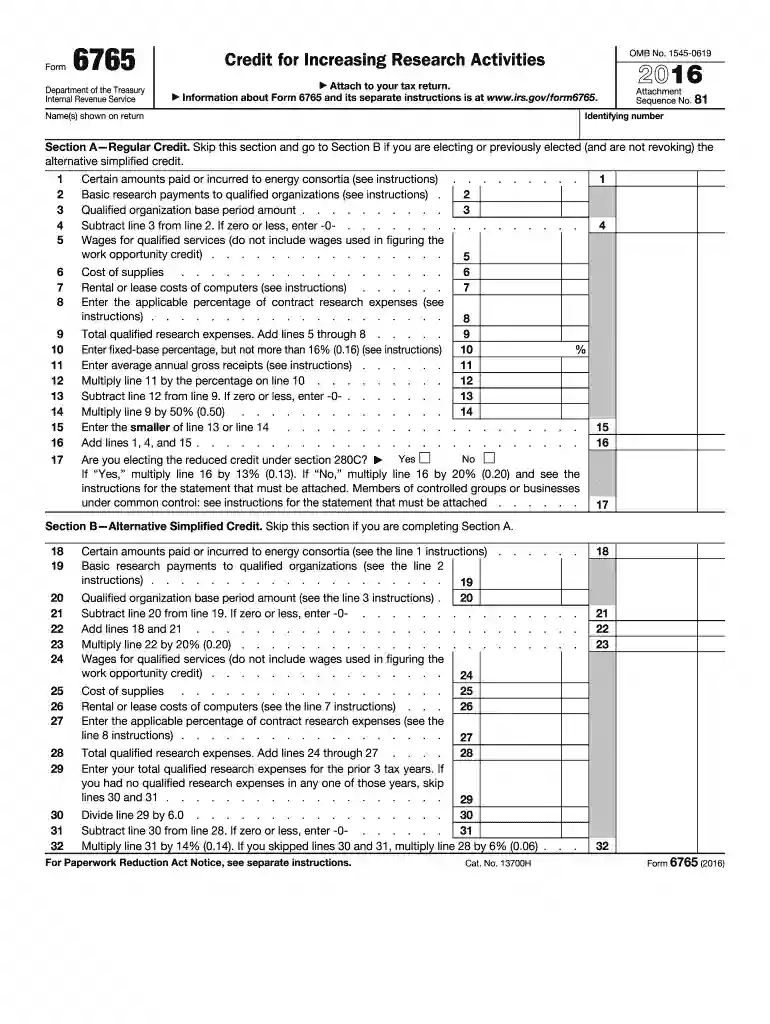
Form 6765 is a tax form used by businesses in the United States to claim the Credit for Increasing Research Activities. This form applies to both the Regular Credit and the Alternative Simplified Credit, which incentivize companies to invest in research and development (R&D) by providing a tax credit. For the 2016 tax year, this form captures important information about the business's qualified research expenditures, which must align with IRS definitions to meet eligibility.
When filling out the form, it's crucial to understand what counts as "qualified research expenditures." These expenses typically include wages for employees directly involved in R&D activities, costs of supplies used in the research, and payments to third-party contractors conducting research on behalf of the company.
The credit provided by Form 6765 can significantly reduce a business's taxable income, promoting greater investment in innovative activities. This tax credit encourages economic growth by supporting advancements in technology and scientific research.
Completing Form 6765 involves several steps that align with reporting the company's research activities and expenses accurately.
Calculate the Credit: Determine the total qualified research expenses and decide whether to use the Regular Credit method or the Alternative Simplified Credit (ASC) method. Each method requires different calculations and documentation.
Record Keeping: Maintain detailed records of all research activities, including supporting documentation for claimed expenses. This is vital for compliance and to substantiate claims in case of an IRS audit.
Attach to Tax Return: Once completed, Form 6765 must be attached to the business's tax return. Carefully review all sections for accuracy to avoid costly errors or delays in processing.
The choice between Regular Credit and ASC often depends on the availability of historical data and the complexity of calculations. Businesses with substantial R&D activities but less historical data may benefit from using the ASC method.
Completing the form involves several precise steps to ensure accuracy and compliance.
The form is structured to systematically gather necessary information and ensure correct credit calculation.
Taxpayers must ensure that all information entered is consistent with their tax return to avoid discrepancies that could trigger audits or compliance checks by the IRS.
To qualify for the credit, businesses must engage in specific types of research and adequately document their expenses.


Not all research activities qualify. For example, activities related to market research, social sciences, or funded by another entity are not eligible.
Following IRS guidelines is crucial to avoid errors in the form and ensure the tax credit is granted.
Having thorough and organized documentation aids businesses in defending their claims if audited by the IRS. Regular audits require precise substantiation of the activities and expenses reported.
Certain types of businesses are better positioned to take advantage of this credit due to the nature of their operations.
There are many real-world instances where businesses have leveraged Form 6765 to advance their research objectives, enabling significant tax savings which were then reinvested into further innovation.
Meeting filing deadlines is essential to claiming the credit without penalties.
Missing the deadline can result in fines or forfeiture of the credit. It's vital for businesses to integrate this awareness with their financial planning practices, allowing enough lead time to gather and prepare all necessary documentation.
We've got more versions of the form 6765 2016 form. Select the right form 6765 2016 version from the list and start editing it straight away!
| Versions | Form popularity | Fillable & printable |
|---|---|---|
| 2025 | 4.5 Satisfied (52 Votes) | |
| 2023 | 4.3 Satisfied (20 Votes) | |
| 2020 | 4.8 Satisfied (102 Votes) | |
| 2019 | 4.4 Satisfied (270 Votes) | |
| 2018 | 4.3 Satisfied (127 Votes) | |
| 2017 | 4.4 Satisfied (233 Votes) | |
| 2016 | 4.4 Satisfied (608 Votes) | |
| 2015 | 4.3 Satisfied (33 Votes) | |
| 2014 | 4 Satisfied (38 Votes) | |
| 2013 | 4 Satisfied (44 Votes) | |
| 2012 | 4.2 Satisfied (59 Votes) | |
| 2011 | 4 Satisfied (45 Votes) | |
| 2008 | 4.4 Satisfied (52 Votes) |
At DocHub, your data security is our priority. We follow HIPAA, SOC2, GDPR, and other standards, so you can work on your documents with confidence.


