En firearms 2026

Get Form
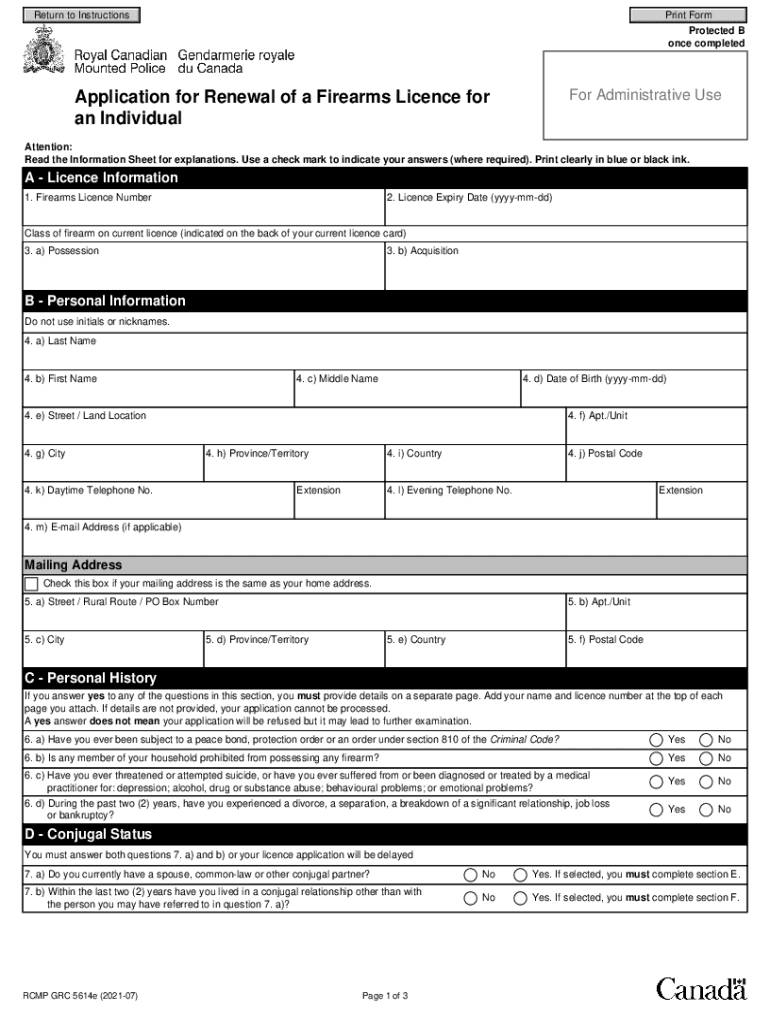
pal renewal Preview on Page 1

Here's how it works

01. Edit your pal renewal online
Type text, add images, blackout confidential details, add comments, highlights and more.
02. Sign it in a few clicks
Draw your signature, type it, upload its image, or use your mobile device as a signature pad.
03. Share your form with others
Send firearms license renewal via email, link, or fax. You can also download it, export it or print it out.

How to use or fill out en firearms with our platform

Form edit decoration
9.5
Ease of Setup
DocHub User Ratings on G2
9.0
Ease of Use
DocHub User Ratings on G2
  1. Click ‘Get Form’ to open the en firearms application in the editor.
  2. In Section A, confirm your licence information by entering your Firearms Licence Number and Licence Expiry Date. Ensure that the class of firearm matches what is indicated on your current licence card.
  3. Proceed to Section B for Personal Information. Fill in your full name, date of birth, and address details. Avoid using initials or nicknames.
  4. In Section C, answer all questions regarding your personal history. If you answer 'yes' to any question, provide additional details on a separate page.
  5. Complete Sections E and F if applicable, providing information about current and former conjugal partners as required.
  6. Review Section G for Fees. Select the appropriate fee based on the class of firearms you possess and indicate your method of payment.
  7. Finally, sign and date the declaration in Section H to confirm that all information provided is accurate before submitting your application.

Start filling out your en firearms application today for free using our platform!

See more en firearms versions

We've got more versions of the en firearms form. Select the right en firearms version from the list and start editing it straight away!
Versions Form popularity Fillable & printable
2023 4.5 Satisfied (49 Votes)
2022 4.7 Satisfied (24 Votes)
2021 4.8 Satisfied (142 Votes)
2020 3.9 Satisfied (27 Votes)
2019 4.3 Satisfied (72 Votes)
2015 4.4 Satisfied (577 Votes)
2014 4.3 Satisfied (129 Votes)
2008 4.4 Satisfied (305 Votes)
be ready to get more

Complete this form in 5 minutes or less

Get form

Got questions?

We have answers to the most popular questions from our customers. If you can't find an answer to your question, please contact us.
Contact us
Under 18 U.S.C. 926A, the Firearm Owners Protection Act allows lawful gun owners to transport firearms across state lines, if the gun is unloaded and stored in a locked container with ammunition kept separate.Oct 22, 2025
Rule 1 Treat Every Firearm as if it is Loaded Conduct a visual inspection of the firearm, always keep the barrel pointed in a safe direction, and avoid relying solely on indicators or safety mechanisms.Dec 26, 2023
Five important safety rules include wearing proper Personal Protective Equipment (PPE), maintaining clean and organized work/living areas to prevent slips/trips, reporting hazards immediately, following established procedures, and practicing situational awareness (being alert to surroundings and potential dangers), ensuring clear communication and never taking unnecessary risks. Here are 5 essential rules applicable in many situations: Wear PPE Follow Gear Rules: Always use the right protective gear (like goggles, gloves, helmets) for the task, and inspect it for damage to prevent injuries. Keep Areas Clear Clean: Tidy up workspaces, clear pathways, and manage cords to prevent slips, trips, and falls, which are common hazards. Report Hazards Promptly: If you see an unsafe condition or near-miss, tell a supervisor or responsible person so it can be fixed before an accident happens. Follow Procedures Dont Take Shortcuts: Safety rules exist for a reason; dont cut corners or take unnecessary risks with machinery, chemicals, or procedures. Stay Aware Communicate: Pay attention to your surroundings, be alert for potential dangers, and communicate clearly with your team about safety concerns. AI can make mistakes, so double-check responses10 Important Rules for Workplace Safety - EHS InsightKeeping arms and legs covered, avoiding dangling jewelry or ties, and wearing closed-toe shoes can go a long way in minimizing comEHS InsightSeven Basic General Industry Safety Rules Seven Basic General Industry Safety Rules * Keep work areas clean. * Use the proper tool for the job. * Always wear the pSafety Talk Ideas
The core 5 gun rules emphasize treating all firearms as loaded, keeping the muzzle pointed safely, keeping your finger off the trigger until ready to shoot, knowing your target and whats beyond, and wearing proper eye/ear protection and securing firearms when not in use, all designed to prevent accidents and ensure responsible handling. Here are the widely accepted rules, often presented slightly differently: Always Treat Firearms As If They Are Loaded: Never assume a gun is unloaded; always verify, even if you think its safe. Keep Your Finger Off the Trigger Until Ready to Shoot: Rest your finger on the frame, outside the trigger guard, until your sights are on the target and youve decided to fire. Always Keep the Muzzle Pointed in a Safe Direction: A safe direction is one where an accidental discharge wont cause injury or damage, like downrange at a range or at the ground when walking. Know Your Target and Whats Beyond It: Be certain of your target and be aware of the backstop and potential hazards in the background. Use Proper Eye and Ear Protection Secure Firearms: Wear hearing and eye protection, and always secure firearms and ammunition separately when not in use to prevent unauthorized access. For legal advice, consult a professional. 5 Firearm Safety Rules for Gun Owners: Minimizing LiabilityDec 26, 2023Prime Insurance CompanyFirearm Safety | State of California - Department of JusticeTreat all guns as if they are loaded. Always assume that a gun is loaded even if you think it is unloaded. Every time a gun is hanState of California - Department of Justice (.gov)
Former Bill C-21 received Royal Assent on December 15, 2023.Aug 13, 2025

Security and compliance

At DocHub, your data security is our priority. We follow HIPAA, SOC2, GDPR, and other standards, so you can work on your documents with confidence.

Learn more
ccpa2
pci-dss
gdpr-compliance
hipaa
soc-compliance
be ready to get more

Complete this form in 5 minutes or less

Get form

People also ask

The 5 main gun safety rules emphasize treating all firearms as loaded, keeping the muzzle pointed safely, keeping your finger off the trigger until ready to shoot, knowing your target and its surroundings, and ensuring the gun is unloaded when not in use. These rules, often taught by organizations like the NRA and NSSF, are universal guidelines to prevent accidents. Here are the core rules: Treat every gun as if its loaded: Always assume a firearm has ammunition, even if you believe its empty, and check for yourself. Always keep the muzzle pointed in a safe direction: A safe direction is where an accidental discharge wont cause injury or damage, so never point it at people or yourself. Keep your finger off the trigger until ready to shoot: Your trigger finger should remain straight and outside the trigger guard until your sights are on the target. Know your target and whats beyond it: Be certain of your intended target and the area behind it before firing. Keep the gun unloaded until ready to use: Unload firearms when not in use and secure them separately from ammunition. Additional Safety Practices: Wear eye and ear protection: when shooting. Be certain the gun is safe to operate: and use only the correct ammunition. Unload your gun immediately: after use and keep the action open when not in use, say NSSF experts. For legal advice, consult a professional. Firearm Safety - 10 Rules of Safe Gun Handling - NSSFFirearms should be loaded only when you are in the field or on the target range or shooting area, ready to shoot. When not in use,NSSF | The Firearm Industry Trade Association5 Firearm Safety Rules for Gun Owners: Minimizing LiabilityDec 26, 2023Prime Insurance Company
While firearms can be categorized in many ways, the four most common types based on general design and use are Handguns, Rifles, Shotguns, and often a category for Automatic/Machine Guns, though sometimes automatic firearms are considered sub-types of rifles or pistols. Handguns are for one-handed use (pistols, revolvers), rifles are long guns with rifled barrels for accuracy, shotguns fire shells (pellets or slugs), and automatic types fire continuously. Heres a breakdown: Handguns (Pistols Revolvers): Compact, designed for one or two-handed use, ideal for self-defense or close-range shooting. Pistols: Typically semi-automatic, using a magazine for fast reloading. Revolvers: Feature a rotating cylinder for ammunition, known for simplicity and reliability. Rifles: Long guns with rifled barrels for high accuracy at longer distances, used for hunting big game, sport, and tactical applications. Shotguns: Shoulder-fired long guns firing shells containing pellets or slugs, excellent for hunting birds, small game, and home defense. Automatic Firearms (Machine Guns, Submachine Guns): Capable of continuous, automatic fire as long as the trigger is held, generally for military or law enforcement. Other classifications focus on actions (bolt-action, lever-action, break-action) or specific features, but the above four cover the broad, traditional categories. What Are the Types of Guns? - USCCAJul 30, 2019 Break-Action Firearms There are break-action handguns and rifles, but the most prevalent example is the double-barrel USCCA5 Different Types of FirearmsJan 22, 2023 2. Rifles: Rifles are long guns that are designed to be fired while shouldered. They have longer barrels than pistols survivalfittest.com
Treat All Guns as Though They are Loaded Whenever you handle a firearm, or hand it to someone, always open the action immediately, and visually check the chamber, receiver and magazine to be certain they do not contain any ammunition. Always keep actions open when not in use.Jul 5, 2021


pal renewal form