Waiver and Release From Liability For Adult for Canoeing - Kayaking 2026

Get Form
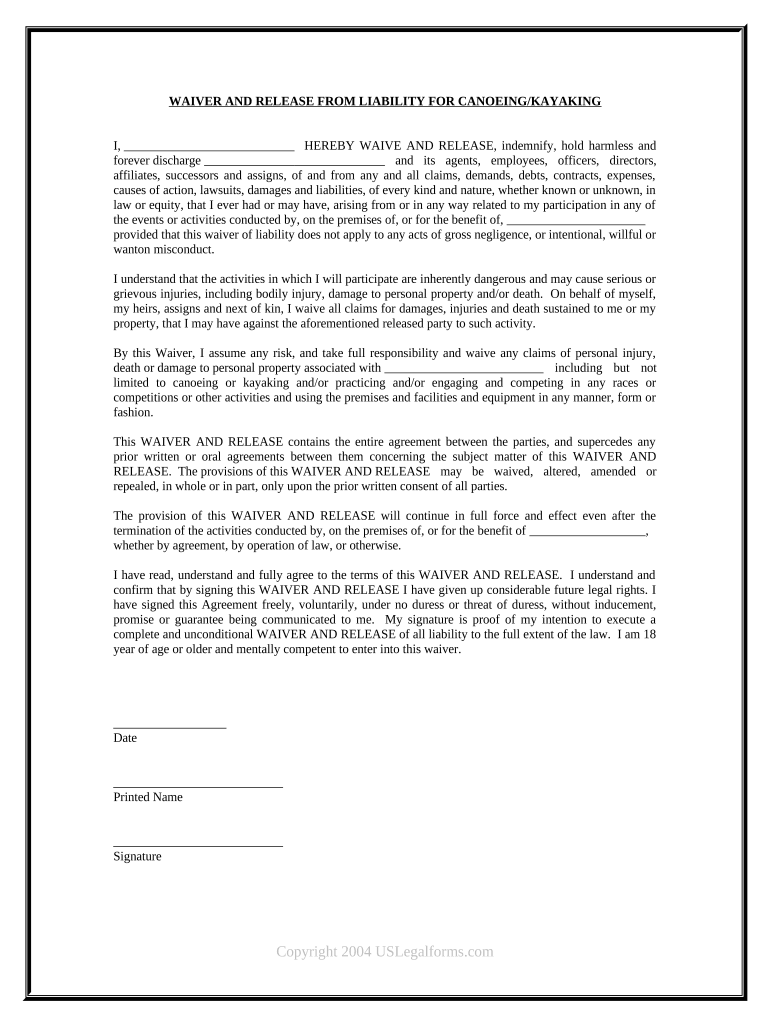
Waiver and Release From Liability For Adult for Canoeing - Kayaking Preview on Page 1

Here's how it works

01. Edit your form online
Type text, add images, blackout confidential details, add comments, highlights and more.
02. Sign it in a few clicks
Draw your signature, type it, upload its image, or use your mobile device as a signature pad.
03. Share your form with others
Send it via email, link, or fax. You can also download it, export it or print it out.

How to use or fill out Waiver and Release From Liability For Adult for Canoeing - Kayaking

Form edit decoration
9.5
Ease of Setup
DocHub User Ratings on G2
9.0
Ease of Use
DocHub User Ratings on G2
  1. Click ‘Get Form’ to open it in the editor.
  2. Begin by entering your full name in the designated field at the top of the form. This identifies you as the participant waiving liability.
  3. Carefully read through each section of the waiver, ensuring you understand the risks associated with canoeing and kayaking. This is crucial for informed consent.
  4. In the next section, confirm your understanding of the inherent dangers by checking any required boxes or signing where indicated.
  5. Fill in the date of signing to validate your agreement. Ensure this is accurate as it may be referenced later.
  6. Finally, sign your name in the signature field, confirming that you are 18 years or older and mentally competent to enter into this waiver.

Start using our platform today to complete your Waiver and Release From Liability for Canoeing - Kayaking quickly and efficiently!

be ready to get more

Complete this form in 5 minutes or less

Get form

Got questions?

We have answers to the most popular questions from our customers. If you can't find an answer to your question, please contact us.
Contact us
A release of liability (commonly referred to as a liability waiver or an exculpatory agreement) governed by Florida law given or signed by a prospective participant in a potentially dangerous activity in favor of the company providing access to the activity.
Activity waivers are agreements between an organization providing an activity and the individual participating in the activity. By signing the waiver, participants acknowledge the activitys risks and agree to release liability from the activity provider.
That said, a valid liability waiver should at least include the following details: Introductory or cautionary statement. A detailed account of the inherent dangers. Assumption of risks. Release clause. Indemnification. Choice of law. A confirmation and signature section.
What is a waiver form? Waiver forms are a type of legal protection used by businesses to reduce their liability and risk. This type of agreement between a business and its customers is used to document that all parties are aware of potential risks in certain situations.
This form is used to describe the participants responsibilities in participating in the activities, identify the risks associated with the activity, and confirm that the participant voluntarily assumes the risks associated with the activity.

Security and compliance

At DocHub, your data security is our priority. We follow HIPAA, SOC2, GDPR, and other standards, so you can work on your documents with confidence.

Learn more
ccpa2
pci-dss
gdpr-compliance
hipaa
soc-compliance

People also ask

I have signed this WAIVER AND RELEASE freely, voluntarily, under no duress or threat of duress, without inducement, promise, or guarantee being communicated to me. My signature is proof of my intention to execute a complete and unconditional WAIVER AND RELEASE of all liability to the full extent of the law.
A release of liability and waiver of the right to sue if any loss results from participation in the activity. An express assumption of risk where the participant acknowledges understanding the nature of the activity and the risks involved, and chooses voluntarily to accept those risks.
Liability waivers are enforceable in California to the extent they immunize the defendant from ordinary negligence. Under California law, a liability waiver cannot excuse an injury caused by a defendants: gross negligence, recklessness, or.

Related links